Monday, January 23, 2017

Collection Additions Volume 9: Road Tripping in Search of Games

Hello dear readers and welcome back to the game room. I apologize for the lengthy absence, it seems that life has caught up with me lately and I haven't had nearly as much time and motivation to write interesting things about games as I'd like to. However, that hasn't stopped me on my quest for ultimate video game collecting glory, and recently that very quest took me beyond the suburbs of my home on Long Island and into the great blue yonder in search of games high and low.

This adventure recently took me to Asbury Park, New Jersey, which is not only home to a very cool pinball museum/arcade, but also a fantastic little video game store called Kill Screen Games. They had a huge variety of retro games, consoles and accessories, and the second you put me in an establishment like that with a handful of money, I'm undoubtedly going to walk out with a pile of games. So what did I get? Let's have a look.


So here we have Zoop! for the Sega Genesis, Street Fighter II for the Super Famicom, China Warrior for the Turbo Grafx 16, and Turok: Dinosaur Hunter for the Nintendo 64.

Let's start off with the obvious here- Street Fighter II, which I believe needs no introduction. It's one of the greatest and most memorable fighting games ever made. Everything about it is great and it still stands up as the gold standard of fighters to this day. I already own literally 5 different versions of this game, including three on the Super Nintendo and two on the Sega Genesis. Why get it for the Super Famicom? Well, there's just something about playing games from other countries that fascinates me, especially if they are already some of my favorite games ever. I like trying to spot differences between what they got and what we got here in the U.S. As for SFII, the only difference I can see is in some of the enemy names (i.e. M. Bison, Vega, and Balrog were all shuffled around) and the text is almost entirely in Japanese. Still, it's fun to see it in a bit of a different light. Also, not for nothing, but I think the Super Famicom console and cartridges just look way cooler than their American counterparts.


Moving on, we have a strange little puzzle game called Zoop! for the Sega Genesis. I admittedly had no idea what this one was about, but I have seen it many times before. For three dollars I think it was worth investigating. What I got..well...is certainly quite interesting. It's very unique, I'll give it that. It's a bit difficult to explain so if I do a poor job, just refer to this video instead. As a little triangle piece, you move around a grid shooting away corresponding-colored pieces that move in from all sides. Once you clear away a certain amount, you move on to another stage where the difficulty increases. Yeah, that was pretty bad. Sorry, just watch the video. In all, it's not bad. I definitely enjoy the jazzy soundtrack it has.


Next we have China Warrior for the Turbo Grafx 16. As I've mentioned in the past, I'm a bit of a sucker for TG-16 games; if I see a bunch of them, I'm pretty much guaranteed to walk away with at least one, especially if it actually comes with the case. China Warrior is definitely on the more common end of the spectrum as far as TG-16 games go, as I've seen it many times before. As far as it's quality as a game...well, it seems to me like it can't make up its mind about whether it wanted to be a side-scrolling beat 'em up or a straight up fighting game. What you get is some kind of weird hybrid. Also, as you can probably tell from the picture, the first thing you notice is that the characters are huge. As in, they take up half the damn screen. Well, at least its consistent?


And lastly, there's Turok: Dinosaur Hunter for the Nintendo 64. This game is freakin' awesome. It might be one of the best first person shooters on the N64, for that matter. I remember playing this game as a kid and having a blast blowing away dinosaurs and such with modern guns. It's sequels got even better, adding in multiplayer that rivaled even the likes of Goldeneye 007. But this one started it all and is still a lot of fun to this day. I remember it also had a ton of hidden bonus features like a cheat code that turned every map into a disco with flashing lights and dancing dinosaurs. Now that's trippy. Another bonus about this one is that it might be the best condition box I have for any N64 games. I'm personally not really a stickler when it comes to the condition of my games, but this one looks like it just came off the shelf of a Toys 'R Us for the first time yesterday. It's also got all those little extra pamphlets and stuff that came with all N64 games. Pretty cool.


So that's it for this week, thanks for reading. Hopefully I will have more material to write about soon, but I can't promise anything for the time being. Just keep checking back for updates and as always, game on.

Monday, January 2, 2017

My Top 10 Most Disappointing Video Game Sequels


Hello dear readers and welcome back to the game room, where I reminisce about the disappointments of the past so you don't have to (sorry Nostalgia Critic, please don't sue me). Remember that feeling of holding a video game in your hands that you never played before? Whether it was a birthday or holiday gift or you were just renting it for the weekend, there was something special about having a new game to play after playing all of your other games to death. And if you think that feeling was great, imagine it being multiplied by ten if your new game was a sequel to another game that you loved and you had been waiting a long time for. I remember always feeling a rush of excitement when I found out that a game I had previously enjoyed was getting a sequel, especially when I saw screenshots and promotions for it in magazines and on the internet. Sometimes you'd have to wait months, even years before you'd get a chance to play that highly anticipated sequel. And unfortunately, sometimes all of that hype and excitement could be dashed like a freight train barreling off a cliff the second you popped the game in.


Sometimes sequels do live up to their predecessors, some even passing them in overall quality, notable examples being Banjo-Tooie, Resident Evil 2, and Super Mario Bros. 3. However, other times you'd be left scratching your head as to how the developers could possibly screw up so badly when they already had a winning formula in the palm of their hands. I've had plenty of these moments myself, and I'm here to share them in my top 10 personal experiences with disappointing sequels. Now mind you this is a subjective list and some will probably disagree with my choices. That's fine, and in fact I encourage you to disagree all you want. My choices are really based on my own personal context and the expectations I had when I purchased the game in question, which I'll elaborate further on in each one. So that being said, let's dive into some disappointment and check it out.

10) Dead Space 3 (Microsoft Xbox 36)


A while back I did a full review of the entire Dead Space trilogy, which you can read here if you're interested. In it I discussed in detail why I was so disappointed with Dead Space 3, but I'll give a concise summary here for those who don't feel like reading that whole thing. Dead Space 3 was a major departure from the previous games in that it did away with the claustrophobic feeling of being trapped in a space ship with horrific monsters that the first two games had. Instead of creeping around tight corridors in dark, maze-like space ships, DS3 mostly has you traversing large, wide open areas in broad daylight on a snowy planet. That effectively neutered the horror aspect that was conveyed in the others and really detracted from the overall experience. In addition, the story and characters got blander, the weapon/suit upgrade system that was so fun and satisfying from the originals was thrown out the window, and the gameplay just felt like a chore by the end. Clearly, the law of diminishing returns had taken its toll by this one. I have it at number 10 because although it was certainly a letdown compared to the first two, it wasn't all that bad of a game. It was just mediocre compared to them, especially when Dead Space 2 had proven that it was certainly possible to make an improved sequel to an already great game.

9) Halo 2 (Microsoft Xbox)


Halo: Combat Evolved was on this mysterious console called the Microsoft Xbox which I didn't know much about until it was thrust into my face in the early 2000s and it suddenly became the most exciting first person shooter I'd played since Goldeneye 007. The cool story, the endless hours of entertainment blasting the crap out of aliens, and the highly addicting multiplayer deathmatches with friends put the Xbox on the map and launched one of the most successful franchises of the new millennium. It took nearly 3 years, but by the time the sequel was set to launch, I was ready. I had an Xbox of my own by then and I was ready to take on the Covenant once more. Now, before I say anything else I should clarify something here- Halo 2's MULTIPLAYER was a blast. Sure it suffered from some ridiculous flaws which I also spoke about in a previous entry, but for the most part I didn't have any qualms with playing that. No, the big problem I had with Halo 2 came from its single player campaign. For starters, there was content from the original trailers that was noticeably cut out, which watered down the level of excitement right off the bat. Also, I was pretty shocked to find out that you only actually play as the Master Chief, the main character of the series, for a little less than half of the game. In his place you take control of the Arbiter, an elite with his own storyline and individual levels. The gameplay mechanics are exactly the same, but the bait-and-switch of going from the badass Master Chief to a character that was an enemy in the previous game just didn't feel right. It'd be like in Super Mario Bros. 2, if all of a sudden you unexpectedly stopped playing as Mario and took control of a Goomba. And you know what else felt weird? The fact that elites were no longer snarling and growling at you in an alien language, but instead speaking perfectly fine English with a bit of a posh accent. And you know what else else felt weird? Ditching the classic assault rifle weapon in favor of a submachine gun that sounded like popcorn being cooked when you fired it. And you know what downright sucked big time? The fact that the Master Chief's portion of the game just ends on a massive cliffhanger when you expected there to be an explosive climactic finale. It all just rubbed me the wrong way in a sequel to a game as thrilling as the original Halo.

8) Silent Hill 4 (Sony Playstation 2)


The original Silent Hill trilogy that spanned the Playstation 1 & 2 represented some of the finest horror games in the history of all video games. Their distinct brand of psychological horror was unmatched in it's time, and I would definitely consider all three some of the scariest games I've ever played. This can especially be said of 2 & 3, which took the terror to new heights on the PS2 with fantastic graphics and some of the most disturbing imagery in a game that I can even think of. After SH3, I wondered how they could possibly top it when I heard that SH4 was on the horizon. Well as it turns out, they couldn't top it...or even reach the same level, for that matter. SH4 is once again disconnected from the previous three games, aside from a very minor connection to a character that was mentioned in a text in SH2. It's not a bad game, but the biggest problem I had with it was that I wasn't scared by it at all. SH2 and 3 scared the ever loving shit out of me, but that's what drew me toward them- what can I say, I'm just a horror junkie. But SH4 dumbs down the disturbing factor and seems like it's just trying too hard to be edgy and scary but very much failing to do so. The best example I can think of is the hospital portion of the game. In the previous games, hospitals were the absolute worst; I dreaded every time the game directed me toward one, as they were easily the scariest parts of all three previous games. However, the hospital in SH4 is just...dumb. There's a few wheelchairs rolling up and down hallways on their own (ooooooo, spooky!), the whole building is well-lit (a far cry from the originals which were completely consumed in darkness), and the demonic nurse enemies burp at you when you hit them with a weapon. No, I'm not kidding. The game was just lacking in that distinct psychologically distressing feel that made the first games so enticingly terrifying, which felt like a big letdown to me.

7) Mega Man X4 (Sony Playstation)


I never had a Super Nintendo as a young kid, but I can tell you for certain that after I acquired one when I was a bit older, the Mega Man X trilogy quickly became some of my favorite games for the system. It's in your face, non-stop platforming action with fantastic graphics, some of the best music on the SNES, and dozens of hidden features that keep you playing for hours on end. After releasing the series' first three games on the SNES, Capcom shifted the series to the Sony Playstation, which seemed like their best bet since it was probably the premier console available at the time. However, things just didn't translate all that well to the new console, in my opinion. The graphics aren't that impressive, the music is lackluster, the enemies are boring, and the fun just felt like it was cut in half. On top of that, add in the influence of Capcom's notoriously bad localization department from the 90s and you've got yourself some horrific voice acting that rivals even the original Resident Evil in cheesiness. In all, it just doesn't do it for me the way the original trilogy did. That didn't stop them though, as they continued to make mediocre sequels all the way up to X8 before putting the kibosh on the series. Some aren't quite that bad, like X5 & X6, but X4 is the point at which things just started getting too far away from the originals for me to enjoy thoroughly.

6) Resident Evil: Outbreak (Sony Playstation 2)


I think the thing that upset me the most about Resident Evil: Outbreak was that it even existed to begin with. When it was released in 2003, the main series had been on a bit of a hiatus for several years. The last game that was part of the main canon of the series was Code: Veronica, which came out in 1999. After that, we got two spinoff games (Survivor and Gaiden), followed by a remake of the original, a prequel (0), and another spinoff (Dead Aim). By now I was dying to see the series get back on track and move the story forward once again, especially since we were now on a new generation of 128-bit consoles and graphical and technical capabilities were at an all-time high. However, what we got next wasn't the next in line for the Resident Evil series. It was hardly even a spinoff either. Resident Evil: Outbreak was nothing more than a gimmick. It was just a big advertisement for the Playstation Network, which was brand new at the time, that brought online playability to the PS2 for the very first time. But if you didn't have the PS2 network adaptor and a subscription to the Playstation Network, Outbreak's novelty as a game pretty much dries up right from the get-go. The scenarios are tedious and confusing, the zombies infinitely respawn while the game gives you about 10 bullets to deal with them, the characters are all annoying and uninteresting, and chiefly, as I mentioned before, it doesn't move the story forward at all. Chronologically it takes place right before the events of Resident Evil 2, so by now we all knew how the story ends. The only semi-interesting thing about Outbreak is that two scenarios have you revisit locations from Resident Evil 2 and 3, which were pretty cool to see in updated graphics. Beyond that though, Outbreak just felt like an incredibly cheap cash-in on the market of online gaming which was just beginning to catch on to the mainstream. I gave it a weekend rental when it came out because I couldn't resist playing a new Resident Evil title, but as I mentioned, the appeal of it as a single-player game evaporates almost instantly. I imagine it would've been pretty cool to play online back in the day, but beyond that there really wasn't much else to it.

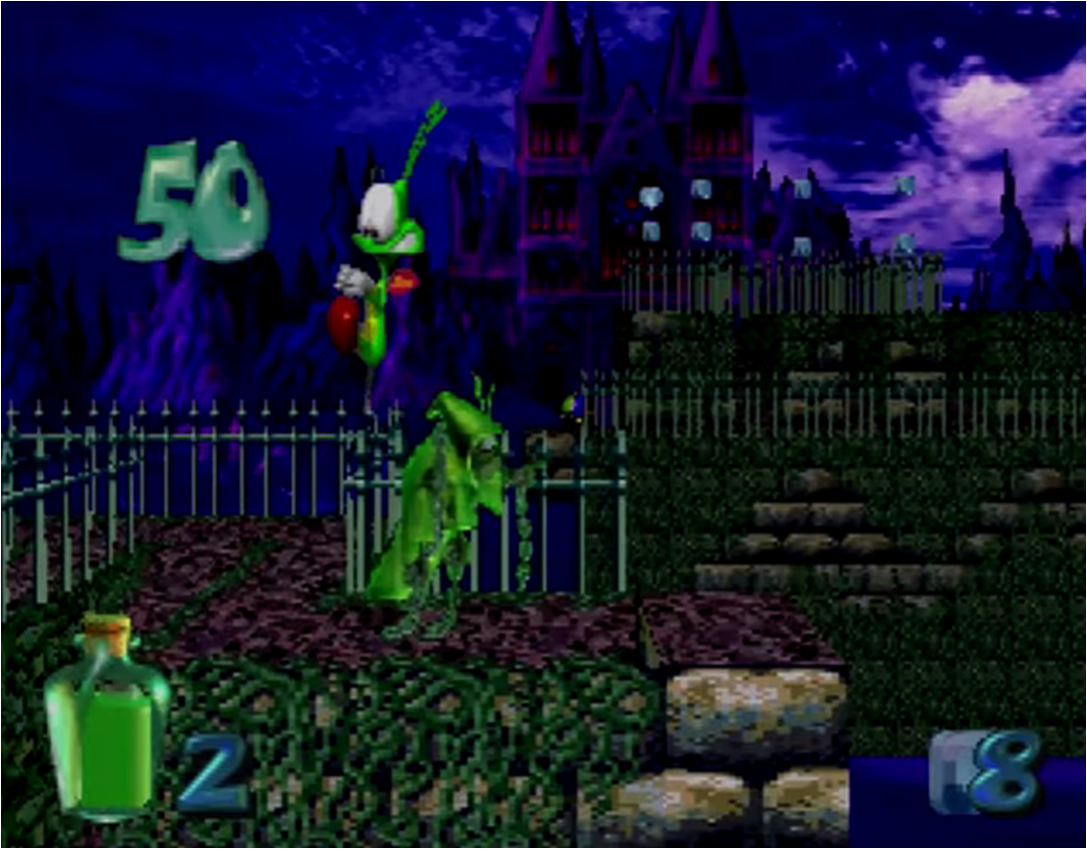
5) Bug Too! (Sega Saturn)

Bug! is one of those games that has just become one of my obscure favorites over the years. It's a fun, quirky platformer with a ton of personality and certain nostalgic appeal to me. While I never owned a Sega Saturn myself back in the day, I spent many an afternoon at a friend's house playing this game on his Saturn in the late 90s. However, what we didn't spend a whole lot of time playing was its very lackluster sequel, Bug Too!. Whereas the first game had a fairly simple and straightforward platforming scheme (see this review if you want a better idea of it- I know, I'm referencing a lot of old reviews I did here), the second seemed like it tried to be a little more than what it really was, that being a 2D platformer with some "sort of" 3D elements. It has much more of the "open areas," and by that I mean areas where you aren't fixed to a 2D path and can move around..uh..sort of freely, at least in four directions instead of just two. It's a little hard to explain without playing for yourself, but suffice it to say that it just didn't feel like the original, and not in a good way. There's two new characters to play as, but they don't offer anything drastically different from Bug. Also, the voice acting is pretty bad. Like, notorious 90s video game bad. In all, it basically killed what could've been a really great original franchise for the Saturn, which was desperately lacking one due to the absence of a certain blue hedgehog (spoiler alert, more on that later).

4) Banjo-Kazooie: Nuts & Bolts (Microsoft Xbox 360)

What more do you have to say about Banjo-Kazooie? It's one of the most beloved Nintendo 64 games that helped push the console to new heights and also produced a sequel that's arguably much better than the original. Where could you go wrong from there? Well, for starters you can sell your parent company to Microsoft in 2002, then turn it into a racing-based game 6 years later with horrific controls. Such is the story of BK:N&B. But let's back up a moment here. At the end of Banjo-Tooie back on the N64, Gruntilda the witch proclaims that she'll be back for her revenge in Banjo-Threeie. I remember seeing that and immediately getting excited at the prospect of another game in the series coming to the N64. I was pretty young and naive and I assumed that automatically meant there was going to be a third one coming soon, but nothing ever came of it. A couple of Banjo-related games were quietly released on the Gameboy Advance (that I didn't even know about at the time), but it wasn't until 2008 that we finally got a fully fledged console release of a Banjo-Kazooie sequel on the Xbox 360. However...it didn't feel like a sequel, mainly because the gameplay scheme was so radically different than the originals. Also, it wasn't on a Nintendo console, which in itself didn't feel right either. The new game primarily focused on building custom vehicles and using them to compete in a variety of different challenges, from racing to pushing opponent vehicles out of a circle like sumo wrestling. I certainly give them points for originality, and also for keeping the tongue-in-cheek writing style of the first two games intact. However, the main weakness of this game comes in two forms: the general fact that it was such a huge departure from the previous games, and the God-awful slippery controls that made me want to eject the disc and smash it repeatedly with a hammer. I should note that the game is far from impossible- despite the handicap, I did manage to grind my way to 100% completion of the game. However, it was more than an arduous task, entirely because of the controls. No matter how I constructed my vehicles, it always felt as though I was driving an 18-wheeler on a frozen lake and using a golf club to turn the steering wheel. One slight tap of the stick will just send your vehicle careening off into oblivion while the CPU-controlled characters laugh at you. The whole thing just left me missing how much fun I had playing the originals and wondering why they couldn't just recreate that style again.

3) Bomberman Hero (Nintendo 64)


When you think of the Nintendo 64, you probably think of games like Super Mario 64, Goldeneye 007, Super Smash Bros., and The Legend Of Zelda: Ocarina Of Time. However, how many still stop to consider Bomberman 64 in the top tier of N64 games? I would certainly place it there. It's mix of fun 3D puzzle solving and frantically addicting multiplayer games made for the perfect game to play alone or with friends. In a similar vein to Banjo-Kazooie, I anxiously waited for a sequel that would be just as thrilling as the game I enjoyed so much before. And also in a similar vein, what I got felt like something completely different. Now, I should say that change in video games is good, since doing the same thing over and over again does get stale- however, it should be implemented with respect to its predecessors. As in, keeping what made the previous games great and improving upon it substantially. However, there is a fine line between changing a game "just enough" and changing it "too much," and Bomberman Hero unfortunately crossed that line for me. It felt like a watered down experience that just wasn't nearly as fun as the original. Oh, and Bomberman can jump now. Might seem like that's actually an improvement, but it just felt weird to me after playing the previous game where you're pretty much glued to the ground. But perhaps the biggest travesty of Bomberman Hero is that it didn't have a multiplayer game. The Nintendo 64 was practically built for multiplayer; it had 4 controller ports and nearly all of its best games had some kind of multiplayer function. As I mentioned, the multiplayer games were a hugely significant reason as to why I enjoyed Bomberman 64 so much, and having that taken away with the sequel was really a disappointment. Not only that, but certain aspects of multiplayer also fed into the single-player campaign of Bomberman 64 with the hidden "custom parts" that could be found in it. Custom parts allowed you to personalize your multiplayer character, which was a ton of fun as a kid trying to make your character stand out with your friends. It also added this certain aspect of mystique by giving you a reason to explore the game further and search for all of the hidden areas where the custom parts lied in wait. Again, another fun aspect that was thrown out the window with Bomberman Hero.

2) Sonic 3D Blast (Sega Genesis)


It was Christmas, 1996. Sonic The Hedgehog was at the peak of his popularity, and the Sega Genesis and Sonic were my automatic go-to in the way of video games. After the masterpiece that was Sonic 3 & Knuckles (that's two games in one, for the uninitiated), I was ready for Sonic's next big hit to arrive on the Genesis. Little did I know, this game was about to signal the beginning of an ugly downhill slope for Sonic the Hedgehog on a whole. Unbeknownst to 8-year-old me at that time, Sega had already been on the downturn- both the Sega CD and 32X were in the trash and the Genesis was about to be phased out as part of the transition to their newest console, the Saturn. However, in order to squeeze one last drop of profits out of their prime franchise, Sega quickly crapped out one last Sonic game that landed on the Genesis in November of '96. I unwrapped my Christmas present and jumped for joy when I saw another Sonic game in my grubby little hands. However, the joy ended faster than Sonic himself when I saw what I got in the game. Sonic 3D Blast is a gimmick, if you can even call it that. It's neither 3D or a blast. It gives the illusion of 3D, but it's the video game equivalent of drawing two squares on top of each other and then connecting them with lines and calling it 3-dimensional. The controls are slippery, the gameplay is tedious and there's no sense of story or progression or basically anything that made the previous game so amazing. Remember the save feature of the previous game? That's gone. Remember the bonus stages from the previous game where you have to collect blue spheres and there was an actual a challenge to it? The bonus stages in this game are so laughably easy that you can literally close your eyes and beat them. Remember the climactic finale of the previous game? This game is so boring that you'll be asleep by the final battle. It's a playable game, but it's a completely unworthy successor to the epic that was Sonic 3 & Knuckles. I knew it on Christmas morning in 1996 and I still know it today. And perhaps what's even more insulting about this game is the fact that Sega never even came out with a triple-A Sonic sequel on the Saturn- no, Sonic's "magnum opus" on the Saturn was simply a graphically upgraded port of this game. That's right, Sonic's ultimate 64-bit adventure was a retreaded version of a game that wasn't even what its title suggested. The Sonic franchise has since never even come close to the success it achieved in the mid-90s, and this game was merely the first in a long string of disappointments that are still ongoing to this day. Maybe "Sonic Mania" will change that, but only time will tell.


1) Devil May Cry 2 ( Sony Playstation 2)


Devil May Cry is just one of those games that makes me think that the Sony Playstation 2 was an incredible console. It's one part Resident Evil, one part Onimusha, one part heavy metal music and a whole lot of kick ass action. As one of the first games I had for the PS2, I totally loved it. The non-stop satisfaction of slashing the crap out of enemies with your swords, the intense action sequences of boss battles, the hidden secrets and upgrade systems, the in-your-face metal blasting the entire time, the gripping storyline- everything about the gameplay just totally enthralled me. DMC ends with a thrilling boss battle to the death with a huge demon named Mundus, and upon his defeat, he swears to return and have his vengeance against Dante, the protagonist of the game. Dante then walks off into the sunset with Trish, a half-demon woman whom he saved earlier in the game, and in the end the duo team up to keep the forces at evil at bay. Yet again, this was a case of the original game perfectly setting up a sequel and the sequel falling flat on it's face- but DMC2 took this to a whole other level. For starters, it has NOTHING TO DO WITH THE FIRST GAME. Yeah, all that stuff about Mundus and Trish? Gone. In their places were completely different people- generic bad guy #2 and a woman named Lucia. I was totally stunned as to how they could just completely ignore what happened in the first game but still call it "Devil May Cry 2." The first game had the perfect set up for a sequel- how could they just throw that in the trash and start over? It was the video game equivalent of missing a putt in golf when you're 2 feet away from the hole. Perhaps I could forgive all of that if the gameplay made up for it- but no, it doesn't at all. It's so God-damned boring and bland that it makes you wonder if the developers ever even saw footage of the original. Enemies have very little variety, the move combinations have almost no flow to them, the upgrade system is a shadow of its former self, and once again, with more feeling this time, what the hell happened to Trish and Mundus!? They were written out existence like women in a James Bond sequel. I hated Devil May Cry 2 so much when I played it that there was no way it could be anything less than number 1 on my list, simply because it failed so hard as a sequel for a fantastic game. Sequels can definitely be done right with the correct set of ingredients; it's a fact that's been proven time and again over the history of video games. Why DMC2 fell so far off the beaten path from the original is just something that always leaves me shaking my head.

So that's my list, hopefully you've gained some amusement from my many previous disappointments. Thanks for reading.

Monday, December 26, 2016

Gaming Memories: Ghostbusters: The Video Game

Hello dear readers and welcome back to the game room, where the ectoplasmic residue is the real thing and all of our nuclear accelerators are licensed, thanks for asking. We all have that one special childhood thing that we have the fondest memories of as we grew up. For some of us it was Star Wars, for others it was Batman, and still others it was Ninja Turtles, Disney Movies, Transformers, what have you. For me, that thing was Ghostbusters.

The 1984 comedy classic that spawned a sequel, a lengthy cartoon series, and a huge amount of toys- yes, it was just my thing as a kid. I'd spend day after day playing with my toys until they were so worn down that they were practically falling apart. I'd run around in my backyard with my plastic proton pack strapped to my back having adventures and capturing ghosts everywhere I went. And even though the world's enthusiasm for Ghostbusters started to fade as the 80's turned to the 90's, my own certainly didn't. I was definitely one of those people always waiting in vain for a third movie that would never come. However, in the year 2009, I did get something awfully close. But let's back up a minute here.

When the cartoon series "The Real Ghostbusters" ended in 1991, Ghostbusters as a whole almost seemed to end with it. The original actors moved on with their lives and careers, the toys stopped getting made, and the brand name just went quiet for a while. Sure, there were minor resurgences here and there- Dan Akroyd dropped rumors about a possible Ghostbusters 3 all through the 90s, a short-lived cartoon show called "Extreme Ghostbusters" aired in 1997 and had it's own brief merchandise run, and of course "Ecto-Cooler" lived on for quite a while in the lunch boxes of kids all over the country. But for the most part, Ghostbusters as a franchise went dark as the 90s gave way to the new millennium and for a while, it seemed like it might stay that way forever. Then, in late 2007, something big happened.

Throughout the mid-2000s I had a subscription to the magazine Game Informer which I received monthly in the mail. This was back when I was still hip to the cutting edge of gaming and had all the latest consoles as they arrived, so I still had plenty to read about as the magazines came in. I loved seeing all of the latest news and goings-on in the gaming world, as well as checking out the current hottest games on the market. However, I was totally shocked when I opened my mailbox in December of 2007 and saw this:


Ghostbusters in a video gaming magazine? I never saw it coming. I frantically flipped through the pages to get to the article, where I read all ten pages of it from start to finish. A Ghostbusters video game was in the works for the latest generation of consoles. It had a script written by Harold Ramis and Dan Akroyd, just like the original movies. It had ALL FOUR original actors (Bill Murray, Harold Ramis, Dan Akroyd, and Ernie Hudson) reprising their roles as Peter Venkman, Egon Spengler, Ray Stantz, and Winston Zeddmore. Hell, even Annie Potts and William Atherton were returning as well (unfortunately no Sigourney Weavor or Rick Moranis, but I was still happy with what I got). 

I read the article again and again and again. I scrutinized every picture and piece of concept art. And then read it one more time. The new game was set to take place three years after the events of Ghostbusters 2 and would have the player assuming the role of a nameless rookie who joined the team as the fifth Ghostbuster. As per the article, the game would have the player clashing with familiar foes such as Slimer, the library ghost, and even the Stay Puft marshmallow man himself. It all seemed too good to be true. I couldn't wait to see how things would play out.

There was a long time of silence between the announcement in the article and any further news, but the silence was broken in December of 2008 when a trailer was finally released to the public. I remember jumping on my computer with my face glued to the monitor as the trailer started. Just like the article I had read earlier, I watched it from start to finish. And again. And again. It was really happening. There was Murray delivering his deadpan Venkman lines, Ramis and Akroyd spitting out scientific technical jargon as Egon and Ray, and Hudson doing his down-to-Earth Winston. It didn't seem real, but somehow it was. We were going to get as close to the third movie as we ever would.

Some time passed and while I anxiously waited, the advertising campaign ramped up. Commercials were on TV and various alternate trailers were released. For a short and beautiful time, Ghostbusters was back. It was delayed a bit for some time but eventually was released on June 16th, 2009, nearly coinciding with the 25th anniversary of the release of the first film on June 8th, 1984. I promptly arrived at Best Buy that morning to procure a copy, which I did and rushed home to play.


While previous Ghostbusters games may not have lived up to the franchise's potential (or have been downright awful), Ghostbusters: The Video Game is just about everything you'd want as a GB fan. It wasn't the third movie we all wanted, of course, but it was close enough to be it. Picking up where the story last left off, the Ghostbusters' business is still booming and they've even started pushing for franchises (much like Venkman mentioned in the first movie). They've hired a new member to the team, a so-called "experimental weapons tech" who basically serves as a guinea pig for the Ghostbusters' many untested gadgets. You assume the role of the nameless rookie, who also has no speaking lines in the game. Some people might scoff at this but I think it was a perfect idea because it preserves the interactions between the four main Ghostbusters that we loved so much from the movies. Anyway, shortly after the newbie joins the crew a massive spectral energy force is unleashed upon Manhattan and it's up to the Ghostbusters to figure out what's going on.

With a third person point of view, you guide the rookie in and out of situations where you trap ghosts and solve puzzles throughout levels. Ghosts aren't entirely uniform, however- there's a wide range of types that have different strengths and weaknesses and must be dealt with accordingly. For example, many ghosts require the typical method of blasting them with the proton stream and then sucking them into a ghost trap, but others require you to freeze them in place with a different type of beam and then disintegrate them with a shotgun-like blast. Trapping ghosts earns you money, which you can then use to purchase upgrades for the four different proton pack weapons you switch between. There's the regular proton stream and the stasis stream which I just mentioned, as well as the slime tether and the meson collider. The slime tether is pretty much exactly what it sounds like- you use it to shoot a tether of slime at at object, which you can then attach to another in order to move it out of the way. You also must use the good slime to neutralize the effects of black slime which you'll encounter throughout the game, as well as defeat certain enemies. Finally, the meson collider acts sort of a like a powerful machine gun version of the regular proton stream.


By far though, the most fun I had in the game was by trapping ghosts using the regular proton stream, just like in the movies. It works a tad differently however, as they needed to add some extra layer of challenge to the game. In order to be able to trap a ghost, you need to first substantially weaken it by slamming it around using the proton stream. Holding onto it for longer charges the "slam meter", and once that is high enough you can deal greater damage to it, thus making it easier to drag into a trap. It sort of feels like fishing, except way cooler because, well, it's Ghostbusters.

As you progress through the game, you can also use the PKE meter practically to locate ghosts and also find hidden areas (usually that lead to an achievement or trophy for the Xbox 360 and PS3 versions, respectively). You can also use it to scan different ghosts, which gives you more info about them that you can read about in "Tobin's Spirit Guide", which was mentioned by Egon and Ray in the movies. It's little tie-ins like that to the lore of both movies that made it such a fun experience for die-hard fans of the movies like myself. There's tons of little references everywhere if you look hard enough. There's also so-called cursed artifacts all around, which can be picked up and examined to even further expand the Ghostbusters lore. There's even a few nods to the cartoon shows for eagle-eyed players, such as the PKE meter at the workbench in the basement that looks suspiciously like the one from the Real Ghostbusters. Also, there's a reference to the hilariously badly translated ending screen of the first Ghostbusters video game for NES on one of the computers in the firehouse. Like I said, I couldn't get enough of it all.

 The appearance of the infamous ending text from the NES Ghostbusters game was just one little nod to a franchise with as rich of a history as Ghostbusters.

As you play through the game, you learn that the spectral energy surge has been the result of Ivo Shandor, the servant of Gozer who was discussed at length in the first movie, attempting to break through to our world and take control. You visit many familiar locations such as the New York Public Library and the Sedgewick Hotel, which all tie into the story nicely. You also get to sit back and let the four Ghostbusters work their comedic magic together again. For instance, one part that cracked me up was when Egon and Winston are assessing a giant machine.

"What if we try locking those things down?" asks Winston.

To which Egon replies- "I can calculate 54 likely outcomes...we'd survive three of them."

Winston then nonchalantly responds- "That beats our usual odds."

Aside from the comedy, you also get to experience a lot of the strange and mystical spirit world qualities of Ghostbusters, the kinds that were only alluded to in the movies, most likely because of a lack of production budget to bring them to life. For example, one chapter has you crossing through a dimensional portal into a nightmarish "ghost world" version of the New York Public Library. Also, there's a boss fight with a "giant Slor," which was only briefly mentioned in passing in the first movie. And of course every Ghostbusters fan wondered what the hell a Slor was! After this game, we finally knew- and it was just one more indication that the developers clearly recognized the franchise and its fanbase, treating it with the due respect it deserved.

Ever wonder what a giant Slor is? Well, there you go! Many Shuvs and Zuuls knew what it was to be roasted in the depths of the Slor that day, I can tell you.

The game mostly felt, to me, like a big combination of both the movies and the cartoon show. For example, in the chapter where you follow the Stay Puft Marshamallow Man through Times Square in an attempt to suck him into a massive trap mounted on top of the Ecto-1 called the "Super Slammer," it reminded me very much of some of the plots to episodes of The Real Ghostbusters. To further illustrate that point- in an episode called "Cry Uncle", the climax has the Ghostbusters chasing Mr. Stay Puft through the city in order to trap him, very much like in the video game. Also, in another chapter the Ghostbusters are riding a boat around that Ray refers to as "Marine Ecto-8." That had to be a direct reference to the cartoons, in which the Ghostbusters often used a helicopter called Ecto-2.

From an episode of The Real Ghostbusters...

...and the second chapter of the game. Once again, you can clearly see the influence with the right set of eyes.

This was all perfectly fine with me because I love the cartoons, probably just as much as I love the movies. Seeing them both mixed together and thrown into a video game was just about everything that could've made me happy as GB fan.

Just about. Now, I've said this to many people before and also alluded to it in a previous review, but I'm always quick to defend Ghostbusters 2 from the many people who claim it's a bad movie (many of which, by the way, seem to have suspiciously emerged within the last year or so. Wonder why that is?). Firstly, no, it's not a bad movie, and if you think it is then get out of my life. Secondly, as a fan of the second movie just as much as the first one, I would've liked to see more references to it throughout the game. There's a few minor ones here and there such as the discarded firehouse sign outside the window that can just barely be seen, or the cursed artifact of the "hot beverage thermal mug and free balloons for the kids," and even the painting of Vigo the Carpathian that's hanging around in the firehouse, but for the most part it is much more strongly connected to the story of first movie as opposed to the second. The closest the game comes to having a tie-in with the second movie is during the chapter on Shandor Island, in which you run around in a sewer-like area following a flow of dangerous black slime, which was quite reminiscent of the river of slime in GB2. However, that's about it as far as references. Personally, I would've loved to have seen a return of the Scolari Brothers- I mean, what a perfect opportunity for a boss battle would that have been? We got to see three of the big monsters from the first movie return to play prominent roles in the story, so why not the Scolari Brothers? Seemed like a missed opportunity to me.

The chapter which has you following an underground flow of black slime was about the closest the game got to a Ghostbusters 2 feel.

Anyway, beyond my gripes about the lack of Ghostbusters 2 references, there really isn't much I had to complain about while playing through. Just some minor things- for instance, sometimes the dialogue becomes noticeably unsynchronized with the character's mouth movements during cutscenes, something that seemed a tad amateurish even in 2009. And speaking of dialogue, it's pretty obvious in his voice acting that Bill Murray was not that into the project. You can tell almost every time he was speaking that he really phoned in his performance. In fact, sometimes you can't even tell what he's saying at all because he's mumbling his lines so much. It's a bit of a shame that he couldn't muster up at least a little more enthusiasm, especially since he didn't even have to do anything besides speak into a microphone, but I can look past it because at least he did it at all. At the end of the day, I don't even care if he decided to speak in a pirate accent the entire time, I'm just happy he was on board enough to be a part of it and step back into his role as Peter Venkman one last time. And lastly, the game is generally pretty short. It's fine because it gave it more of that authentic movie feel, but I only complain about it because I didn't want it to end. I wanted to see the Ghostbusters keep going forever.

Alas, nothing gold can stay. After the game came and went, it seemed like Ghostbusters was primed for a comeback. Talk of a third movie once again reared its head on all corners of the internet. Both Dan Akroyd and Ivan Reitman, the director of both movies, repeatedly stoked the flames for several more years. It was all speculation, but there was talk that a script was in the works. Would the world actually see a bonafide Ghostbusters 3 in the theaters? For a short period of time, it seemed plausible.

However, the end finally came on February 24th, 2014, when news broke of the death of Harold Ramis, the original actor for Egon Spengler and writer of the scripts for both movies and the game. With Ramis went the original Ghostbusters, and it seemed that now, once and for all, it was over. But you all know what happened next- shortly afterward, the "reboot" of Ghostbusters was announced, and despite all the doubt surrounding the franchise and the finality of Ramis' death, it continued to build steam and was eventually released in the summer of 2016. I have many mixed feelings about the reboot that are pretty much beyond the scope of this post, but suffice it to say that I think the whole thing was unnecessary. I actually enjoyed Max Landis' pitch for Ghostbusters 3 that has since surfaced on the internet and wouldn't have minded seeing that movie, but it's not what we got and unfortunately will never be. I also thought it was bitterly ironic that the original cast did a reunion for Entertainment Weekly magazine just 9 months after Ramis' death. I remember seeing it and thinking to myself "why couldn't they just put their differences aside like this when Ramis was still alive? He should have been there with them." We'll probably never truly know why.

Anyway, all of this only serves to illustrate how much the game meant to me as a fan. It is, for all intents and purposes, the Ghostbusters 3 that we all were waiting for. It was all of the Ghostbusters back together again for one final encore and it was the last sweet sendoff to a franchise that went away a little too early, as far as I'm concerned. Some might say that Ghostbusters has never really gone anywhere, but I'm in the camp that I would've liked to see all of the guys strap on the proton packs one last time on the big screen. However, I'm very happy with what I got in the game. As a video game it's a blast, as a continuation of the Ghostbusters franchise it's fantastic, and as the last remaining testament to the true fans, it serves its purpose well.

 I can't possibly describe to you how great it was to see the Ghostbusters back for one last ride.

The future of Ghostbusters is somewhat of a huge question mark right now. After the reboot had a mediocre showing in theaters, plans for a sequel were most likely scrapped. There doesn't seem to be anywhere left to go now, but I'm confident that the franchise will find a way to live on. It's my sincere hope that another cartoon series makes a return for a new generation. Hell, even as an adult you can bet I'd be parked in front of my TV every Saturday morning ready to watch further adventures of Peter, Egon, Ray and Winston. One can only hope. However, despite what may happen, the originals will always live on as unforgettable classics in the eyes of every nerd and geek who hoped they could build their own positron collider as a child. And right next to the two movies, you can add the video game to that list. Thanks for reading.

Sunday, December 11, 2016

Review: Doom 64


Hello dear readers and welcome back to the game room. Today we'll be looking at a pretty sweet Nintendo 64 game, one I spoke of not too long ago in my collection additions segment, if you've been paying attention. Yes, I'm talking about Doom 64, Nintendo's very own incarnation of the first-person shooter classic. Having recently completed this game for the first time ever, which is admittedly a bit embarrassing considering that Doom is one of my favorite video game franchises ever, I'm ready to give it a proper review. So let's travel to the shores of hell as we take a look at Doom 64.


Released in 1997 for the Nintendo 64, Doom 64 is quite an interesting specimen because it was the first, to my knowledge, to do something completely original with the series. Up to that point, there were only three other games in the series: the original, Doom II, and Final Doom. The original had been ported to just about every console that was around at the time, including Nintendo's biggest rivals, the Sony Playstation and Sega Saturn. Both the PS1 and Saturn versions took a good deal of liberties from the original including a new soundtrack, sound effects, and a few new levels. However, for the most part it was running on the same engine as the original PC version. Enemy sprites, weapons, items and level design from the original all remained the same.

Meanwhile, Doom II had yet to be brought to any home console and Final Doom had only been released on the Playstation, but neither of these games really brought anything radically new to the table yet. Enter Doom 64, which started from scratch and did something very much original while keeping the core gameplay intact. The end result was a game that managed to be both new and familiar at the same time. I think this novelty of it is what I enjoyed the most. I've played Doom 1 & 2 probably a zillion times in my life and a good deal of Final Doom as well. I've also done several playthroughs of Doom 3 too. So, playing an entry in the series that I've never experienced before was just very refreshing.

Story-wise, the game seems to follow the events of the original PC Doom trilogy (I, II, and Final Doom), yet stands alone as its own game for the most part. Actually, from the level design, it reminds me a lot of movies like Alien and Event Horizon with the "haunted space ship" vibe going for it. There's a lot of long corridors with glowing computer monitors buzzing everywhere, sliding metal doors with that classic sci-fi spaceship sound effect, and very few wide-open outdoor areas which makes you feel like you are somewhere deep in space. It's also interesting to note that this game and Event Horizon came out in the same year, about 5 months apart, and Event Horizon has basically the same plot as the original Doom: an inter-dimensional gateway is opened up which causes hell to spill out. This has nothing to do with Doom 64 of course, it's just an interesting footnote.

Anyway, the gameplay is just as straightforward as any other Doom game- grab some weapons, blast the crap out of demons, and find the level exit. The game throws a few curveballs at you however, if you were expecting everything to be exactly like the earlier Doom games. For one thing, as I alluded to before, all enemies and items sport completely redesigned sprites and sound effects. Most are pretty similar to the originals, but some have interesting design choices- for example, Cacodemons now have arms with chains attached to them, the plasma gun has a constant buzzing electrical field, etc.

Enemies, weapons and items all sport newly redesigned sprites, like our friend the Cacodemon here.

The game is also notably darker than it's predecessors. It could just be the TV I'm using, but there were some points where I had absolutely no idea what I was doing until I increased the in-game brightness, and even then it was still hard to see what was happening. Actually, I imagine that back in the day it probably would've been pretty scary to play this game; considering the dark lighting effects in tandem with the chilling minimalistic music that plays in each level, I could definitely imagine being easily frightened playing this alone at night as a kid.

You'll find yourself stuck in a lot of hallways like this, where you can be ambushed quickly from any direction.

There's also some new types of mechanics too, such as items that only appear when certain conditions are met. For example, in some parts of the game killing all the enemies in a certain room is required in order to make a key appear, which just sort of materializes in after all the demons are dealt with. You can also look through little monitors at different parts of the level (often hidden ones), reminiscent of the security monitors in Duke Nukem 3D.

And lastly, there's even new enemies- only two to speak of, but still a fresh take on Doom that wasn't anywhere else at the time. There's the so-called "nightmare imps," which are just regular imps that have been re-colored and fire faster, more powerful projectiles at you. And there's also the "Mother Demon," the final boss of the game. This continued the Doom tradition to that point of having something entirely new as a final boss, and just as before, she's pretty effin' difficult.

Anyway, despite the changes the core gameplay concept is still the same- which is certainly fine with me, since I love Doom so much. There are a few notable flaws though. For one thing, the control scheme is a bit weird. You can use either the D-pad or the control stick in order to move around, but the control stick is far more responsive, meaning I mostly gravitated toward using that. However, strafing is an integral part of dodging enemy attacks and those buttons are mapped to the left and right bumpers. Maybe my hands just aren't big enough, but I find that when I use the control stick, I can only manage to reach one of them, which only allows me to strafe one direction. I don't have this problem when using the D-pad, so I found myself switching back and forth between to two which sometimes got confusing and led to a few unnecessary deaths.

Speaking of deaths, restarting a level after dying is a tad unnecessarily annoying. If you die, you'll automatically start over at the beginning- however, you'll be stripped of all of your weapons and ammo. There's a fairly simple password system that lets you restart with all of your items, but inputting it is kind of awkward. If you die you'll need to go back into the menu, select the password option, and then you'll be taken to the password entry screen. Your previously entered password will still be there- however, for some reason you won't be able to just start up the level again. You need to erase the last letter of the password, then re-enter it and hit start, at which point you'll be back at the beginning with your weapons again. Not too much of a hassle, just annoying to do every time you die.

Another unique and interesting feature of this game that wasn't present in any other game of the franchise, which I haven't actually completed myself but I've read about, is acquiring the three so-called "demon artifacts" in secret levels in order to make the final boss easier to complete. Secret levels were nothing new to the franchise; Doom 1, 2, and Final Doom all had hidden levels within. However, this was the first time that secret levels had specific objectives to them- to collect three "demon keys" that both upgraded the powerful "Unmaker" weapon and deactivated teleporters during the final boss that normally spawn in extra demons to deal with. Again, just another unique twist to the formula not seen in any other game (and also one that will likely give me a reason to revisit this game in the future).

The "Unmaker" weapon gives you this quaint message upon picking it up. 

In all, Doom 64 is a very fun game. It's Doom, so you pretty much can't go wrong there, but it adds plenty of twists and turns to the formula for fans of the earlier games to enjoy thoroughly. These days, the franchise has been turned on it's head numerous times, starting with Doom 3 all the way up the "reboot" (just so you all know, I really hate that word) released earlier this year. However, back in 1997 Doom 64 was the very first shakeup in the series, one that I think went over very well. If you're a fan of Doom and haven't had a chance to play it, I'd definitely recommend giving it a try. Thanks for reading.