Hello dear readers and welcome back to the game room, where I reminisce about the disappointments of the past so you don't have to (sorry Nostalgia Critic, please don't sue me). Remember that feeling of holding a video game in your hands that you never played before? Whether it was a birthday or holiday gift or you were just renting it for the weekend, there was something special about having a new game to play after playing all of your other games to death. And if you think that feeling was great, imagine it being multiplied by ten if your new game was a sequel to another game that you loved and you had been waiting a long time for. I remember always feeling a rush of excitement when I found out that a game I had previously enjoyed was getting a sequel, especially when I saw screenshots and promotions for it in magazines and on the internet. Sometimes you'd have to wait months, even years before you'd get a chance to play that highly anticipated sequel. And unfortunately, sometimes all of that hype and excitement could be dashed like a freight train barreling off a cliff the second you popped the game in.
Sometimes sequels do live up to their predecessors, some
even passing them in overall quality, notable examples being Banjo-Tooie,
Resident Evil 2, and Super Mario Bros. 3. However, other times you'd be left scratching
your head as to how the developers could possibly screw up so badly when they
already had a winning formula in the palm of their hands. I've had plenty of
these moments myself, and I'm here to share them in my top 10 personal
experiences with disappointing sequels. Now mind you this is a subjective list
and some will probably disagree with my choices. That's fine, and in fact I
encourage you to disagree all you want. My choices are really based on my own
personal context and the expectations I had when I purchased the game in question,
which I'll elaborate further on in each one. So that being said, let's dive
into some disappointment and check it out.
10) Dead Space 3 (Microsoft Xbox 36)

A while back I did a full review of the entire Dead Space
trilogy, which you can read here if you're interested. In it I discussed
in detail why I was so disappointed with Dead Space 3, but I'll give a concise
summary here for those who don't feel like reading that whole thing. Dead Space
3 was a major departure from the previous games in that it did away with the
claustrophobic feeling of being trapped in a space ship with horrific monsters
that the first two games had. Instead of creeping around tight corridors in
dark, maze-like space ships, DS3 mostly has you traversing large, wide open
areas in broad daylight on a snowy planet. That effectively neutered the horror
aspect that was conveyed in the others and really detracted from the overall
experience. In addition, the story and characters got blander, the weapon/suit
upgrade system that was so fun and satisfying from the originals was thrown out
the window, and the gameplay just felt like a chore by the end. Clearly, the
law of diminishing returns had taken its toll by this one. I have it at number
10 because although it was certainly a letdown compared to the first two, it
wasn't all that bad of a game. It was just mediocre compared to them,
especially when Dead Space 2 had proven that it was certainly possible to make
an improved sequel to an already great game.
9) Halo 2 (Microsoft Xbox)

Halo: Combat Evolved was on this mysterious console called
the Microsoft Xbox which I didn't know much about until it was thrust into my
face in the early 2000s and it suddenly became the most exciting first person
shooter I'd played since Goldeneye 007. The cool story, the endless hours of
entertainment blasting the crap out of aliens, and the highly addicting
multiplayer deathmatches with friends put the Xbox on the map and launched one
of the most successful franchises of the new millennium. It took nearly 3
years, but by the time the sequel was set to launch, I was ready. I had an Xbox
of my own by then and I was ready to take on the Covenant once more. Now,
before I say anything else I should clarify something here- Halo 2's
MULTIPLAYER was a blast. Sure it suffered from some ridiculous flaws which I
also spoke about in a previous entry, but for the most part I didn't have
any qualms with playing that. No, the big problem I had with Halo 2 came from its
single player campaign. For starters, there was content from the original
trailers that was noticeably cut out, which watered down the level of
excitement right off the bat. Also, I was pretty shocked to find out that you
only actually play as the Master Chief, the main character of the series, for a little less than half of the game. In his place you take control of the
Arbiter, an elite with his own storyline and individual levels. The gameplay
mechanics are exactly the same, but the bait-and-switch of going from the
badass Master Chief to a character that was an enemy in the previous game just
didn't feel right. It'd be like in Super Mario Bros. 2, if all of a sudden you
unexpectedly stopped playing as Mario and took control of a Goomba. And you
know what else felt weird? The fact that elites were no longer snarling and
growling at you in an alien language, but instead speaking perfectly fine
English with a bit of a posh accent. And you know what else else felt weird?
Ditching the classic assault rifle weapon in favor of a submachine gun that
sounded like popcorn being cooked when you fired it. And you know what
downright sucked big time? The fact that the Master Chief's portion of the game
just ends on a massive cliffhanger when you expected there to be an explosive
climactic finale. It all just rubbed me the wrong way in a sequel to a game as
thrilling as the original Halo.
8) Silent Hill 4 (Sony Playstation 2)

The original Silent Hill trilogy that spanned the
Playstation 1 & 2 represented some of the finest horror games in the
history of all video games. Their distinct brand of psychological horror was
unmatched in it's time, and I would definitely consider all three some of the
scariest games I've ever played. This can especially be said of 2 & 3,
which took the terror to new heights on the PS2 with fantastic graphics and
some of the most disturbing imagery in a game that I can even think of. After
SH3, I wondered how they could possibly top it when I heard that SH4 was on the
horizon. Well as it turns out, they couldn't top it...or even reach the same
level, for that matter. SH4 is once again disconnected from the previous three
games, aside from a very minor connection to a character that was mentioned in
a text in SH2. It's not a bad game, but the biggest problem I had with it was
that I wasn't scared by it at all. SH2 and 3 scared the ever loving shit out of
me, but that's what drew me toward them- what can I say, I'm just a horror
junkie. But SH4 dumbs down the disturbing factor and seems like it's just
trying too hard to be edgy and scary but very much failing to do so. The best
example I can think of is the hospital portion of the game. In the previous
games, hospitals were the absolute worst; I dreaded every time the game
directed me toward one, as they were easily the scariest parts of all three
previous games. However, the hospital in SH4 is just...dumb. There's a few
wheelchairs rolling up and down hallways on their own (ooooooo, spooky!), the
whole building is well-lit (a far cry from the originals which were completely consumed in darkness), and the demonic
nurse enemies burp at you when you hit them with a weapon. No, I'm not kidding. The game was just lacking in that distinct psychologically distressing
feel that made the first games so enticingly terrifying, which felt like a big
letdown to me.
7) Mega Man X4 (Sony Playstation)

I never had a Super Nintendo as a young kid, but I can tell
you for certain that after I acquired one when I was a bit older, the Mega Man
X trilogy quickly became some of my favorite games for the system. It's in your
face, non-stop platforming action with fantastic graphics, some of the best
music on the SNES, and dozens of hidden features that keep you playing for
hours on end. After releasing the series' first three games on the SNES, Capcom
shifted the series to the Sony Playstation, which seemed like their best bet
since it was probably the premier console available at the time. However,
things just didn't translate all that well to the new console, in my opinion.
The graphics aren't that impressive, the music is lackluster, the enemies are
boring, and the fun just felt like it was cut in half. On top of that, add in
the influence of Capcom's notoriously bad localization department from the 90s
and you've got yourself some horrific voice acting that rivals even the
original Resident Evil in cheesiness. In all, it just doesn't do it for me the
way the original trilogy did. That didn't stop them though, as they continued
to make mediocre sequels all the way up to X8 before putting the kibosh on the
series. Some aren't quite that bad, like X5 & X6, but X4 is the point at
which things just started getting too far away from the originals for me to
enjoy thoroughly.
6) Resident Evil: Outbreak (Sony Playstation 2)

I think the thing that upset me the most about Resident
Evil: Outbreak was that it even existed to begin with. When it was released in
2003, the main series had been on a bit of a hiatus for several years. The last
game that was part of the main canon of the series was Code: Veronica, which
came out in 1999. After that, we got two spinoff games (Survivor and Gaiden),
followed by a remake of the original, a prequel (0), and another spinoff (Dead
Aim). By now I was dying to see the series get back on track and move the story
forward once again, especially since we were now on a new generation of 128-bit
consoles and graphical and technical capabilities were at an all-time high.
However, what we got next wasn't the next in line for the Resident Evil series.
It was hardly even a spinoff either. Resident Evil: Outbreak was nothing more
than a gimmick. It was just a big advertisement for the Playstation Network,
which was brand new at the time, that brought online playability to the PS2 for
the very first time. But if you didn't have the PS2 network adaptor and a
subscription to the Playstation Network, Outbreak's novelty as a game pretty
much dries up right from the get-go. The scenarios are tedious and confusing,
the zombies infinitely respawn while the game gives you about 10 bullets to
deal with them, the characters are all annoying and uninteresting, and chiefly,
as I mentioned before, it doesn't move the story forward at all.
Chronologically it takes place right before the events of Resident Evil 2, so by
now we all knew how the story ends. The only semi-interesting thing about
Outbreak is that two scenarios have you revisit locations from Resident Evil 2
and 3, which were pretty cool to see in updated graphics. Beyond that though,
Outbreak just felt like an incredibly cheap cash-in on the market of online
gaming which was just beginning to catch on to the mainstream. I gave it a
weekend rental when it came out because I couldn't resist playing a new
Resident Evil title, but as I mentioned, the appeal of it as a single-player
game evaporates almost instantly. I imagine it would've been pretty cool to
play online back in the day, but beyond that there really wasn't much else to
it.
5) Bug Too! (Sega Saturn)
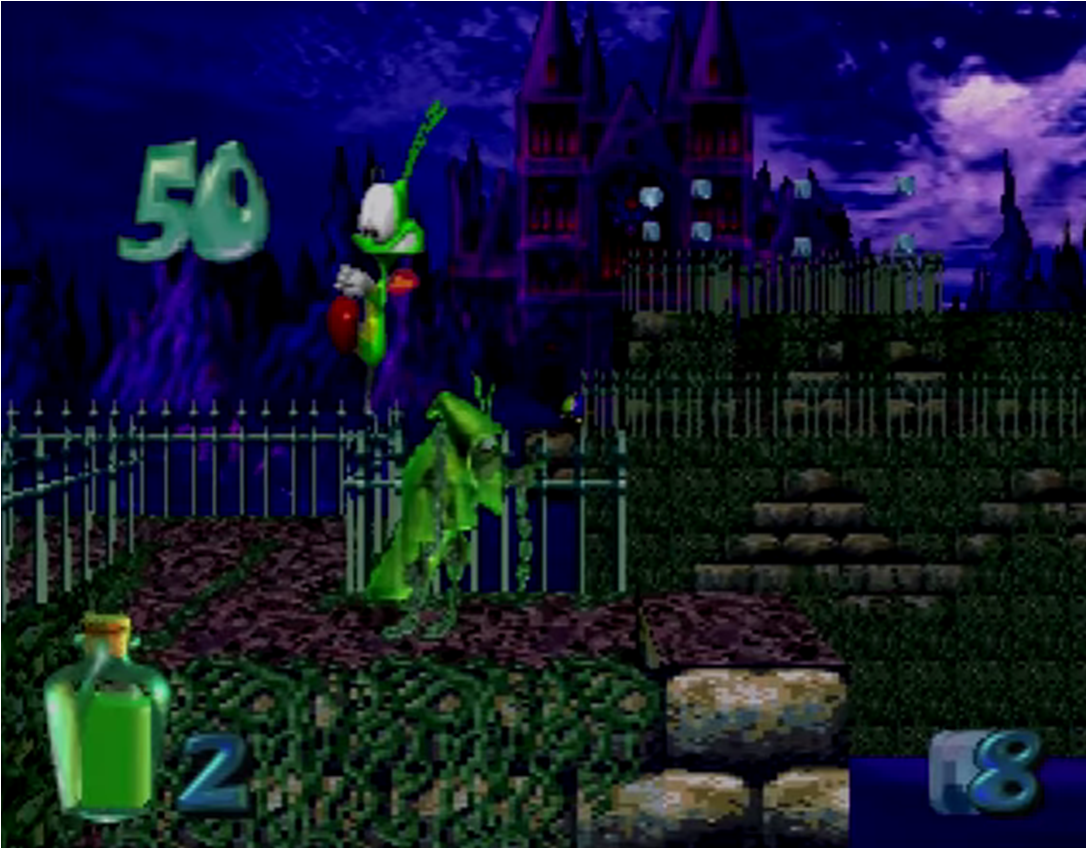
Bug! is one of those games that has just become one of my obscure
favorites over the years. It's a fun, quirky platformer with a ton of
personality and certain nostalgic appeal to me. While I never owned a Sega
Saturn myself back in the day, I spent many an afternoon at a friend's house
playing this game on his Saturn in the late 90s. However, what we didn't spend a whole lot of time playing
was its very lackluster sequel, Bug Too!. Whereas the first game had a fairly
simple and straightforward platforming scheme (see this review if you want a
better idea of it- I know, I'm referencing a lot of old reviews I did here),
the second seemed like it tried to be a little more than what it really was,
that being a 2D platformer with some "sort of" 3D elements. It has
much more of the "open areas," and by that I mean areas where you
aren't fixed to a 2D path and can move around..uh..sort of freely, at least in
four directions instead of just two. It's a little hard to explain without
playing for yourself, but suffice it to say that it just didn't feel like the
original, and not in a good way. There's two new characters to play as, but
they don't offer anything drastically different from Bug. Also, the voice
acting is pretty bad. Like, notorious 90s video game bad. In all, it basically
killed what could've been a really great original franchise for the Saturn,
which was desperately lacking one due to the absence of a certain blue hedgehog
(spoiler alert, more on that later).
4) Banjo-Kazooie: Nuts & Bolts (Microsoft Xbox 360)

What more do you have to say about Banjo-Kazooie? It's one
of the most beloved Nintendo 64 games that helped push the console to new heights
and also produced a sequel that's arguably much better than the original. Where
could you go wrong from there? Well, for starters you can sell your parent
company to Microsoft in 2002, then turn it into a racing-based game 6 years
later with horrific controls. Such is the story of BK:N&B. But let's back
up a moment here. At the end of Banjo-Tooie back on the N64, Gruntilda the
witch proclaims that she'll be back for her revenge in Banjo-Threeie. I
remember seeing that and immediately getting excited at the prospect of another
game in the series coming to the N64. I was pretty young and naive and I
assumed that automatically meant there was going to be a third one coming soon,
but nothing ever came of it. A couple of Banjo-related games were quietly
released on the Gameboy Advance (that I didn't even know about at the time),
but it wasn't until 2008 that we finally got a fully fledged console release of
a Banjo-Kazooie sequel on the Xbox 360. However...it didn't feel like a sequel, mainly because
the gameplay scheme was so radically different than the originals. Also, it wasn't on a Nintendo console, which in itself didn't feel right either. The new game
primarily focused on building custom vehicles and using them to compete in a
variety of different challenges, from racing to pushing opponent vehicles out
of a circle like sumo wrestling. I certainly give them points for originality,
and also for keeping the tongue-in-cheek writing style of the first two games
intact. However, the main weakness of this game comes in two forms: the general
fact that it was such a huge departure from the previous games, and the
God-awful slippery controls that made me want to eject the disc and smash it
repeatedly with a hammer. I should note that the game is far from impossible-
despite the handicap, I did manage to grind my way to 100% completion of the
game. However, it was more than an arduous task, entirely because of the
controls. No matter how I constructed my vehicles, it always felt as though I
was driving an 18-wheeler on a frozen lake and using a golf club to turn the
steering wheel. One slight tap of the stick will just send your vehicle
careening off into oblivion while the CPU-controlled characters laugh at you.
The whole thing just left me missing how much fun I had playing the originals
and wondering why they couldn't just recreate that style again.
3) Bomberman Hero (Nintendo 64)

When you think of the Nintendo 64, you probably think of
games like Super Mario 64, Goldeneye 007, Super Smash Bros., and The Legend Of
Zelda: Ocarina Of Time. However, how many still stop to consider Bomberman 64
in the top tier of N64 games? I would certainly place it there. It's mix of fun
3D puzzle solving and frantically addicting multiplayer games made for the
perfect game to play alone or with friends. In a similar vein to Banjo-Kazooie,
I anxiously waited for a sequel that would be just as thrilling as the game I
enjoyed so much before. And also in a similar vein, what I got felt like
something completely different. Now, I should say that change in video games is good,
since doing the same thing over and over again does get stale- however, it
should be implemented with respect to its predecessors. As in, keeping what
made the previous games great and improving upon it substantially. However,
there is a fine line between changing a game "just enough" and
changing it "too much," and Bomberman Hero unfortunately crossed that
line for me. It felt like a watered down experience that just wasn't nearly as
fun as the original. Oh, and Bomberman can jump now. Might seem like that's
actually an improvement, but it just felt weird to me after playing the
previous game where you're pretty much glued to the ground. But perhaps the
biggest travesty of Bomberman Hero is that it didn't have a multiplayer game.
The Nintendo 64 was practically built
for multiplayer; it had 4 controller ports and nearly all of its best games had
some kind of multiplayer function. As I mentioned, the multiplayer games were a
hugely significant reason as to why I enjoyed Bomberman 64 so much, and having
that taken away with the sequel was really a disappointment. Not only that, but
certain aspects of multiplayer also fed into the single-player campaign of
Bomberman 64 with the hidden "custom parts" that could be found in
it. Custom parts allowed you to personalize your multiplayer character, which
was a ton of fun as a kid trying to make your character stand out with your
friends. It also added this certain aspect of mystique by giving you a reason
to explore the game further and search for all of the hidden areas where the
custom parts lied in wait. Again, another fun aspect that was thrown out the
window with Bomberman Hero.
2) Sonic 3D Blast (Sega Genesis)

It was Christmas, 1996. Sonic The Hedgehog was at the peak
of his popularity, and the Sega Genesis and Sonic were my automatic go-to in
the way of video games. After the masterpiece that was Sonic 3 & Knuckles
(that's two games in one, for the uninitiated), I was ready for Sonic's next
big hit to arrive on the Genesis. Little did I know, this game was about to
signal the beginning of an ugly downhill slope for Sonic the Hedgehog on a
whole. Unbeknownst to 8-year-old me at that time, Sega had already been on the
downturn- both the Sega CD and 32X were in the trash and the Genesis was about
to be phased out as part of the transition to their newest console, the Saturn.
However, in order to squeeze one last drop of profits out of their prime
franchise, Sega quickly crapped out one last Sonic game that landed on the
Genesis in November of '96. I unwrapped my Christmas present and jumped for joy
when I saw another Sonic game in my grubby little hands. However, the joy ended
faster than Sonic himself when I saw what I got in the game. Sonic 3D Blast is
a gimmick, if you can even call it that. It's neither 3D or a blast. It gives
the illusion of 3D, but it's the video game equivalent of drawing two squares
on top of each other and then connecting them with lines and calling it
3-dimensional. The controls are slippery, the gameplay is tedious and there's
no sense of story or progression or basically anything that made the previous
game so amazing. Remember the save feature of the previous game? That's gone.
Remember the bonus stages from the previous game where you have to collect blue
spheres and there was an actual a challenge to it? The bonus stages in this
game are so laughably easy that you can literally close your eyes and beat
them. Remember the climactic finale of the previous game? This game is so
boring that you'll be asleep by the final battle. It's a playable game, but
it's a completely unworthy successor to the epic that was Sonic 3 &
Knuckles. I knew it on Christmas morning in 1996 and I still know it today. And
perhaps what's even more insulting about this game is the fact that Sega never
even came out with a triple-A Sonic sequel on the Saturn- no, Sonic's
"magnum opus" on the Saturn was simply a graphically upgraded port of
this game. That's right, Sonic's ultimate 64-bit adventure was a retreaded
version of a game that wasn't even what its title suggested. The Sonic
franchise has since never even come close to the success it achieved in the
mid-90s, and this game was merely the first in a long string of disappointments
that are still ongoing to this day. Maybe "Sonic Mania" will
change that, but only time will tell.
1) Devil May Cry 2 ( Sony Playstation 2)

Devil May Cry is just one of those games that makes me think
that the Sony Playstation 2 was an incredible console. It's one part Resident
Evil, one part Onimusha, one part heavy metal music and a whole lot of kick ass
action. As one of the first games I had for the PS2, I totally loved it. The
non-stop satisfaction of slashing the crap out of enemies with your swords, the
intense action sequences of boss battles, the hidden secrets and upgrade
systems, the in-your-face metal blasting the entire time, the gripping
storyline- everything about the gameplay just totally enthralled me. DMC ends with a thrilling boss battle to the death with a huge demon named Mundus,
and upon his defeat, he swears to return and have his vengeance against
Dante, the protagonist of the game. Dante then walks off into the sunset with
Trish, a half-demon woman whom he saved earlier in the game, and in the end the
duo team up to keep the forces at evil at bay. Yet again, this was a case of
the original game perfectly setting up a sequel and the sequel falling flat on
it's face- but DMC2 took this to a whole
other level. For starters, it has NOTHING TO DO WITH THE FIRST GAME. Yeah,
all that stuff about Mundus and Trish? Gone. In their places were completely
different people- generic bad guy #2 and a woman named Lucia. I was totally
stunned as to how they could just completely ignore what happened in the first
game but still call it "Devil May Cry 2." The first game had the
perfect set up for a sequel- how could they just throw that in the trash and
start over? It was the video game equivalent of missing a putt in golf when
you're 2 feet away from the hole. Perhaps I could forgive all of that if the
gameplay made up for it- but no, it doesn't at all. It's so God-damned boring
and bland that it makes you wonder if the developers ever even saw footage of
the original. Enemies have very little variety, the move combinations have
almost no flow to them, the upgrade system is a shadow of its former self, and
once again, with more feeling this time, what the hell happened to Trish and
Mundus!? They were written out existence like women in a James Bond sequel. I
hated Devil May Cry 2 so much when I played it that there was no way it could
be anything less than number 1 on my list, simply because it failed so hard as a sequel for a fantastic
game. Sequels can definitely be done right with the correct set of ingredients;
it's a fact that's been proven time and again over the history of video games.
Why DMC2 fell so far off the beaten path from the original is just something
that always leaves me shaking my head.
So that's my list, hopefully you've gained some amusement
from my many previous disappointments. Thanks for reading.


