Hello dear readers and welcome back to the game room. Once again I'm back to give an update on my ever-growing collection, which I've been working on for nearly 6 years now and have not showed any signs of slowing down just yet. In fact, I recently reached a milestone: 600 individual video games in my collection, spread out across over 20 different consoles and handhelds. That being said, let's look at the games that got me to that point.
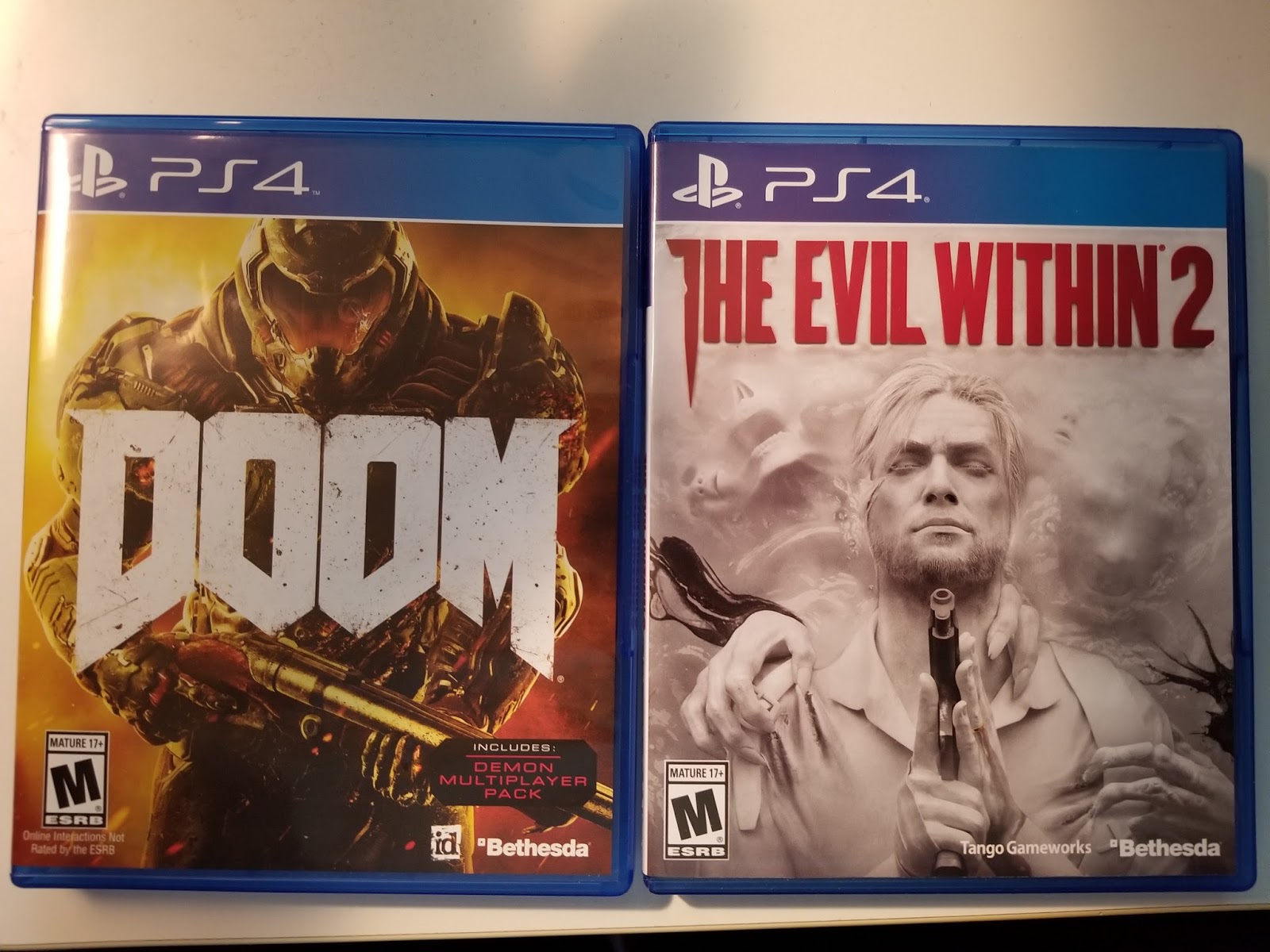
Though I usually focus on retro games on this blog, here's two brand new ones: The Evil Within 2 and Doom, both for the Playstation 4. The Evil Within was a game I enjoyed a lot when it came out in 2014, so I was looking forward to a sequel for a while now. Having played through it and just finished it yesterday, I have a lot of thoughts on it that just may fill a review at some point in the near future. However, for now, suffice it to say that it was pretty cool. Both the story and characters were all kinds of cliché and lackluster compared to the first, but the gameplay really made up for it. Again, I'll save the commentary for a longer review. As for Doom, I haven't played it yet but will definitely start it soon. I was a bit skeptical about it when I first saw trailers, since I'm very wary of "reboots" and thought it looked a little dumb. However, I've heard nothing but positive things about it since it's been released, so I'm willing to give it a try and judge for myself.
Back to retro, we have two Sonic The Hedgehog games for the Sega Saturn: Sonic Jam and Sonic R. Having already owned Sonic 3D Blast on the Saturn for a long time now, these two games complete the "trilogy" of Sonic games released for the Saturn in the mid-90s. Sonic Jam is probably the best of the three, but only because it's a compilation of games from back when Sonic games were actually still good (-Author's note: Sonic Mania is probably good, I haven't played it yet. Soon.). It contains the classic four of the Genesis era: Sonic 1, 2, 3, and Sonic & Knuckles. It even simulates the "lock on" ability of Sonic & Knuckles with 2 and 3, which is pretty cool.
Sonic R, however, is not a good game. I have a certain nostalgic sentimentality toward it since I played it a lot when I was kid, but having played it for about an hour as an adult...yeah, no, it's really bad. I think it wouldn't nearly be as bad if it weren't for the god-awful controls. Oh. My. They're terrible. Your character will just fly all over the place, repeatedly slam into walls, fall into water and other hazards, and constantly careen out of control as you struggle to just finish a race, let alone win it. This came out the same year as Mario Kart 64 (in fact, 10 months after it), so there's absolutely no excuse for being as bad as it is. But you want to know the worst thing about Sonic R? It's the only original Sonic The Hedgehog game that came out on the Saturn! As I just mentioned, Sonic Jam is just a compilation game and Sonic 3D Blast is a lame port of an even lamer Sega Genesis game. For Sega's next-generation console at the time, that was pathetic. It's really no wonder the Saturn did so poorly in the U.S. After the debacle that was the Sega 32X, one would think that Sega of America would do a better job with its next console, and while the Saturn does have some quality games of its own, the lack of a definitive game for its primary mascot was pretty sad. Looking back, it's pretty easy to see why Sega eventually pulled out of the home console market for good.
HOWEVER...just a few years prior, Sega did have a golden age of sorts with the Genesis. Here's two games to help prove that point: Fatal Labyrinth and Teenage Mutant Ninja Turtles: Hyperstone Heist. First off, Fatal Labyrinth is a really fun and original dungeon explorer/RPG that is still really fun to play. I first tried it on a compilation of Genesis games on the Xbox 360 called "Sonic's Ultimate Genesis Collection", and always wanted to play it some more. Again, I think I might have a longer review of it coming soon, but it's a really great original game for the Genesis, I think. Hyperstone Heist is an interesting specimen- it's the Genesis version of Teenage Mutant Ninja Turtles IV: Turtles in Time (which I also own), which was released one year prior, which in itself is the home console version of an arcade game of the same title. Still with me? I've never played it, but from what I understand it's a watered down version of the SNES game, though it's still a fantastic beat 'em up. I'd love to compare the two side by side one day and judge the merits of both simultaneously.
Last but not least, we end on an accessory, if not only for the ridiculous story I have about buying it. So, in short, I am a moron. I had been on the lookout for a Nintendo Gamecube Broadband Adapter, a very rare accessory that regularly sells for $80 or more on eBay. I'm mainly interested in this little piece of hardware for its ability to connect two Gamecube consoles to one another, which one could theoretically use to play a massive 8-man game of Mario Kart: Double Dash or Kirby's Air Ride (assuming you'll also be able to acquire not only a second adapter but two Gamecubes, two copies of the game, eight controllers, two TVs, and seven other people willing to play it with you). Anyway, when this popped up on my eBay feed one day for $40, I thought I had a steal on my hands and jumped on it as fast as I could. However...I didn't look very closely at the label. Yeah, that's not the Broadband Adapter, it's the Modem Adapter, which looks nearly identical to the Broadband Adapter, if not for a shinier label and text which distinguishes it from its counterpart.
What was it used for? Apparently, for connecting your Gamecube to a dial-up modem (remember those?) to play a very few select games online. In fact, the only game I know of that this could be used for is the RPG Phantasy Star Online. Anyway, I had no idea there was even such a thing and didn't read the description very carefully- I just saw a picture of it, assumed it was the Broadband Adapter and purchased it immediately, thinking I'd just gotten a pretty good deal. Well that, boys and girls, is a perfect example of why you should always read the descriptions carefully, lest you end up with a small piece of plastic that's worth no more than interesting an historical footnote in the graveyard of obsolete online-connectivity technology. Thanks for reading.
Showing posts with label Collecting. Show all posts
Thursday, January 18, 2018
Thursday, November 30, 2017
Collection Additions Volume 14: Catching up again
Hello dear readers and welcome back to the game room. Once again, I've taken quite a bit of time off from the 'ol blog. I'd like to say it's because I've been busy, but in the interest of full disclosure, I've just been pretty damn lazy. However, I haven't forgotten about it, and since forming opinions on video games constitutes roughly 40% of my daily thoughts, it's unlikely I'll stop posting any time soon. As long as I can get myself to keep writing, that is.
Anyway, seeing as I'm always buying new things, here's another edition of collection additions to tide you over until I get around to writing another review (which, by the way, I have several drafts of things sitting around on my computer waiting to be finished, so one of these days I will probably get around to finishing and posting them).
So first up, I've completed the Super Mario Bros. trilogy on the NES. I've had all the games for a while of course, but I wanted boxes for all of them because they're just such iconic games for the NES. I bought Mario 3 complete a long time ago, and it just looked lonely on my shelf without Mario 1 and 2 next to it. So, being the completionist that I am, I hunted down boxes for 1 and 2 and was able to get them both in decent condition and for good prices. The box for 2 is very good, but 1 is a little bit rougher around the edges. That's alright with me though, since I don't put too much stock in condition. It's got some creases here and there, but for a 30+ year old game, I'm happy to have a decent box for it at all.
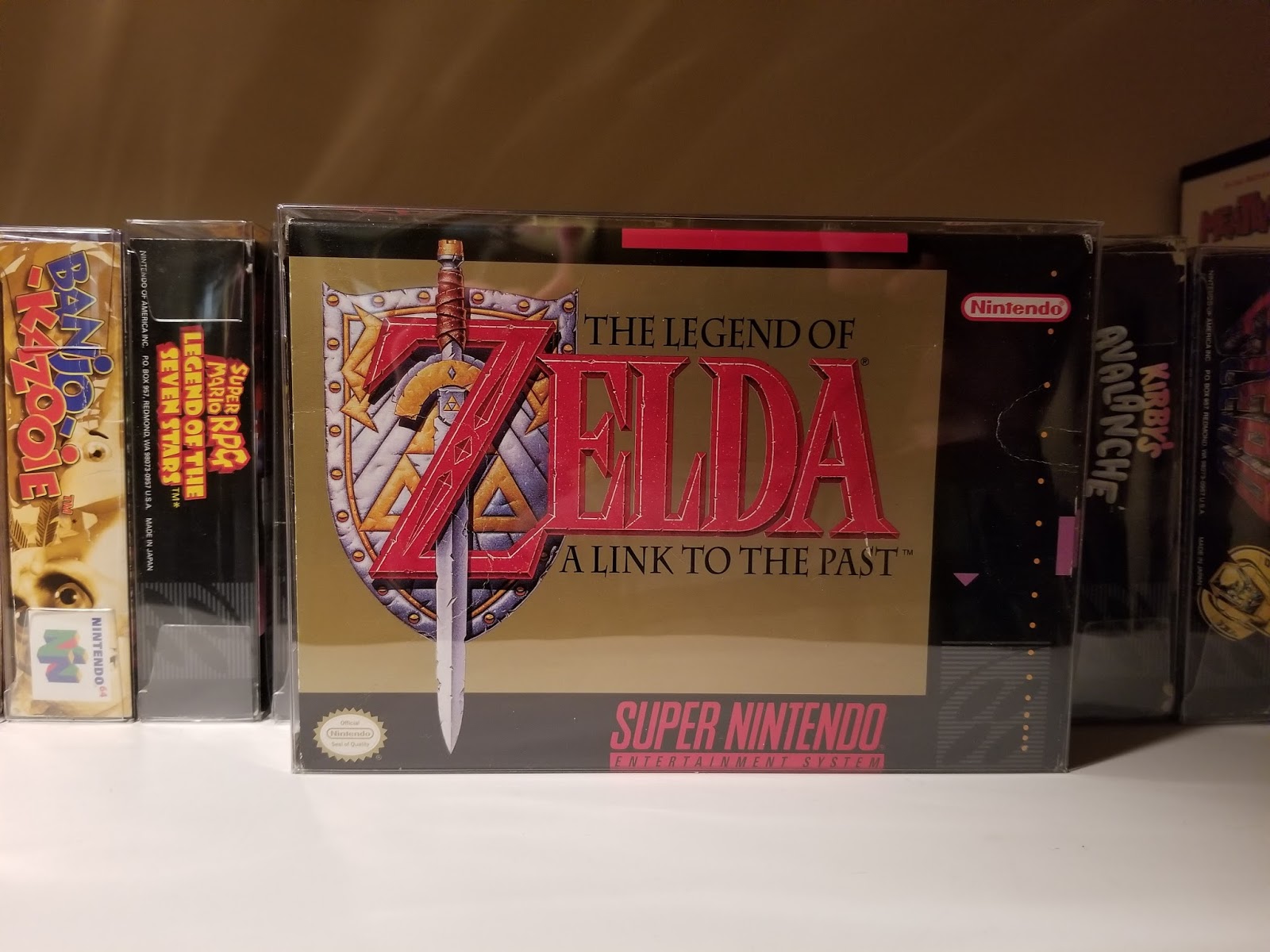
Speaking of boxes, I also picked one up for another iconic game, The Legend of Zelda: A Link to the Past. Once again, this was a game I had purchased a while ago that had just been sitting around on my shelf. Then, a few months back, I purchased a wholesale lot of manuals and boxes and such for SNES games on eBay, which came with the both the manual and the map from Link to the Past. With those two items in tow, I really wanted to get my hands on a box so I could complete the whole thing. I searched high and low for a while, sometimes finding decent ones, but never at a good enough price tag to justify purchasing it. Then, a few weeks ago I found a good one and jumped on it. Like the Super Mario Bros. box, it's got some creases here and there, but I'm happy enough with it.
Moving on to Sega Genesis, we have a game I've been meaning to pick up for a quite a while now: Ghostbusters. As you all should be aware of by now, Ghostbusters is one of my favorite things in existence (and if that statement doesn't convince you, read this review of Ghostbusters: The Video Game for Xbox 360 I did last year). I had never actually known about this game until seeing a review of it by the Angry Video Game Nerd a few years back, which is a real shame because I absolutely would have loved this game as a kid. I only had Ghostbusters II on NES, which is a fairly mediocre game but was still loved to death by me nonetheless, so I likely would've bought the Genesis one and played it nonstop, had I known of it back then. Anyway, Ghostbusters for Sega Genesis is actually on the more uncommon spectrum of Genesis games, so getting a nice complete copy is no easy task. I finally found a good one for a reasonable price recently, and now it's probably the second rarest Genesis game I own, behind Castlevania: Bloodlines.
Next up, we have MediEvil II for PS1. MediEvil was a game I played a long, long time ago on one of those random demo discs for the PS1 that you'd get from gaming magazines or video game stores. I liked it a lot, but never got around to buying the actual game until I was much older. I thought that it was possibly just nostalgia clouding my memory, but to my surprise, the game is actually really great. It sort of reminds me a little bit of Devil May Cry, before that was even a thing. I also had no idea that it had a sequel, so when I spotted it at my local retro gaming store, I had to pick it up. I haven't played it yet, but if it's anything at all like the first one, I'm sure it will make a solid addition to my PS1 library.
Next, a smattering of random games...NFL Football and Operation Wolf for the NES, and Super Punch Out!! for SNES. Very common NES games, two I'm not all that interested in, but when you can get a boxed NES game for under $8, it's pretty much always worth it. And now I can say I own an LJN game...perhaps the worst offender for bad games on the NES. As for Super Punch Out!!, I loved the original Punch Out!! on NES, so this one is a no brainer. I've never played it before but I've seen videos, and it looks just as fun as the original. I'll definitely check it out soon.
And lastly, we end on not an actual game, but an accessory. So, long before people built mods for their games in order to hack the game and do whatever they wanted with it, there was a little thing called Game Genie which seemingly allowed ultimate control over your video games. Want unlimited lives? Invulnerability? The ability to skip levels on command? Game Genie let you do it. It's interesting to think that we were actually using this thing to reprogram the game by rewriting it's coding right before our eyes. But we didn't know how the hell it worked, nor did we care- we just wanted to bend games to our will. I specifically remember using the Game Genie for Game Boy in order to hack myself a Mew in the original Pokémon. Anyway, this Game Genie for the NES is pretty beat up (as evidenced by the crack in the top covered up by an ancient blob of dried glue) and corroded-looking on the contacts, and though I haven't tested it, it likely doesn't work. However, what I find most interesting is the little code book that came with it. Back in the 80s and 90s the internet wasn't really a thing, so we had no way of looking up the codes. As such, this book was an absolute necessity in order to make the Game Genie work. I think some versions had pre-loaded codes on them, but it seems this one didn't.
Anyway, thumbing through the book is kind of interesting because it doesn't just list out the codes for a game, it actually has a little synopsis of each game and other little blurbs. I was also surprised at just how many games it has codes for: over 150, including some of the most popular titles for the NES.
It does get a little weird, however, when it starts talking about some strange and unintended effects that code alterations can have on your games. For example, look at this blurb in the Super Mario Bros. 3 section:
That's actually pretty funny, and not just because they spelled "Bowser" wrong.
Anyway, that's all for now. Thanks for reading and as always, game on.
Anyway, seeing as I'm always buying new things, here's another edition of collection additions to tide you over until I get around to writing another review (which, by the way, I have several drafts of things sitting around on my computer waiting to be finished, so one of these days I will probably get around to finishing and posting them).
So first up, I've completed the Super Mario Bros. trilogy on the NES. I've had all the games for a while of course, but I wanted boxes for all of them because they're just such iconic games for the NES. I bought Mario 3 complete a long time ago, and it just looked lonely on my shelf without Mario 1 and 2 next to it. So, being the completionist that I am, I hunted down boxes for 1 and 2 and was able to get them both in decent condition and for good prices. The box for 2 is very good, but 1 is a little bit rougher around the edges. That's alright with me though, since I don't put too much stock in condition. It's got some creases here and there, but for a 30+ year old game, I'm happy to have a decent box for it at all.
Speaking of boxes, I also picked one up for another iconic game, The Legend of Zelda: A Link to the Past. Once again, this was a game I had purchased a while ago that had just been sitting around on my shelf. Then, a few months back, I purchased a wholesale lot of manuals and boxes and such for SNES games on eBay, which came with the both the manual and the map from Link to the Past. With those two items in tow, I really wanted to get my hands on a box so I could complete the whole thing. I searched high and low for a while, sometimes finding decent ones, but never at a good enough price tag to justify purchasing it. Then, a few weeks ago I found a good one and jumped on it. Like the Super Mario Bros. box, it's got some creases here and there, but I'm happy enough with it.
Moving on to Sega Genesis, we have a game I've been meaning to pick up for a quite a while now: Ghostbusters. As you all should be aware of by now, Ghostbusters is one of my favorite things in existence (and if that statement doesn't convince you, read this review of Ghostbusters: The Video Game for Xbox 360 I did last year). I had never actually known about this game until seeing a review of it by the Angry Video Game Nerd a few years back, which is a real shame because I absolutely would have loved this game as a kid. I only had Ghostbusters II on NES, which is a fairly mediocre game but was still loved to death by me nonetheless, so I likely would've bought the Genesis one and played it nonstop, had I known of it back then. Anyway, Ghostbusters for Sega Genesis is actually on the more uncommon spectrum of Genesis games, so getting a nice complete copy is no easy task. I finally found a good one for a reasonable price recently, and now it's probably the second rarest Genesis game I own, behind Castlevania: Bloodlines.
Next up, we have MediEvil II for PS1. MediEvil was a game I played a long, long time ago on one of those random demo discs for the PS1 that you'd get from gaming magazines or video game stores. I liked it a lot, but never got around to buying the actual game until I was much older. I thought that it was possibly just nostalgia clouding my memory, but to my surprise, the game is actually really great. It sort of reminds me a little bit of Devil May Cry, before that was even a thing. I also had no idea that it had a sequel, so when I spotted it at my local retro gaming store, I had to pick it up. I haven't played it yet, but if it's anything at all like the first one, I'm sure it will make a solid addition to my PS1 library.
Next, a smattering of random games...NFL Football and Operation Wolf for the NES, and Super Punch Out!! for SNES. Very common NES games, two I'm not all that interested in, but when you can get a boxed NES game for under $8, it's pretty much always worth it. And now I can say I own an LJN game...perhaps the worst offender for bad games on the NES. As for Super Punch Out!!, I loved the original Punch Out!! on NES, so this one is a no brainer. I've never played it before but I've seen videos, and it looks just as fun as the original. I'll definitely check it out soon.
And lastly, we end on not an actual game, but an accessory. So, long before people built mods for their games in order to hack the game and do whatever they wanted with it, there was a little thing called Game Genie which seemingly allowed ultimate control over your video games. Want unlimited lives? Invulnerability? The ability to skip levels on command? Game Genie let you do it. It's interesting to think that we were actually using this thing to reprogram the game by rewriting it's coding right before our eyes. But we didn't know how the hell it worked, nor did we care- we just wanted to bend games to our will. I specifically remember using the Game Genie for Game Boy in order to hack myself a Mew in the original Pokémon. Anyway, this Game Genie for the NES is pretty beat up (as evidenced by the crack in the top covered up by an ancient blob of dried glue) and corroded-looking on the contacts, and though I haven't tested it, it likely doesn't work. However, what I find most interesting is the little code book that came with it. Back in the 80s and 90s the internet wasn't really a thing, so we had no way of looking up the codes. As such, this book was an absolute necessity in order to make the Game Genie work. I think some versions had pre-loaded codes on them, but it seems this one didn't.
Anyway, thumbing through the book is kind of interesting because it doesn't just list out the codes for a game, it actually has a little synopsis of each game and other little blurbs. I was also surprised at just how many games it has codes for: over 150, including some of the most popular titles for the NES.
It does get a little weird, however, when it starts talking about some strange and unintended effects that code alterations can have on your games. For example, look at this blurb in the Super Mario Bros. 3 section:
That's actually pretty funny, and not just because they spelled "Bowser" wrong.
Anyway, that's all for now. Thanks for reading and as always, game on.
Monday, September 11, 2017
Collection Additions Volume 13: From old to new
Hello dear readers and welcome back to the game room. It's been a while since I've done a collection updates edition, and I certainly have not slowed down on that front. I've purchased quite a bit over the last few months, evening out my collection with various ins and outs across several different consoles. That's said, let's check out what I got.
First off, we have a bunch of complete black box games for
the NES. I often have these random thoughts where I suddenly decide that I want
to focus on a certain thing, and for a while I was fixed on obtaining complete
so-called "black box" games for the NES. For those who aren't aware
of the history, the "black box" NES games consist of 17 games that
served as the launch titles when the console was first released in America in
the Fall of 1985, plus an additional 13 games that came shortly afterward. The
30 games are collectively known as the "black box" games due to their
black color and similar artwork scheme. Anyway, there's something just
incredibly aesthetically pleasing to me about these games, so I wanted to try
and grab a few complete ones, mostly the easier-to-obtain ones. Golf, Pinball,
and 10-Yard Fight were very easy to find for cheap, while Gumshoe and Popeye
proved a bit more of a challenge.
Next, we have something I've been meaning to buy for quite a
while- Zelda II: The Adventure of Link. Everyone knows that The Legend Of Zelda
is an absolute classic, and owning it is a must for anyone who has an NES. But
what of its lesser known sequel? People have a lot of mixed feelings about
Zelda II, but I believe the general consensus is that it is vastly inferior to
the first game. At any rate, I've never actually played it myself, and my
complete copy of the original looked very lonely on my shelf without the sequel
next to it, so I knew I eventually had to get a complete copy of that one as
well. It took me quite a while to find one in good condition for a reasonable
price, but I jumped on it once I did, and now I can put them together and feel
that much more complete about my collection because of that. Well, that is
until I realized that the actual title is "Zelda II," meaning I'd
have to put it at the very end to maintain alphabetical order. Have I ever
mentioned I am a fantastically huge nerd?
Here's a great flea market find I made: a complete copy of
Mario Paint for Super Nintendo. For the uninitiated, Mario Paint was basically
Nintendo's version of Microsoft Paint, complete with it's own mouse peripheral
that could be plugged into the Super Nintendo. You could draw freehand, use
pre-rendered backgrounds to color, and even make simple animations and music.
There were also a few mini-games thrown in as well. It might seem primitive for
today's standards, but back then this game provided hours upon hours of
entertainment, all without really having much of an objective as a game. It's a
very common SNES game, but what isn't so common is finding it complete with the
giant, oversized original box, as well as the mouse, a plastic mousepad, and
all the instruction booklets with it. The only thing missing from my copy is
the inner styrofoam tray that held everything, but considering how cheap I
got it for at the flea market, I'm not complaining.
Moving up a few generations, here's two Gamecube games that
stand out in the Gamecube library: The Legend Of Zelda: The Wind Waker, and
Metal Gear Solid: The Twin Snakes. Another Zelda game here, and I suppose now
is as good a time as ever to say that I honestly have not played very many
Zelda games in my lifetime. I own a bunch, but out of those I have only really
played the original, Ocarina of Time, and Link's Awakening (the last of which I've never
beaten). That said, with the purchase of two more in the series, I hope to
change that soon so I can call myself a proper gamer. The Twin Snakes is quite
an interesting specimen, as it's an updated remake of the original Metal Gear
Solid (which, if you're keeping score, is technically the 3rd installment in
the franchise). I'm not sure if much else was changed besides updated graphics,
but I'd really like to play it soon and find out. It also apparently includes
Metal Gear Solid 2 as well, which is probably one of my favorite games of all
time.
And last but not least, it may not be related to retro games,
but I'd be remiss to not include my most recent addition, a Playstation 4
console given to me by my girlfriend for my birthday. I may be about 4 years
late to this party, but between games like Resident Evil 7, The Evil Within 2,
and Sonic Mania being released or coming soon, I felt that I now had enough of
a reason to obtain a current-generation console. Sonic Mania is definitely at
the top of the list for me, and I plan on purchasing it later this week, so
look forward to a review of that in the future after I've played it through.
So that's all for now, thanks for reading and as always,
game on.
Sunday, May 14, 2017
Collection Additions Volume 12: NTSC-J FTW
Hello dear readers and welcome back to the game room. Well, after a long winter, here we are in late spring at last. The weather's getting nicer, the flowers are in bloom, and a deadly bio-organic weapons experiment has gone terribly wrong and spilled a horrific mutagenic toxin in a hidden laboratory underneath a crumbling mansion out in the woods. That last part is fictional of course, but in the game Resident Evil, released in 1996 for the Sony Playstation, these events did take place on May 11th, 1998.
As such, this time of year always makes me think of the Resident Evil series. If it wasn't already evident from the myriad of posts I've previously made about it, Resident Evil is one of my favorite video game franchises of all time. To talk about everything I enjoy about it at this point would be exceedingly redundant, so suffice it to say that it's one of my absolute favorites. And of course, once this time of year rolls around, I always get the itch to play it again. Itchy/Tasty, that is.
Anyway, this year I decided to try something a mite bit different. Heading over to the 'ol interwebs, I went ahead and purchased these two items:
A simple Sony Playstation 1 and a game called Biohazard. At first glance, the unassuming reader might ask, what does this have to do with Resident Evil?
Well dear reader, as it happens, Biohazard is Resident Evil, just the Japanese version of the game. When the game was brought over to the U.S., it was renamed due to a swath of trademark issues with the name Biohazard, and thus Resident Evil was born. However, that's not all that was changed. The game was also censored in a few places and rearranged a tiny bit. Being the hardcore RE fan that I am, I wanted to get a closer look at these aspects and find everything I could see that was different.
However, I first needed something to play it on. Japanese PS1 games are region-locked, meaning that they will only play on a Japanese PS1. Therefore, I went ahead and picked one up. Thankfully, only the games are an issue; U.S. controllers, cables, and memory cards will work perfectly fine (though memory cards do need to be reformatted to work, meaning all previous data on them needs to be wiped. Also, the power cable needs to have a "figure-8" ending, as opposed to the U.S. power cord that ends with one square side, which won't fit in the power slot of a Japanese console).
Aesthetically, the console is nearly identical to a U.S. region PS1. In fact, the only way you can really tell the difference is by looking at the sticker on the bottom of the console:
The NTSC-J code marks the console's region as Japanese, meaning that I had everything set to get the game going.
I decided to play through Jill's scenario, since it's the easier of the two. The very first thing I noticed was that both Jill and Chris' scenarios are actually marked easy and hard, respectively, as opposed to the U.S. version where the player is left to just play it and figure out which one is more difficult on their own. An interesting omission.
Of course, there's the infamous censored scenes in the beginning of the game. During the opening FMV cutscene, there's three moments that were censored. When Chris begins discussing the bizarre murders that have been occurring, a mutilated corpse is actually shown; in the U.S. version, it cuts to newspaper headlines describing the murders instead. Later on, when the S.T.A.R.S. team is investigating the forest, one of the members finds a severed hand and is subsequently attacked and brutally killed by dogs, which his teammates then fire at and kill. His gruesome death is shown in full detail, as well as the mutant dogs being shot at; in the U.S. version, the scene cuts away just before the severed hand is shown fully and his death is edited down to a few jump cuts of dog teeth and feral growls. Lastly, during the character introductions, Chris Redfield is shown lighting up a cigarette and taking a drag from it; this scene was censored in an odd way in the U.S. by pasting other footage of Chris over it, while the other character intros were left the same.
Another interesting tidbit, I always thought that the Japanese version was colorized, as opposed to the U.S. version which is in black and white. However, this is not the case, as both versions are in black and white. I thought this was odd because I have actually seen the full uncensored cutscene on YouTube, which is colorized. As such, I thought this was the Japanese version. As it turns out though, this intro is actually from the PC version of the game. The Japanese one is uncut but is still in black and white, which was kind of a downer, but was likely due to hardware limitations of the time.
Moving on, while playing through I noticed that the Japanese version is actually easier, oddly enough. Usually it's the other way around because us dumbass Americans can't seem to handle the difficulty, or at least that's what the corporate suits thought (see: Super Mario Bros. 2, NES). Anyway, everything is a lot easier. Enemies are weaker, auto aim is enabled, and the amount of ink ribbons found is higher, meaning game saves can be made more frequently. Also, in some areas where three enemies might attack you in the U.S. version, only two or one will be present.
There's also a few minor differences that only an eagle-eyed RE veteran would notice. For example, for each of the file texts, a picture of the file will appear behind the text, unlike the U.S. version which just shows the text on a blank screen. At least it gives me something to look at since I can't read Japanese. Also, the Plant 42 boss has some, um, interesting music to say the least. However, this music was replaced with the music of another boss in the JP version, that of the giant spider. Small details, but noticeable if you've played the game as many times as I have.
So that's Biohazard on the Japanese PS1. Was it necessary for me to buy it? Not really, since I already have the original, the Director's Cut, the Director's Cut Dual Shock Edition, and the Sega Saturn port of Resident Evil, meaning that this is literally the 5th different version of it I now possess. But it was cool to play it as it was originally intended for the folks in Japan, and it's also generally cool to me that I've played the game so many times in my life that I can beat it without even needing to read the text. I define "cool" quite differently from most people, as you can probably tell.
Anyway, I have one last thing to share as far as collection additions, and it's just as redundant as having a 5th different version of the same exact game I already own: a Game Boy Advance.
But not just any Game Boy Advance! No, this is the special "Target" edition, only sold at Target stores (obviously) with a big old corporate logo plastered right on the front of it. Whatever, I thought it was unique. And all I need is two more and then four copies of Mario Kart Super Circuit and I'll be able to get a sweet four-player Mario Kart advance race going! Or, at least I can tell people that I can if I wanted to. Thanks for reading.
As such, this time of year always makes me think of the Resident Evil series. If it wasn't already evident from the myriad of posts I've previously made about it, Resident Evil is one of my favorite video game franchises of all time. To talk about everything I enjoy about it at this point would be exceedingly redundant, so suffice it to say that it's one of my absolute favorites. And of course, once this time of year rolls around, I always get the itch to play it again. Itchy/Tasty, that is.
Anyway, this year I decided to try something a mite bit different. Heading over to the 'ol interwebs, I went ahead and purchased these two items:
A simple Sony Playstation 1 and a game called Biohazard. At first glance, the unassuming reader might ask, what does this have to do with Resident Evil?
Well dear reader, as it happens, Biohazard is Resident Evil, just the Japanese version of the game. When the game was brought over to the U.S., it was renamed due to a swath of trademark issues with the name Biohazard, and thus Resident Evil was born. However, that's not all that was changed. The game was also censored in a few places and rearranged a tiny bit. Being the hardcore RE fan that I am, I wanted to get a closer look at these aspects and find everything I could see that was different.
However, I first needed something to play it on. Japanese PS1 games are region-locked, meaning that they will only play on a Japanese PS1. Therefore, I went ahead and picked one up. Thankfully, only the games are an issue; U.S. controllers, cables, and memory cards will work perfectly fine (though memory cards do need to be reformatted to work, meaning all previous data on them needs to be wiped. Also, the power cable needs to have a "figure-8" ending, as opposed to the U.S. power cord that ends with one square side, which won't fit in the power slot of a Japanese console).
Aesthetically, the console is nearly identical to a U.S. region PS1. In fact, the only way you can really tell the difference is by looking at the sticker on the bottom of the console:
The NTSC-J code marks the console's region as Japanese, meaning that I had everything set to get the game going.
I decided to play through Jill's scenario, since it's the easier of the two. The very first thing I noticed was that both Jill and Chris' scenarios are actually marked easy and hard, respectively, as opposed to the U.S. version where the player is left to just play it and figure out which one is more difficult on their own. An interesting omission.
Of course, there's the infamous censored scenes in the beginning of the game. During the opening FMV cutscene, there's three moments that were censored. When Chris begins discussing the bizarre murders that have been occurring, a mutilated corpse is actually shown; in the U.S. version, it cuts to newspaper headlines describing the murders instead. Later on, when the S.T.A.R.S. team is investigating the forest, one of the members finds a severed hand and is subsequently attacked and brutally killed by dogs, which his teammates then fire at and kill. His gruesome death is shown in full detail, as well as the mutant dogs being shot at; in the U.S. version, the scene cuts away just before the severed hand is shown fully and his death is edited down to a few jump cuts of dog teeth and feral growls. Lastly, during the character introductions, Chris Redfield is shown lighting up a cigarette and taking a drag from it; this scene was censored in an odd way in the U.S. by pasting other footage of Chris over it, while the other character intros were left the same.
Another interesting tidbit, I always thought that the Japanese version was colorized, as opposed to the U.S. version which is in black and white. However, this is not the case, as both versions are in black and white. I thought this was odd because I have actually seen the full uncensored cutscene on YouTube, which is colorized. As such, I thought this was the Japanese version. As it turns out though, this intro is actually from the PC version of the game. The Japanese one is uncut but is still in black and white, which was kind of a downer, but was likely due to hardware limitations of the time.
Moving on, while playing through I noticed that the Japanese version is actually easier, oddly enough. Usually it's the other way around because us dumbass Americans can't seem to handle the difficulty, or at least that's what the corporate suits thought (see: Super Mario Bros. 2, NES). Anyway, everything is a lot easier. Enemies are weaker, auto aim is enabled, and the amount of ink ribbons found is higher, meaning game saves can be made more frequently. Also, in some areas where three enemies might attack you in the U.S. version, only two or one will be present.
There's also a few minor differences that only an eagle-eyed RE veteran would notice. For example, for each of the file texts, a picture of the file will appear behind the text, unlike the U.S. version which just shows the text on a blank screen. At least it gives me something to look at since I can't read Japanese. Also, the Plant 42 boss has some, um, interesting music to say the least. However, this music was replaced with the music of another boss in the JP version, that of the giant spider. Small details, but noticeable if you've played the game as many times as I have.
So that's Biohazard on the Japanese PS1. Was it necessary for me to buy it? Not really, since I already have the original, the Director's Cut, the Director's Cut Dual Shock Edition, and the Sega Saturn port of Resident Evil, meaning that this is literally the 5th different version of it I now possess. But it was cool to play it as it was originally intended for the folks in Japan, and it's also generally cool to me that I've played the game so many times in my life that I can beat it without even needing to read the text. I define "cool" quite differently from most people, as you can probably tell.
Anyway, I have one last thing to share as far as collection additions, and it's just as redundant as having a 5th different version of the same exact game I already own: a Game Boy Advance.
But not just any Game Boy Advance! No, this is the special "Target" edition, only sold at Target stores (obviously) with a big old corporate logo plastered right on the front of it. Whatever, I thought it was unique. And all I need is two more and then four copies of Mario Kart Super Circuit and I'll be able to get a sweet four-player Mario Kart advance race going! Or, at least I can tell people that I can if I wanted to. Thanks for reading.
Saturday, April 29, 2017
Collection Additions Volume 11: TurboGrafx Goodies And More
Hello dear readers and welcome back to the game room once more. With a bit more time and effort on my hands, I've stepped up my collecting game a bit in the last few weeks. With an eclectic pile of stuff there's a lot to discuss, so let's dive into it.
So firstly, there's the obvious TurboGrafx-16 items. Unlike many other consoles, extra TG-16 controllers in working condition are a bit hard to come by these days. You have to be fairly patient to find one for a good price, and when you do you need to jump on it. I had been on the hunt for one for quite a while now, since the TG-16 was the only console I owned with only a single controller for it. Honestly, it's hardly even worth having since most TG-16 games are only one-player, but for the relatively uncommon situations where I might have a friend over who would say "hey, let's break out some TurboGrafx games and play them together!", and then I whip out TV Sports Hockey and am like "yeah, let's do this!", now I'm covered.
But wait, there's another problem. The TurboGrafx-16 has only ONE controller port! Yeah, I did not even realize that until the second controller came in the mail. How ridiculous is that! Hell, even the Atari 2600 had a second controller port and that came out over a decade earlier.
So what is one to do in this situation? Why, spend even more money just to be able to play with a second player! And not just a second player, but up to four others with the TG-16 Turbotap. Yes, a multitap was required just to be able to play with a second player. Seems excessive, but hey, I only need three more controllers now to a get a sweet session of Battle Royale going. I did happen across one with the original box & instructions though, which is always cool to have.
Next we come to a fantastically rare TG-16 game, Bonk 3: Bonk's Big Adventure. Now the Bonk series might not be all that well known to the average gamer, but it's a really great one and fantastic addition to any library. Bonk actually spanned multiple consoles, from the NES to SNES, something I was not aware of at all until I did some digging. Anyway, Bonk's Adventure is one of the more common TG-16 games, while it's sequel, Bonk's Revenge, is on the more uncommon end but still readily available. However, Bonk 3 is very hard to find, having been released quite late in the life-cycle of the TG-16.
I spotted a Hu-card only copy on eBay for quite a bit of cash, but a decent enough price that I had my eye on it for a while. I kept a lookout for other game only copies, but the only other two listings I saw were a complete one for $800 and a sealed one for an even more ridiculous price. Finally, when no other copies came up, I decided to go for it. And I'm quite happy that I did, because Bonk 3 officially became one of the rarest games in my entire collection once I received it. I haven't played it extensively yet, but it is definitely worth showcasing in my collection given it's rarity. I'd probably rank it at #4 out of the rarest games I own, behind only complete copies of Mega Man X2 and X3, and of course my crown jewel, a complete copy of Spider-Man: Web of Fire for the 32X.
Anyway, moving on we have two Nintendo pieces: an emerald blue Gamecube controller and Snowboard Kids for the N64. The emerald blue Gamecube controller might not seem like anything fancy at first, but this color of controller was never released in the U.S.; yes, it's a Japanese exclusive color. I love the way it looks and couldn't resist grabbing one, even though I already have five other Gamecube controllers. Well, now all I need is 3 more, another Gamecube, two network adapters, and another copy of Mario Kart: Double Dash in order to have an eight-man tournament...
Uh, yeah, where was I? Oh yes, lastly we have Snowboard Kids for the N64. I admittedly knew pretty much nothing about this game, I mostly just purchased it as a special request from my girlfriend, who had it when she was a kid and had been dying to play it again. So being the chivalrous boyfriend that I am, we went straight to the local game store and snatched it up, then promptly went back to my house and played it. It's...uh...interesting to say the least...
It felt kind of like a poor man's version of Mario Kart 64, if you ask me. I tried to persuade her to try that instead, but she wasn't having any of it. Oh well, we all have that one game from our childhood that might not be very good to others, but we love it simply due to the nostalgia factor. I mean, I absolutely love Ghostbusters II for the NES, so I'm not immune either.
So that's all for this edition, thanks for reading and as always, game on.
So firstly, there's the obvious TurboGrafx-16 items. Unlike many other consoles, extra TG-16 controllers in working condition are a bit hard to come by these days. You have to be fairly patient to find one for a good price, and when you do you need to jump on it. I had been on the hunt for one for quite a while now, since the TG-16 was the only console I owned with only a single controller for it. Honestly, it's hardly even worth having since most TG-16 games are only one-player, but for the relatively uncommon situations where I might have a friend over who would say "hey, let's break out some TurboGrafx games and play them together!", and then I whip out TV Sports Hockey and am like "yeah, let's do this!", now I'm covered.
But wait, there's another problem. The TurboGrafx-16 has only ONE controller port! Yeah, I did not even realize that until the second controller came in the mail. How ridiculous is that! Hell, even the Atari 2600 had a second controller port and that came out over a decade earlier.
So what is one to do in this situation? Why, spend even more money just to be able to play with a second player! And not just a second player, but up to four others with the TG-16 Turbotap. Yes, a multitap was required just to be able to play with a second player. Seems excessive, but hey, I only need three more controllers now to a get a sweet session of Battle Royale going. I did happen across one with the original box & instructions though, which is always cool to have.
Next we come to a fantastically rare TG-16 game, Bonk 3: Bonk's Big Adventure. Now the Bonk series might not be all that well known to the average gamer, but it's a really great one and fantastic addition to any library. Bonk actually spanned multiple consoles, from the NES to SNES, something I was not aware of at all until I did some digging. Anyway, Bonk's Adventure is one of the more common TG-16 games, while it's sequel, Bonk's Revenge, is on the more uncommon end but still readily available. However, Bonk 3 is very hard to find, having been released quite late in the life-cycle of the TG-16.
I spotted a Hu-card only copy on eBay for quite a bit of cash, but a decent enough price that I had my eye on it for a while. I kept a lookout for other game only copies, but the only other two listings I saw were a complete one for $800 and a sealed one for an even more ridiculous price. Finally, when no other copies came up, I decided to go for it. And I'm quite happy that I did, because Bonk 3 officially became one of the rarest games in my entire collection once I received it. I haven't played it extensively yet, but it is definitely worth showcasing in my collection given it's rarity. I'd probably rank it at #4 out of the rarest games I own, behind only complete copies of Mega Man X2 and X3, and of course my crown jewel, a complete copy of Spider-Man: Web of Fire for the 32X.
Anyway, moving on we have two Nintendo pieces: an emerald blue Gamecube controller and Snowboard Kids for the N64. The emerald blue Gamecube controller might not seem like anything fancy at first, but this color of controller was never released in the U.S.; yes, it's a Japanese exclusive color. I love the way it looks and couldn't resist grabbing one, even though I already have five other Gamecube controllers. Well, now all I need is 3 more, another Gamecube, two network adapters, and another copy of Mario Kart: Double Dash in order to have an eight-man tournament...
Uh, yeah, where was I? Oh yes, lastly we have Snowboard Kids for the N64. I admittedly knew pretty much nothing about this game, I mostly just purchased it as a special request from my girlfriend, who had it when she was a kid and had been dying to play it again. So being the chivalrous boyfriend that I am, we went straight to the local game store and snatched it up, then promptly went back to my house and played it. It's...uh...interesting to say the least...
It felt kind of like a poor man's version of Mario Kart 64, if you ask me. I tried to persuade her to try that instead, but she wasn't having any of it. Oh well, we all have that one game from our childhood that might not be very good to others, but we love it simply due to the nostalgia factor. I mean, I absolutely love Ghostbusters II for the NES, so I'm not immune either.
So that's all for this edition, thanks for reading and as always, game on.
Sunday, April 2, 2017
Collection Additions Volume 10: Tax Return Season Glory
Hello dear readers and welcome back to the game room, where video games are the only thing on my mind when I get those lovely checks in the mail from the federal government and the state of New York. I unfortunately have to make this entry another quickie since I have a lot of very important things unrelated to video games to do today (what a world we live in, right?), but I did get quite a nice haul from my latest venture, too good not to discuss. That said, let's have a look:
It may not look much, but this pile of plastic and metal cost nearly $500. Amazing, right? It was mainly due to the Turbo Grafx 16 games, which if you're unfamiliar with, are the baseball card-sized chips on the bottom (and one in a jewel case on the left). I've developed a bit of an addiction to buying TG-16 games, since they are often quite obscure and the console on a whole had a pretty small library (only 94 so-called "TurboChip" games). As with any other console, its library ranges from dime-a-dozen sports type games to very uncommon and rare games like Super Star Soldier (the one on the right). I honestly don't know what makes these games so rare, if they are just great games or had a low print run or what, since I haven't been able to really sit down and play each one of them in an extended session yet, but some of them do look quite interesting. The aforementioned Super Star Soldier, for the example, is a shoot-em-up space shooter type game, the very Japanese kind of "bullet-hell" games which launches about a thousand projectiles at you in a minute. But it looks and plays really well, and I will definitely be playing that one quite a bit when I have more time. And on first glance at the others, Devil's Crush is a pinball game very similar to Alien Crush (which I mentioned in my first "collection additions" segment that was also entirely about TG-16 games), Dragon's Curse is like a side-scroller mixed with an RPG, and Neutopia is a bit of a Legend of Zelda knockoff. Tricky Kick, I honestly have no idea. Anyway, like I said, I will have to examine all of them more closely in the future to make sure I get my money's worth.
Moving on, we have an undisputed video game classic for the Super Nintendo, one that any 90's kid will probably remember well: Teenage Mutant Ninja Turtles IV: Turtles in Time. This game was an absolute hit in the arcades and kids would be lined up around the block to take control of their favorite turtle and battle Shredder and the Foot Clan. Unlike many other arcade games though, it managed to gracefully make the jump to home consoles and retain its fantastically fun gameplay. It's a side-scrolling beat-em-up, which do tend to get monotonous after a while, but Turtles in Time still manages to keep it fun throughout and still have a lovely sheen on it over 20 years later. Just grab a second player and you have an instant afternoon's worth of fun.
Lastly, we end on two related games for the Nintendo 64: Chameleon Twist 1 and 2. These aren't rare games by any means at all, but they are definitely fun games worth owning. I distinctly remember renting the first game from Blockbuster back in the late 90s and spending a weekend trying to beat it, ultimately never being able to do so. So I have a long-standing grudge to settle there, and although I've never actually played the second one, if its anything like the first one I will be able to move right onto it after I finish the first.
So that's all for now, I apologize once again to the most likely two or three people who read this regularly that I've been slacking on entries lately, but after my big test next Saturday I'll be able to focus a lot more on gaming that I have been lately. So for now, thanks for reading and as always, game on.
It may not look much, but this pile of plastic and metal cost nearly $500. Amazing, right? It was mainly due to the Turbo Grafx 16 games, which if you're unfamiliar with, are the baseball card-sized chips on the bottom (and one in a jewel case on the left). I've developed a bit of an addiction to buying TG-16 games, since they are often quite obscure and the console on a whole had a pretty small library (only 94 so-called "TurboChip" games). As with any other console, its library ranges from dime-a-dozen sports type games to very uncommon and rare games like Super Star Soldier (the one on the right). I honestly don't know what makes these games so rare, if they are just great games or had a low print run or what, since I haven't been able to really sit down and play each one of them in an extended session yet, but some of them do look quite interesting. The aforementioned Super Star Soldier, for the example, is a shoot-em-up space shooter type game, the very Japanese kind of "bullet-hell" games which launches about a thousand projectiles at you in a minute. But it looks and plays really well, and I will definitely be playing that one quite a bit when I have more time. And on first glance at the others, Devil's Crush is a pinball game very similar to Alien Crush (which I mentioned in my first "collection additions" segment that was also entirely about TG-16 games), Dragon's Curse is like a side-scroller mixed with an RPG, and Neutopia is a bit of a Legend of Zelda knockoff. Tricky Kick, I honestly have no idea. Anyway, like I said, I will have to examine all of them more closely in the future to make sure I get my money's worth.
Moving on, we have an undisputed video game classic for the Super Nintendo, one that any 90's kid will probably remember well: Teenage Mutant Ninja Turtles IV: Turtles in Time. This game was an absolute hit in the arcades and kids would be lined up around the block to take control of their favorite turtle and battle Shredder and the Foot Clan. Unlike many other arcade games though, it managed to gracefully make the jump to home consoles and retain its fantastically fun gameplay. It's a side-scrolling beat-em-up, which do tend to get monotonous after a while, but Turtles in Time still manages to keep it fun throughout and still have a lovely sheen on it over 20 years later. Just grab a second player and you have an instant afternoon's worth of fun.
Lastly, we end on two related games for the Nintendo 64: Chameleon Twist 1 and 2. These aren't rare games by any means at all, but they are definitely fun games worth owning. I distinctly remember renting the first game from Blockbuster back in the late 90s and spending a weekend trying to beat it, ultimately never being able to do so. So I have a long-standing grudge to settle there, and although I've never actually played the second one, if its anything like the first one I will be able to move right onto it after I finish the first.
So that's all for now, I apologize once again to the most likely two or three people who read this regularly that I've been slacking on entries lately, but after my big test next Saturday I'll be able to focus a lot more on gaming that I have been lately. So for now, thanks for reading and as always, game on.
Saturday, March 11, 2017
Surgical Strike for the Sega CD-32X: a mystery finally solved
Hello dear readers and welcome back to the game room, where we go looking for the truth about obscure games that nobody has cared about for over 20 years (and even back then they probably didn't care). I apologize once again for not posting anything in a while, I've been studying to take a big test soon and video games have kind of taken a back seat. However, I did just get my tax returns back recently, and as such I planned on going on a video game spending binge pretty soon, so once I come back with a massive haul, I'll do a nice big post about it. For now though, I want to revisit a certain unanswered footnote in gaming history that has bugged me for quite a long time: the mystery of Surgical Strike for the 32X.
If you read my post from a while back about completing the 32X library, you already know my feelings about this long lost game, but I'll give a quick recap if you don't feel like reading that: back in the 90s, when Sega was still desperately trying to keep their doomed add-on consoles chugging along, a number of CD games were released that utilized both the Sega CD and 32X simultaneously with the Sega Genesis to produce the "ultimate" gaming experience.
While that description is obviously questionable, what isn't questionable is that five CD-32X games were indeed released for the console, which were all just slightly upgraded versions of their original Sega CD counterparts. None of them are very interesting in their own right and they pretty much proved to be the last dying gasps of a console that had overstayed its welcome in the market. However, where our mystery begins is with an advertisement on the front of a Sega CD game called Surgical Strike, which touted a free copy of the advanced CD-32X version for gamers who sent in a mail-in coupon included with the game. Unsurprisingly, very little hype was generated for this, and the CD-32X version was never even put into production. Or...was it?
As you may know, I'm somewhat of a 32X aficionado, if you will. Yes, I know the thing is pretty much a mushroom-shaped hunk of garbage, but it just has this odd appeal to me. I can't really explain it. Anyway, that appeal is what inspired me to collect all 36 games that were ever released for it, as well as a few that weren't even released in America. However, my quest for completion has always had this one strange caveat to it: what about Surgical Strike for the CD-32X?
The reason I ask this question is because many websites, including GameFAQs and Wikipedia, list Surgical Strike as an official CD-32X release. However, it is one of four games that is listed as exclusive to other countries (the other three being Darxide and FIFA '96 in Europe and San Goku Shi IV in Japan). This piqued my interest while collecting, since I'd obviously have to obtain it in order to have the complete worldwide collection, right? However, in all my years of researching, I was never actually able to confirm that the game was ever released at all. I was able to procure copies of FIFA and San Goku Shi, and though I don't have a copy of Darxide, I have seen it floated around for sale on rare occasions. However, I have never once seen a copy of Surgical Strike for sale, and any pictures of it I have found on the internet all seem to be of the same beat up copy. This led me to believe, for a while, that the game was never actually released in Brazil and that the one copy that has cropped up in pictures from time to time was likely just a prototype or something. However, it seems I was wrong.
While surfing the random dark corners of the internet, I happened to stumble across this article from two years ago, which did a fantastic job outlining the very mystery I just described. It provided a wealth of historical background and testimonials from insiders of Sega's South America distributor Tec-Toy, who were said to have released the game in 1995. Indeed, as the article points out, the game was released in 1995 in very limited quantities. Considering the economic turmoil of Brazil in the 90s that was described by the article, it seems like a small miracle that it even managed to happen at all. That being said, it's no surprise that only 500 units were sold, according to the article. That would certainly explain why it has scarcely ever been seen or spoken of over the last 20 years.
An already obscure and quite frankly mediocre game released in minuscule quantities into South America, for a combination of three different consoles that I'm sure exceedingly few people even had in Brazil 20 years ago. It's no wonder very few copies have ever seen the light of day.
However, this does confirm a very strange and fascinating mystery that I've long kept in the back of my mind. It also leads me to believe that if one were to ever get their filthy little hands on such a rarity and add it to their library, they might have the greatest and most distinct 32X collection the world has ever seen. While I can't even imagine what the logistics involved in attempting to hunt down a copy would look like, one can always dream. And if there's multiple copies out there, who knows? It's good to always stay open minded. And you know what, a quest isn't a quest without some shining light at the end of the tunnel with mysterious and mythical properties attached to it. Thanks for reading.
If you read my post from a while back about completing the 32X library, you already know my feelings about this long lost game, but I'll give a quick recap if you don't feel like reading that: back in the 90s, when Sega was still desperately trying to keep their doomed add-on consoles chugging along, a number of CD games were released that utilized both the Sega CD and 32X simultaneously with the Sega Genesis to produce the "ultimate" gaming experience.
While that description is obviously questionable, what isn't questionable is that five CD-32X games were indeed released for the console, which were all just slightly upgraded versions of their original Sega CD counterparts. None of them are very interesting in their own right and they pretty much proved to be the last dying gasps of a console that had overstayed its welcome in the market. However, where our mystery begins is with an advertisement on the front of a Sega CD game called Surgical Strike, which touted a free copy of the advanced CD-32X version for gamers who sent in a mail-in coupon included with the game. Unsurprisingly, very little hype was generated for this, and the CD-32X version was never even put into production. Or...was it?
As you may know, I'm somewhat of a 32X aficionado, if you will. Yes, I know the thing is pretty much a mushroom-shaped hunk of garbage, but it just has this odd appeal to me. I can't really explain it. Anyway, that appeal is what inspired me to collect all 36 games that were ever released for it, as well as a few that weren't even released in America. However, my quest for completion has always had this one strange caveat to it: what about Surgical Strike for the CD-32X?
The reason I ask this question is because many websites, including GameFAQs and Wikipedia, list Surgical Strike as an official CD-32X release. However, it is one of four games that is listed as exclusive to other countries (the other three being Darxide and FIFA '96 in Europe and San Goku Shi IV in Japan). This piqued my interest while collecting, since I'd obviously have to obtain it in order to have the complete worldwide collection, right? However, in all my years of researching, I was never actually able to confirm that the game was ever released at all. I was able to procure copies of FIFA and San Goku Shi, and though I don't have a copy of Darxide, I have seen it floated around for sale on rare occasions. However, I have never once seen a copy of Surgical Strike for sale, and any pictures of it I have found on the internet all seem to be of the same beat up copy. This led me to believe, for a while, that the game was never actually released in Brazil and that the one copy that has cropped up in pictures from time to time was likely just a prototype or something. However, it seems I was wrong.
While surfing the random dark corners of the internet, I happened to stumble across this article from two years ago, which did a fantastic job outlining the very mystery I just described. It provided a wealth of historical background and testimonials from insiders of Sega's South America distributor Tec-Toy, who were said to have released the game in 1995. Indeed, as the article points out, the game was released in 1995 in very limited quantities. Considering the economic turmoil of Brazil in the 90s that was described by the article, it seems like a small miracle that it even managed to happen at all. That being said, it's no surprise that only 500 units were sold, according to the article. That would certainly explain why it has scarcely ever been seen or spoken of over the last 20 years.
An already obscure and quite frankly mediocre game released in minuscule quantities into South America, for a combination of three different consoles that I'm sure exceedingly few people even had in Brazil 20 years ago. It's no wonder very few copies have ever seen the light of day.
However, this does confirm a very strange and fascinating mystery that I've long kept in the back of my mind. It also leads me to believe that if one were to ever get their filthy little hands on such a rarity and add it to their library, they might have the greatest and most distinct 32X collection the world has ever seen. While I can't even imagine what the logistics involved in attempting to hunt down a copy would look like, one can always dream. And if there's multiple copies out there, who knows? It's good to always stay open minded. And you know what, a quest isn't a quest without some shining light at the end of the tunnel with mysterious and mythical properties attached to it. Thanks for reading.
Monday, January 23, 2017
Collection Additions Volume 9: Road Tripping in Search of Games
Hello dear readers and welcome back to the game room. I apologize for the lengthy absence, it seems that life has caught up with me lately and I haven't had nearly as much time and motivation to write interesting things about games as I'd like to. However, that hasn't stopped me on my quest for ultimate video game collecting glory, and recently that very quest took me beyond the suburbs of my home on Long Island and into the great blue yonder in search of games high and low.
This adventure recently took me to Asbury Park, New Jersey, which is not only home to a very cool pinball museum/arcade, but also a fantastic little video game store called Kill Screen Games. They had a huge variety of retro games, consoles and accessories, and the second you put me in an establishment like that with a handful of money, I'm undoubtedly going to walk out with a pile of games. So what did I get? Let's have a look.
So here we have Zoop! for the Sega Genesis, Street Fighter II for the Super Famicom, China Warrior for the Turbo Grafx 16, and Turok: Dinosaur Hunter for the Nintendo 64.
Let's start off with the obvious here- Street Fighter II, which I believe needs no introduction. It's one of the greatest and most memorable fighting games ever made. Everything about it is great and it still stands up as the gold standard of fighters to this day. I already own literally 5 different versions of this game, including three on the Super Nintendo and two on the Sega Genesis. Why get it for the Super Famicom? Well, there's just something about playing games from other countries that fascinates me, especially if they are already some of my favorite games ever. I like trying to spot differences between what they got and what we got here in the U.S. As for SFII, the only difference I can see is in some of the enemy names (i.e. M. Bison, Vega, and Balrog were all shuffled around) and the text is almost entirely in Japanese. Still, it's fun to see it in a bit of a different light. Also, not for nothing, but I think the Super Famicom console and cartridges just look way cooler than their American counterparts.
Moving on, we have a strange little puzzle game called Zoop! for the Sega Genesis. I admittedly had no idea what this one was about, but I have seen it many times before. For three dollars I think it was worth investigating. What I got..well...is certainly quite interesting. It's very unique, I'll give it that. It's a bit difficult to explain so if I do a poor job, just refer to this video instead. As a little triangle piece, you move around a grid shooting away corresponding-colored pieces that move in from all sides. Once you clear away a certain amount, you move on to another stage where the difficulty increases. Yeah, that was pretty bad. Sorry, just watch the video. In all, it's not bad. I definitely enjoy the jazzy soundtrack it has.
Next we have China Warrior for the Turbo Grafx 16. As I've mentioned in the past, I'm a bit of a sucker for TG-16 games; if I see a bunch of them, I'm pretty much guaranteed to walk away with at least one, especially if it actually comes with the case. China Warrior is definitely on the more common end of the spectrum as far as TG-16 games go, as I've seen it many times before. As far as it's quality as a game...well, it seems to me like it can't make up its mind about whether it wanted to be a side-scrolling beat 'em up or a straight up fighting game. What you get is some kind of weird hybrid. Also, as you can probably tell from the picture, the first thing you notice is that the characters are huge. As in, they take up half the damn screen. Well, at least its consistent?
And lastly, there's Turok: Dinosaur Hunter for the Nintendo 64. This game is freakin' awesome. It might be one of the best first person shooters on the N64, for that matter. I remember playing this game as a kid and having a blast blowing away dinosaurs and such with modern guns. It's sequels got even better, adding in multiplayer that rivaled even the likes of Goldeneye 007. But this one started it all and is still a lot of fun to this day. I remember it also had a ton of hidden bonus features like a cheat code that turned every map into a disco with flashing lights and dancing dinosaurs. Now that's trippy. Another bonus about this one is that it might be the best condition box I have for any N64 games. I'm personally not really a stickler when it comes to the condition of my games, but this one looks like it just came off the shelf of a Toys 'R Us for the first time yesterday. It's also got all those little extra pamphlets and stuff that came with all N64 games. Pretty cool.
So that's it for this week, thanks for reading. Hopefully I will have more material to write about soon, but I can't promise anything for the time being. Just keep checking back for updates and as always, game on.
This adventure recently took me to Asbury Park, New Jersey, which is not only home to a very cool pinball museum/arcade, but also a fantastic little video game store called Kill Screen Games. They had a huge variety of retro games, consoles and accessories, and the second you put me in an establishment like that with a handful of money, I'm undoubtedly going to walk out with a pile of games. So what did I get? Let's have a look.
So here we have Zoop! for the Sega Genesis, Street Fighter II for the Super Famicom, China Warrior for the Turbo Grafx 16, and Turok: Dinosaur Hunter for the Nintendo 64.
Let's start off with the obvious here- Street Fighter II, which I believe needs no introduction. It's one of the greatest and most memorable fighting games ever made. Everything about it is great and it still stands up as the gold standard of fighters to this day. I already own literally 5 different versions of this game, including three on the Super Nintendo and two on the Sega Genesis. Why get it for the Super Famicom? Well, there's just something about playing games from other countries that fascinates me, especially if they are already some of my favorite games ever. I like trying to spot differences between what they got and what we got here in the U.S. As for SFII, the only difference I can see is in some of the enemy names (i.e. M. Bison, Vega, and Balrog were all shuffled around) and the text is almost entirely in Japanese. Still, it's fun to see it in a bit of a different light. Also, not for nothing, but I think the Super Famicom console and cartridges just look way cooler than their American counterparts.
Moving on, we have a strange little puzzle game called Zoop! for the Sega Genesis. I admittedly had no idea what this one was about, but I have seen it many times before. For three dollars I think it was worth investigating. What I got..well...is certainly quite interesting. It's very unique, I'll give it that. It's a bit difficult to explain so if I do a poor job, just refer to this video instead. As a little triangle piece, you move around a grid shooting away corresponding-colored pieces that move in from all sides. Once you clear away a certain amount, you move on to another stage where the difficulty increases. Yeah, that was pretty bad. Sorry, just watch the video. In all, it's not bad. I definitely enjoy the jazzy soundtrack it has.
Next we have China Warrior for the Turbo Grafx 16. As I've mentioned in the past, I'm a bit of a sucker for TG-16 games; if I see a bunch of them, I'm pretty much guaranteed to walk away with at least one, especially if it actually comes with the case. China Warrior is definitely on the more common end of the spectrum as far as TG-16 games go, as I've seen it many times before. As far as it's quality as a game...well, it seems to me like it can't make up its mind about whether it wanted to be a side-scrolling beat 'em up or a straight up fighting game. What you get is some kind of weird hybrid. Also, as you can probably tell from the picture, the first thing you notice is that the characters are huge. As in, they take up half the damn screen. Well, at least its consistent?
And lastly, there's Turok: Dinosaur Hunter for the Nintendo 64. This game is freakin' awesome. It might be one of the best first person shooters on the N64, for that matter. I remember playing this game as a kid and having a blast blowing away dinosaurs and such with modern guns. It's sequels got even better, adding in multiplayer that rivaled even the likes of Goldeneye 007. But this one started it all and is still a lot of fun to this day. I remember it also had a ton of hidden bonus features like a cheat code that turned every map into a disco with flashing lights and dancing dinosaurs. Now that's trippy. Another bonus about this one is that it might be the best condition box I have for any N64 games. I'm personally not really a stickler when it comes to the condition of my games, but this one looks like it just came off the shelf of a Toys 'R Us for the first time yesterday. It's also got all those little extra pamphlets and stuff that came with all N64 games. Pretty cool.
So that's it for this week, thanks for reading. Hopefully I will have more material to write about soon, but I can't promise anything for the time being. Just keep checking back for updates and as always, game on.
Sunday, December 4, 2016
Collection Additions Volume 8: Genesis vs. NES
Hello dear readers and welcome back to the game room once again. It's one of the great ongoing debates in the gaming community- which is better, the NES or the Sega Genesis? I think it goes without question the Super Nintendo was far superior than the Genesis in terms of graphical capabilities, audio output, game library...nearly every category across the board. And this is coming from somebody who grew up with a Genesis and has always personally favored it. But what about the NES? I think it's better to have those two head to head because there's a bit more equal footing. Yes the NES is only 8-bit compared to the Genesis' 16, but does the NES have more to offer with it's massive library of classic games?
Oh, I'm just thinking out loud. I don't really have an
answer there- I see the NES and Genesis in two fundamentally different
categories. I have feelings of nostalgia toward both of them and I don't really
favor one over the other. But I will say that I don't think the Genesis
deserves to be dumped on as much as the internet community likes to do these
days, ridiculous marketing campaigns with made-up technical jargon aside.
Anywho, I buy a lot of games for both consoles, which is
what I AM going to talk about today. Here we have Zombies Ate My Neighbors for
the Genesis, and Adventure Island & Donkey Kong Classics for the NES.
Zombies Ate My Neighbors isn't just the name of a fantastic dubstep techno song- no, it's a cult classic game that was released for both
the Super Nintendo and Sega Genesis in 1993. You can have another debate
over which version is better (I'm sure the SNES version is), but once again I'm
avoiding that and sticking to what I have right in front of me, which is the
Genesis version. It's got everything you could possibly enjoy if you're a fan
of horror by taking the shlocky, B-movie feel of horror movies through the
50's, 60's, 70's and 80's and turning it into a video game. It's also well-renowned
to be one of the best 2-player games of it's time- as two young teenagers, you
have to fight off an army of zombies and save your dumb, oblivious neighbors
from being eaten. It's also a HUGE game too, with 55 levels in which you'll be
fighting not only zombies, but aliens, chainsaw wielding maniacs, vampires, and
more. You'll also be fighting these monsters in a diverse set of locations like
a typical suburban backyard, a supermarket, a football field, and even a medieval
castle. Levels all have goofy-sounding names like "Pyramid of Fear,"
"Dr. Tongue’s Castle Of Terror," and "Terror In Aisle
Five," reminiscent of 50's horror movies with sensationally ridiculous titles. Dr. Tongue’s Castle Of Terror, by the way, has music that's sort of
a 16-bit rendition of the theme from The Shining. How awesome is
that. Really, this game is probably one of the biggest tributes to classic
horror movies ever made. It's made even funnier by the fact that you're playing
as two kids battling zombies with things like squirt guns, fire extinguishers
and weed whackers. This is truly an excellent game and one I thoroughly enjoy,
if not for the huge amount of references to horror movies alone.
Switching over the NES side of the fence, we have Donkey
Kong Classics and Adventure Island. Donkey Kong Classics I believe needs no
introduction- its Donkey Kong and Donkey Kong Jr. packed into one game. Both of
these games were released individually as part of the "black box"series of launch titles for the NES, but this was the first time they
were packaged together as a sort of "value pack." Anyway, while I
would've preferred to have both of the originals (and I'm sure I will
eventually buy both of them either way), having them both together is pretty cool,
especially since I haven't played much of Donkey Kong Jr. in my lifetime.
However, even though it is an absolutely undisputed classic arcade game...it
gets boring pretty fast. Due to the hardware limitations of the time, it
doesn't have all of the levels of the arcade originals, leaving you with about
25% less of the full experience. And even if it did have every level, I still
feel like it would get old fast. The novelty of playing a game like that was
really meant for the arcades, where you'd put in a quarter and your friends
would gather around as you attempted to get your name on the high score board
for the whole world to see. At home...it just doesn't quite have the same
effect. Like I said, it's a classic game, but if you want more than 15 minutes
out of playing a game, you might be a tad disappointed.
Adventure Island is quite a different story. Released in
1988 by Hudson, the company I knew best for making the Bomberman games,
Adventure Island is a simple, fun little platformer that I never really knew
about when I was a kid, yet is often regarded as one of the NES classics. You
take control of the protagonist on a quest to save a princess on a remote
island, fighting various island creatures like birds, snails, and raccoons
along the way. Pretty standard stuff. Such as 2-D platformers go, you run from
the left side of the stage to the right until you reach the goal. Along the way
you can find powerups like an axe to throw at enemies and a skateboard that
lets you move a little faster. The problem with the skateboard though is that
you can't stop moving, which makes jumping on the platforms a bit trickier.
It'd be nice if you had a greater degree of control when you pick it up. It
actually seems to me like the game is meant to be played as quickly as possible,
as you are rewarded when you move through a stage swiftly and
punished when you don't. For instance, you have to grab different kinds of
fruits to stay alive, as your hunger meter will slowly decrease as you progress
through a stage. I didn't think that aspect of being stranded on an island
would be included in a game like this. Obviously it was way ahead of Metal Gear
Solid 3. Actually, it reminds me a lot of those endless mobile games
like Temple Runner, in which the goal is to just keep moving and stay alive. In
that sense it was REALLY ahead of its time. Anyway, I haven't played much of it yet
but it's fun and simple, so I'm sure I'll get a chance to give it more of a go
in the future.
Anyway, that's all for today's collection updates. Thanks
for reading and stay tuned for when I have something actually resembling more of a full game
review in the future.
Subscribe to:
Posts (Atom)