Hello dear readers and welcome back to the game room. Once again, I've taken quite a bit of time off from the 'ol blog. I'd like to say it's because I've been busy, but in the interest of full disclosure, I've just been pretty damn lazy. However, I haven't forgotten about it, and since forming opinions on video games constitutes roughly 40% of my daily thoughts, it's unlikely I'll stop posting any time soon. As long as I can get myself to keep writing, that is.
Anyway, seeing as I'm always buying new things, here's another edition of collection additions to tide you over until I get around to writing another review (which, by the way, I have several drafts of things sitting around on my computer waiting to be finished, so one of these days I will probably get around to finishing and posting them).
So first up, I've completed the Super Mario Bros. trilogy on the NES. I've had all the games for a while of course, but I wanted boxes for all of them because they're just such iconic games for the NES. I bought Mario 3 complete a long time ago, and it just looked lonely on my shelf without Mario 1 and 2 next to it. So, being the completionist that I am, I hunted down boxes for 1 and 2 and was able to get them both in decent condition and for good prices. The box for 2 is very good, but 1 is a little bit rougher around the edges. That's alright with me though, since I don't put too much stock in condition. It's got some creases here and there, but for a 30+ year old game, I'm happy to have a decent box for it at all.
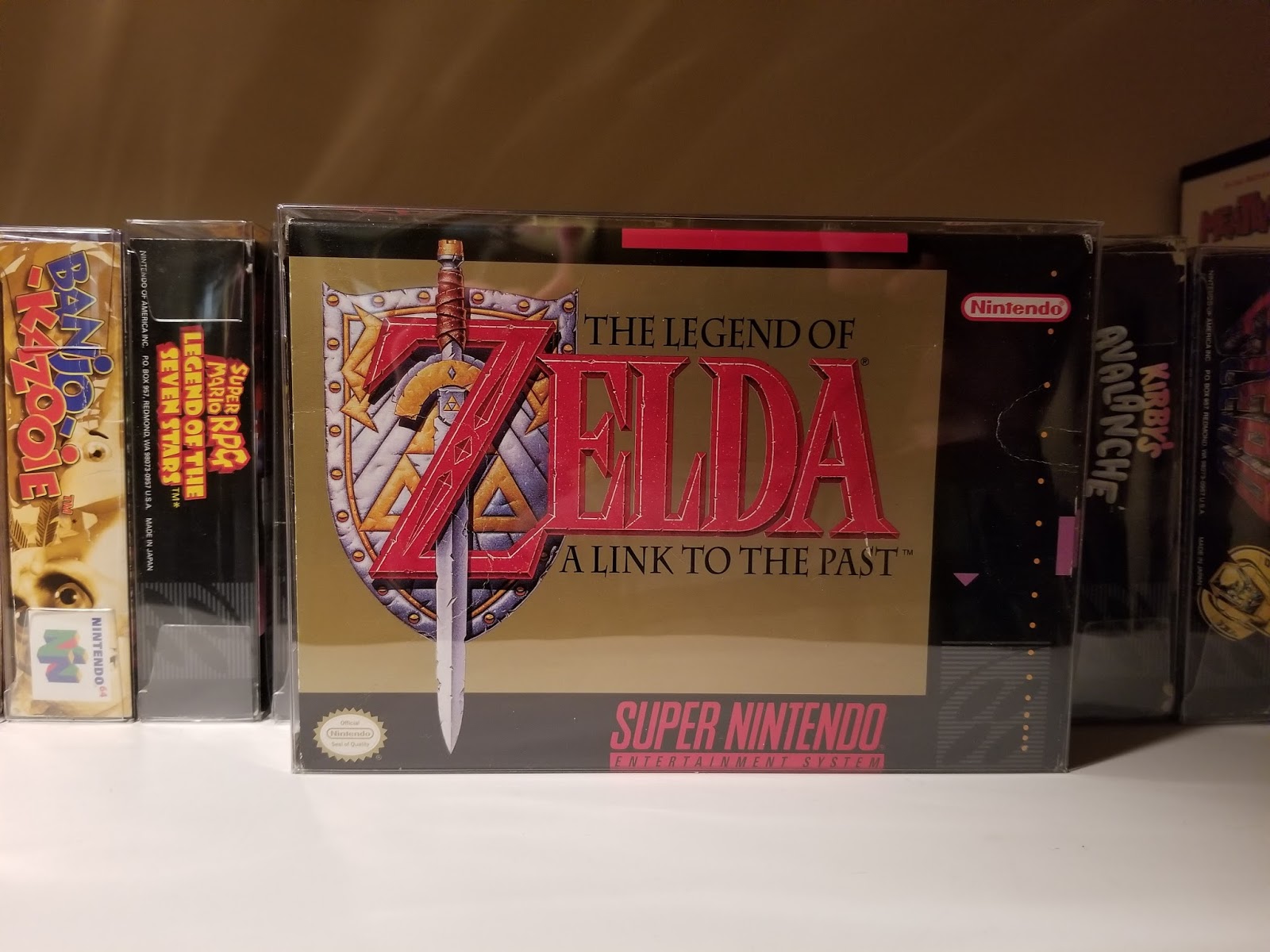
Speaking of boxes, I also picked one up for another iconic game, The Legend of Zelda: A Link to the Past. Once again, this was a game I had purchased a while ago that had just been sitting around on my shelf. Then, a few months back, I purchased a wholesale lot of manuals and boxes and such for SNES games on eBay, which came with the both the manual and the map from Link to the Past. With those two items in tow, I really wanted to get my hands on a box so I could complete the whole thing. I searched high and low for a while, sometimes finding decent ones, but never at a good enough price tag to justify purchasing it. Then, a few weeks ago I found a good one and jumped on it. Like the Super Mario Bros. box, it's got some creases here and there, but I'm happy enough with it.
Moving on to Sega Genesis, we have a game I've been meaning to pick up for a quite a while now: Ghostbusters. As you all should be aware of by now, Ghostbusters is one of my favorite things in existence (and if that statement doesn't convince you, read this review of Ghostbusters: The Video Game for Xbox 360 I did last year). I had never actually known about this game until seeing a review of it by the Angry Video Game Nerd a few years back, which is a real shame because I absolutely would have loved this game as a kid. I only had Ghostbusters II on NES, which is a fairly mediocre game but was still loved to death by me nonetheless, so I likely would've bought the Genesis one and played it nonstop, had I known of it back then. Anyway, Ghostbusters for Sega Genesis is actually on the more uncommon spectrum of Genesis games, so getting a nice complete copy is no easy task. I finally found a good one for a reasonable price recently, and now it's probably the second rarest Genesis game I own, behind Castlevania: Bloodlines.
Next up, we have MediEvil II for PS1. MediEvil was a game I played a long, long time ago on one of those random demo discs for the PS1 that you'd get from gaming magazines or video game stores. I liked it a lot, but never got around to buying the actual game until I was much older. I thought that it was possibly just nostalgia clouding my memory, but to my surprise, the game is actually really great. It sort of reminds me a little bit of Devil May Cry, before that was even a thing. I also had no idea that it had a sequel, so when I spotted it at my local retro gaming store, I had to pick it up. I haven't played it yet, but if it's anything at all like the first one, I'm sure it will make a solid addition to my PS1 library.
Next, a smattering of random games...NFL Football and Operation Wolf for the NES, and Super Punch Out!! for SNES. Very common NES games, two I'm not all that interested in, but when you can get a boxed NES game for under $8, it's pretty much always worth it. And now I can say I own an LJN game...perhaps the worst offender for bad games on the NES. As for Super Punch Out!!, I loved the original Punch Out!! on NES, so this one is a no brainer. I've never played it before but I've seen videos, and it looks just as fun as the original. I'll definitely check it out soon.
And lastly, we end on not an actual game, but an accessory. So, long before people built mods for their games in order to hack the game and do whatever they wanted with it, there was a little thing called Game Genie which seemingly allowed ultimate control over your video games. Want unlimited lives? Invulnerability? The ability to skip levels on command? Game Genie let you do it. It's interesting to think that we were actually using this thing to reprogram the game by rewriting it's coding right before our eyes. But we didn't know how the hell it worked, nor did we care- we just wanted to bend games to our will. I specifically remember using the Game Genie for Game Boy in order to hack myself a Mew in the original Pokémon. Anyway, this Game Genie for the NES is pretty beat up (as evidenced by the crack in the top covered up by an ancient blob of dried glue) and corroded-looking on the contacts, and though I haven't tested it, it likely doesn't work. However, what I find most interesting is the little code book that came with it. Back in the 80s and 90s the internet wasn't really a thing, so we had no way of looking up the codes. As such, this book was an absolute necessity in order to make the Game Genie work. I think some versions had pre-loaded codes on them, but it seems this one didn't. Anyway, thumbing through the book is kind of interesting because it doesn't just list out the codes for a game, it actually has a little synopsis of each game and other little blurbs. I was also surprised at just how many games it has codes for: over 150, including some of the most popular titles for the NES.
It does get a little weird, however, when it starts talking about some strange and unintended effects that code alterations can have on your games. For example, look at this blurb in the Super Mario Bros. 3 section:
That's actually pretty funny, and not just because they spelled "Bowser" wrong. Anyway, that's all for now. Thanks for reading and as always, game on.
Hello dear readers and welcome back to the game room. Remember the days when you had to use a bit of your imagination when playing a video game? The days when a storyline wasn't supplemented with fancy full motion video cutscenes, a tremendous amount of extra material to read about online, or even the luxury of voice acting? If you do, you probably remember thumbing through a good old instruction manual or two.
Yes, before any of those things, the only supplementary material video games had to rely on were manuals- it was where you learned the controls, the plot, and just about anything else you needed to know in order to complete a game from start to finish. I used to lovingly refer to manuals as "history books" as a kid, because anything you needed to know about the backstory of a video game could be found there. These days, manuals are a thing of the past- hell, they even were long before physical media as a whole started dying out. But personally I love having them for my old games, even for reasons besides being the completionist that I am. They're a window to the past, they provide quirky and even downright odd (or just plain wrong) commentary on games, and sometimes they'll tell you a thing or two about a beloved game you may have never even known before. So that being said, let's flip back through a few dusty, torn up pages and take a glimpse into the not-so-distant past of gaming history.
We'll start off somewhere just about everyone in my age group should recall- remember the manual for Pokemon? I couldn't have been the only person who actually took the time to fill out the blank pokedex spaces in the back of it whenever I caught something new. I remember always being annoyed that the last few pages didn't have any pictures at all on them.
There's also some weird stuff going on in the screenshots within the manual. "The Brock"? I don't recall that in the game...
And this one ALWAYS bugged me, even when I was a kid. When you use the
fishing rod, you're only supposed to get text saying "oh! It's a bite!"
But "ho! It's a hit!"? Where did that come from? I remember thinking
that if you saw that message, you'd get a really good Pokemon. Still
waiting on my Mew from fishing, damn it.
Localization is a pretty funny thing. For those who aren't aware, localization is the process by which developers translate video games developed in other countries for their local market, most being translations from Japanese. However, back in the day localizations were abjectly terrible, most famously so for extremely poorly translated lines like "All your base are belong to us." Localization isn't entirely about text translation, however- it also involves explaining the plot. As such, back in the day many game developers chose to craft their own stories that sometimes had absolutely nothing to do with the game. Here in the U.S., this often meant that many games became "Americanized" with ridiculous stories that weren't even a part of the original game at all. Case and point: the manual for Metal Gear on the NES. It's already well known that the game itself was somewhat butchered compared to it's Japanese MSX counterpart, but just read the plot synopsis from the NES manual:
I wonder if Hideo Kojima has ever read that...
I mean, really, Vermon CaTaffy sounds like an STD or something. But no, he's the tranquil shepard boy with 27 sisters. This is canon, right? I feel like I can't even make a joke about how the Metal Gear franchise would write another sequel to retcon this information in.
How about the original Resident Evil? One thing I always found funny about the manual is how it has these quite detailed back stories for characters whose only appearances in the game are as corpses. Take good ol' Kenneth Sullivan for example- the only notoriety he gets in the entire game is having the distinction of being the first victim the player comes across, being eaten by a zombie. Yet the manual dedicates half a page to his picture and a few sentences on his background in chemistry.
Sometimes manuals can be pretty damn funny, especially if the game itself is pretty wacked out. This is evidenced in a few snippets from the Earthworm Jim 2 manual for Sega Saturn, as you can see here:
Now that's hysterical. It just goes to show that when developers were having fun with what they created, the end product was always that much better.
The original Super Mario Bros. has a pretty simple story: a regular plumber named Mario must save a princess and her kingdom from the evil King Koopa. But here's something you might not know, straight from the original manual itself:
Wait, you're telling me that the citizens of the Mushroom kingdom were turned to...blocks? The same blocks from the game? The ones that Mario smashes open repeatedly. So...Mario is a murderer, basically.
I always found it pretty cool when manuals hinted at hidden stages within the game. The manual for Sonic & Knuckles did just that, telling only the title of the Hidden Doomsday Zone, yet withholding pictures of it unlike like every other level.
I also enjoy the bio Sonic 3's manual has for Knuckles. He's 15 years
old and his favorite food is grapes...that's some vital info right
there, folks.
Most manuals were in black and white, which didn't leave a whole lot of room for artistic liberties. However, I think the manual for Street Fighter II pulled off some pretty cool illustrations. I also find it funny how we would always struggle with trying to figure out all of the moves for characters in fighting games as kids, often just smashing all of buttons at once trying to make something happen, while meanwhile the movesets were right there in the manual for every character.
I also find it kinda humorous that manuals often included information like a character's blood type in a fighting game. You know, because Ryu can kick you in the face pretty hard with his tatsu-maki-sen-pu-kyaku, but he's also a universal blood donor. Bet you didn't know that.
But by far the strangest thing I've found is this manual for PGA Tour Golf II. Now, how difficult do you think it is to explain a golf game? You hit the ball in the hole, that's it. But this manual is nearly the size of a freakin' dictionary:
It has all this ridiculously unnecessary information in it like a SIX PAGE history of the PGA tour (including prize money amounts!), lengthy bios for 10 different pro golfers, and very detailed descriptions of different courses.
This is a Sega Genesis game!! What kid was sitting around reading this stuff!? And even if the game was designed for adults instead, what adult would even be reading it?? Or playing it at all for that matter! You know, sitting there in 1992 playing golf on Sega Genesis instead of actually playing golf in real life? Insane.
So anyway, it's always fun to dig around in the past a little bit, because you never know what you might find in between the dirty pages of a long lost manual from over 30 years ago. Thanks for reading.
Hello dear readers and welcome back to the game room. Due to a bit of a hectic week I have to take a break from my game of the week segment this week, but hopefully I should be back on track by next week. For now, here's a quicky about my thoughts on strategy guides.
It’s hard to imagine, but there once was a time when you
couldn’t just type in a question on your phone or at your computer and it would
immediately generate an answer for you. No, in the olden days we had to rely on
good old ink and paper if we needed guidance, and in the realm of video games
this came about in the form of strategy guides. There was always a rack full of
them at whatever game store you walked into, those huge colorful booklets with
the game’s artwork plastered all over the cover.
Like many other mediums, strategy guides have been rendered
all but obsolete by the digital age that has taken over all facets of life, and
if I’m not mistaken they have pretty much died out altogether. However, just
because they have become outdated doesn’t mean they have completely lost all
appeal, and like vinyl records they can still be appreciated for their
wonderful artwork and general feelings of nostalgia when using one.
I have a decent stack of strategy guides, having started
collecting them not too long ago just for the fun of it, and personally I think
there is still a lot of value in owning them. Like I mentioned before, I love
skimming through them and looking at all the great artwork they have. Sure, you
could just drop “Mario” into a Google search and get 10 million images of Super
Mario Bros. artwork, but there’s something about having it printed on a page in
front of you that’s just satisfying as hell.
Strategy guides weren’t just helpful for certain games; they
were all but mandatory for some,
especially if you were a completionist trying to unlock every bit of extra
content and squeeze every little penny out of the game you just bought. For
example, not only is the Metal Gear Solid 2 guide I have humongous (appropriate
for such a complex game), it also goes into fine detail about the vast amount
of easter eggs and secrets the game has to offer, which is something you would
certainly never be able to tackle on
your own in the days when the internet was just a mysterious far away land.
One thing I loved about strategy guides were the detailed
maps they laid out. I have a pretty bad sense of direction, even in simulated
environments, and having an extra map for games like Silent Hill 2 where every
little extra bullet and healing item helps really aided in the experience.
The guides themselves even had their fair share of
additional content you probably wouldn’t see in the game itself. For example,
in the Resident Evil 0 guide I own, there’s many pages dedicated to the making
of the game, including concept artwork and behind the scenes features. And I
can’t forget that most guides would often come with a great poster of the game
that you could tear out and hang up, which I did with almost all of the guides
I owned. Unfortunately most of the guides I own now have had their posters
removed, but the Resident Evil 0 one is still there and I just might have to
hang it up one day when I have a large game room to put it in.
Of course, having strategy guides also took away a bit of
the challenge from games. If you read them from page to page as you were
playing along, it kind of felt like the game was being played for you, and that
sort of ruined the experience a bit. I remember receiving one for Banjo-Tooie
with the game for Christmas, and upon beating the game I felt a bit like the
strategy guide took away a lot of the fun. I suppose it depended on the game
you were playing, but from then on I would only use them sparingly when I was
in desperate need of assistance.
Now, I haven’t played very many modern games for any of the
newest generation of consoles (not owning any of them has something to do with
that), but I feel like pretty much all guides have been rendered useless, even
those posted on the internet. With the abundance of YouTube playthrough videos
and just the general fact that most games are self-explanatory enough and don’t
offer much extra content besides DLCs or whatever, having a strategy guide
would kind of seem like a moot point. It’s a little sad to see the world you
grew up with change so rapidly, and if you’re a Luddite like me it’s hard to
let go of the past. But that’s part of the reason I started collecting guides
in the first place- to keep the spirit of the old days alive for future generations,
reminding old and new gamers alike of what things were like in the halcyon days
of gaming.
As you may have already gathered from reading any of my previous entries, I love horror. I also love video game music, and as such I thought I'd compile a list of musical scores I've encountered in video games over the years that have frightened me the most. Now, keep in mind a good deal of these tracks really aren't that creepy; however, they all completed the distinct job of disturbing me enough to remember them well. So, I present to you, 10 short stories about creepy video game music that I've heard over many years of gaming.
1. Pokémon Gold/Silver- Ruins Of Alph (Radio Music)
So here’s the scenario: it’s the year 2000, I’m 11 years
old, and Pokémon mania is in full swing. After the fallout of Pokémon Red &
Blue and the effects it had on kids my age, parents had begun to realize that
we were all a lot more concerned with catching ‘em all than our math homework
for the night. My parents were certainly among the masses that were in favor of
locking our Gameboys up until we finished our homework for the night. As a
result, the only time I found that I could play to my heart’s content was late
at night, right before I went to sleep. One particular night, I was just
futzing around in the Ruins of Alph, and out of dumb luck I just so happened to
scroll through the radio stations when all of a sudden, I discovered this
sinister little hidden track. With all the elaborate creepy pastas out there
about Pokémon these days, it’s funny to think that this was long before any of
that, and it terrified the hell out of me. Sitting up late at night, the house
completely silent, and suddenly this truly creepy ambience of 8-bit sounds
starts coming out of my Gameboy. It almost felt like something was watching
me…stalking me through the ruins…ready to strike. Needless to say, after that I
stopped playing late at night and stuck to my math homework. Maybe the parents
put that track in there on purpose.
2. Silent Hill 2- Brookhaven Hospital (3rd Floor)
The Silent Hill series may be the most terrifyingly
disturbing franchise of games ever created. I don’t think I’ve ever been as
scared playing a video game than I have been while playing some of these games.
Silent Hill 2 was my favorite of the entire series, and personally, I think
it’s the scariest of any to date. The Brookhaven hospital is about the midway
point of the game, but for me, it was the scariest part. Hospitals have always
creeped me out to the core. They’re places filled with sickness, with disease,
and with death. And not just physical illness, but with mental illness as well.
All these abstract aspects are chilling enough on their own, but when you’re
thrown into a hospital alone, with the lights out, and with horrific monsters
lurking around every corner, you’ll hardly have enough wits left to keep the
controller in your hands. But that’s just the setting. The real horror, and
this is one of the trademarks of the Silent Hill franchise, is the ambience and
atmosphere the music creates which draws you until the world of horror, like it
or not. This music plays when you enter the third floor psychiatric wing of the
hospital. Every time I played through the game, I dreaded going up to that third
floor just because of this music. It was (and still is) utterly horrifying to
have to walk down that long, dark corridor, checking every room along the way
and praying you didn’t run into something
,whatever that might be, waiting for you in the dark. That was the truly
genius thing about the Silent Hill series- it preyed on your psychological
fear. It (for the most part) wasn’t one of those games that relied on cheap
jump scares to frighten you; it did so by isolating you, leaving you feeling
alone and trapped, much like being in the grips of paranoia and insanity itself.
Part of the reason it did so effectively was by surrounding you with music like
this.
3. Doom II- Map 18, 27 (The Courtyard, Monster Condo)
This music played on two levels, but the level I associate
it with that creeped me out the most was level 27, Monster Condo. The level
itself disturbed me in that it was a very dark level, and half the time you
couldn’t even tell where you were going or which direction monsters were attacking
you from. In addition, there were a number of long, wide open hallways with
nothing in them at all; however, one wrong step could set off some kind of trap
or trick wall and you’d be surrounded by demons in an instant. There was also
one room with nothing in it but impaled corpses and body parts hanging from the
ceiling. But aside from all of that, the music was very unsettling and provided
for some of the creepiest in the game. Most of Doom’s soundtrack was very heavy
metal-esque- literally, it blatantly ripped off the likes of Slayer, Alice in
Chains, Pantera, etc. (and speaking of, this track is actually a total copy of
Pantera’s “This Love”, practically note for note. However, I’m okay with it
simply on the grounds that Doom’s soundtrack on a whole kicked ass). But in
contrast, this music is very slow and creeping, like evil luring you into
darkness. I remember that it scared me sufficiently enough to use that level
skip code every time I got to it.
4. Resident Evil 2- RPD Building (1st Floor)
For many young gamers of the late 90’s, the Resident Evil
series was our first taste of fear from playing a video game. I know for
certain that this was the case with me. I hadn’t played much of the first Resident Evil game by the time the
second came out, though I knew of it and its plot. My friend Dave, whom I
played video games with just about every day after school, had gotten Resident Evil 2 right after it came out,
and I would often sit and watch him play it. Just watching was enough to
terrify me beyond belief. Flesh-eating zombies, killer zombie dogs, horrific
virus mutants, it all was enough to make me piss my pants. Well, not literally,
but anyway, I couldn’t even so much as pick up the controller myself without
being scared stiff. I remember lying awake at night after watching it being
played, horrified at the thought of zombies breaking into my room and devouring
me alive. The music only heightened that sense of tension and primal fear as
you wandered the hallways of the abandoned R.P.D. police station, just trying
to stay alive among the living dead and wondering just what the hell else
this game had in store for you lurking beyond the next door. I think the music perfectly
captures that fear, and definitely made it that much harder to keep oneself
together while playing through. When I
finally worked up the nerve to play the game on my own, I would always try to
rush through the areas that had this music, just because it was maddening to
hear it. The part that always got me,
always made me jump a little, is right at the 1:00 mark of the video, when
there’s a loud bang that’s part of the soundtrack, but I always thought it was
something in the game itself, like some monster breaking through the wall ready
to kill me. And that’s why this was the scariest in the whole game for me. There were so many memorable pieces of music, not only from this
game but from other games in the series, that it was truly hard for me to pick one in particular. But I settled on this one because it left such an impression on me at a young age, and still gets to me even after all these years.
5. Super Mario Bros. 3- World 8 Overworld Map
Anyone who calls themselves a true gamer has played Super Mario Bros. 3 at one point in
their lives. It’s one of the best games for the NES, one of the best of the Super Mario Bros. franchise, and possibly
one of the best games of all time. With its mix of platforming action, great
music, and fantastic power-ups, I spent much of my childhood playing this
absolute classic. Now at the time, every kid in the entire neighborhood knew
how to get those warp whistles and skip ahead all the way to the end of the
game, so getting to world 8 wasn’t a big deal. But, oh man, after playing even
just a little bit of the game and listening to the happy, upbeat music and
going through all those bright and colorful levels, nothing in the world could
prepare you for stepping into world 8 for the first time. You go from happy,
sunny, mushroom kingdom straight into hell. Literally, hell. There’s fire,
darkness, and skulls everywhere. It’s like a bad nightmare. You have to fight
your way through Bowser’s battleships and pits of despair (which you are
dragged into by hands coming out of the ground) before you can even get to the
levels, which are some of the most challenging and frustrating of the whole
game. But in the overworld map, you’re treated to this 8-second loop of doom.
And that’s what it is, pure doom. Like, “oh, you like using those warp whistles
to get here kiddies? Well, welcome to hell. Just try to get to Bowser’s castle
if you can.” Being very young and playing this was honestly a terrifying
experience.
6. Kirby 64: The Crystal Shards- Dark Matter’s Cave
Like all the other great Nintendo mascots, Kirby made a jump
to the Nintendo 64 in a spectacular fashion. The game was pretty simplistic, no
doubt, but it provided endless entertainment in the form of combining power-ups
and searching for all the hidden secrets. Playing the game for five minutes
might leave you with the false impression that this is purely a kid’s game.
Granted, that’s how it and many other N64 games were marketed, but there were
some legitimately challenging puzzles to deal with that often left me stumped
as to how to how to collect all those crystals. And much like Super Mario
Bros. 3, once you leave those cheery, happy, upbeat levels and make your way to
the final world, what you find might truly disturb you. Entering level 2 of world 6, you’ll be greeted
by this sinister music. I remember feeling like the game took on a decidedly
darker tone upon entering the final world. This track in particular always left
me feeling very unsettled as I trekked into the heart of the dark matter.
7. Pikmin- The Final Trial
Upon first listen, this track seems fairly innocuous. You’ve
all but completed the game, and one last ship part to collect stands between
you and 100% completion. Considering the hell you’ve gone through on some of
the previous levels, building a few bridges and knocking down some walls
doesn’t seem very difficult, right? Right? But behind the façade lurks
something terrible. Something horrific the likes of which you haven’t even come
close to encountering in the game yet. And that very sentiment is reflected in
the music- the background music is pure doom, which is glossed over by a cheery
little tune. As you’re progressing through the level, you’re thinking to
yourself, “this is it? This is too easy, something isn’t right.” And if you’ve
trusted your instincts enough, your dark fears will be confirmed when you break
down the last wall and step into the arena, only to be ambushed by the biggest,
ugliest, nastiest boss you’ve ever seen- the Emperor Bulblax. I literally
jumped during my first playthrough when he burst from the ground and sent my
Pikmin flying. He’ll effortlessly wipe out entire squadrons of your Pikmin if
you aren’t careful- which, let’s face it, none of us really were the first time
we faced him. And the worst part of it all? After nearly your entire army of
Pikmin has been annihilated, and you finally manage to slay the beast, and that
final ship part falls to your feet, you’ll notice that it’s a piggy bank. A god-damned piggybank, not even an
essential part needed to fly the ship and complete the game. All the lives of
those Pikmin sacrificed for greed. Utterly horrific. Intentional moment or not
(er, probably not, but whatever), it really puts everything into perspective
and makes you think about what you’ve just done. As such, this unsettling music
is quite fitting.
8. Crash Bandicoot- Slippery Climb
The original Crash Bandicoot is a platforming masterpiece,
plain and simple. The gameplay is engaging, the graphics are still wonderfully
appealing even to this day, and it’s just such an overall fun experience.
However, as you progress to the third and final island, the levels take a
massive step up in difficulty. Case and point: slippery climb. Just the mention
of its name is enough to make most Crash veterans shudder. Easily one of the
hardest levels of the game, you’ll find yourself scaling the walls of a
medieval castle in the rain while dodging enemies and performing some insane
jumps. And just attempting to get the gem from this level was a nightmarish
experience. If all of that wasn’t enough, this terrible, twisted track is
playing the entire way through.
9. Twisted Metal- City Park
Along with Resident Evil, TwistedMetal was one of the first games I ever played for the PS1. It’s
an action-packed battle game that’s still fun to this day. Different cars,
unique special abilities, and some kick-ass heavy metal music made for some
great gaming memories. However, things got sinister on the second level if you’ve
strayed far enough away from any of the other cars doing battle in the map. If
you did, you were treated to this lovely track, which sort of sounds to me like
a serial killer’s rendition of classic Christmas songs. I remember just hating
this track because of how disturbing it was and always trying to get it to go
back to the heavy metal music.
10. Gex: Enter The Gecko- Scream TV
Though it might not be as memorable as the first game in the
Gex series, Enter The Gecko was still a fun little game in its own right. As
you traversed through the different levels based on TV shows and movies, you’d
notice that it was all pretty cartoony and silly. The second you head into the
Scream TV levels, however, things take a much more devilish turn. Looking back
on it, these levels are pretty cartoonish too, but it doesn’t change the fact
that these levels have you smashing coolers filled with blood, dodging giant
monster faces coming out of the walls, and fighting off killer dolls straight
out of Child’s Play. That all seemed
pretty creepy to me, but this music just totally topped it off. I remember that
I couldn’t play this game late at night alone in my basement if I had to go
into those levels because of this music.