Tuesday, April 2, 2019

Thoughts On: Resident Evil 2 Remake (PS4)

 **This review contains spoilers for the Remake of Resident Evil 2. So, what are you reading this for? Go play it!**

Hello dear readers and welcome back to the game room once again, after yet another quite long break. I doubt anyone is out there who has been reading this on a regular basis but if you have been and were expecting an update, I thank you for standing by patiently. I've been busy being a sad, tired adult at the age of 30, but that hasn't stopped me from playing video games. Or thinking about them. Or buying them. Well, actually, it has slowed me down in terms of buying them because I have too many other expenses, but hopefully it won't stay that way forever. Anyway, I'm here today because I wanted to talk about something (for, like, the 8th time on this blog) that's quite near and dear to my heart: Resident Evil 2. No, not the one from 1998- the one from this year. And what a long 21 years it's been.


A remake of the original Resident Evil was released for the Nintendo Gamecube in North America on April 30th, 2002. This re-do of the survival horror classic was more than just a simple graphical upgrade; the game was completely rebuilt from the ground up, addressing every issue with the original and intensifying the story, the action, and the horror tenfold. I should know; it's within my top 5 favorite video games of all time. Probably #2, second only to Sonic 3 & Knuckles. Anyway, when this game came out, it blew my freakin' 13 year-old mind. I loved it so much- and still do. I'll play the hell out of this game any time at all, even to this day. But when I finished it back in 2002, an overwhelming thought came over me- "what if they do a similar remake of Resident Evil 2?"

Now, while the the original Resident Evil was badly in need of a re-do due to some extremely cheesy writing and a lot of early 3D gaming stiffness, I think most of us can agree that Resident Evil 2 did not need a remake. The original RE2 was great in so many ways the first one wasn't- the writing and voice acting were exponentially better, the story that was established in the first game was advanced, and the game was just fucking horrifying. Aside from maybe Silent Hill 2, I can't think of another game that scared me quite as much as RE2 did. It was a masterpiece of the genre and probably the most beloved entry to the series by old school fans. But while it may not have needed a remake, it was still a very welcome announcement to the RE community when it was initially confirmed. A long period of speculation followed the original announcement, but the day finally arrived on January 25th, 2019, and my body was completely and totally ready. Seriously, this was the first game I've actually pre-ordered to ensure I would get a copy in a VERY long time. Like, the last one I actually remember was Halo 3 back in 2007.

I picked it up, played it 6 times through now, and this is everything I have to say about it at this point.

The basic story of RE2 is kept intact: two strangers, a rookie police officer and a young woman searching for her older brother, arrive in the town of Raccoon City to find it's been overrun by zombies and other horrific creatures and must fight their way through to survive. They both end up in a derelict police station, where they slowly unravel the mystery behind the monsters that have appeared and slaughtered most of the town's inhabitants, all while fighting to survive and trying to escape the nightmare.

Given what the previous game in the franchise (RE7) did and the direction it was steering toward, it's nice to see Remake 2 follow that trajectory of sticking to horror and relative subtlety rather than grandiose action, as most games prior to RE7 had been doing. Granted, I think fans would probably riot if Remake 2 was anything but that, considering RE2 is one of the greatest survival horror games of all time, but I'm still happy to see that this is where we're at currently.

I won't bother rehashing the whole damn story, as you probably know it by now if you've even read this far. What I really want to talk about is my experience with the game as a huge fan of both the original and the entire Resident Evil franchise on a whole.

First, positives. The developers definitely put a lot of care into staying faithful to the spirit of the original. At the surface level, you progress through the game in pretty much the same manner: a trek through the police station, followed by a descent into the basement of the station, then a return to the station with some new key items, then on into the sewers, and finally into the laboratory at the end. Areas from the original have been redone in exquisite detail, especially many of the areas of the R.P.D. station. Weapons are just about the same for both Leon and Claire, with the addition of "defense" weapons that can be used if an enemy grabs you. There's also plenty of opportunities to upgrade your weapons with scopes, stocks, and larger ammo clips over the course of the game. You'll also find various hip pouches as well, which serve to increase your inventory space as you go along.

Just like it's predecessor, Remake 2 recreated areas of the original game beautifully.

The regular enemies are a lot deadlier this time around. Zombies are much tougher to take down than the original, and landing repeated headshots is almost a must. And even when they do go down, they can get back up 2 or 3 more times before staying down for good, making them significantly more dangerous than I remember in any previous game (with the exception of the crimson heads in Remake 1). Lickers and zombie dogs are really difficult to deal with too- both are extremely agile and are tough to hit to begin with, and you really need a heavier weapon if you want to keep Lickers from counterattacking you. And then there's Mr. X.

Hoo boy, yes, Mr. X. The hulking monstrosity that stalked you all throughout the B scenarios of the original is back with a vengeance. This time you run into him in any scenario, and he is absolutely relentless. You can put him down temporarily with a few well-placed shots to the head, but after a little bit he'll be right back up to come after you. When he's on the prowl, you have very little time to stop and take things slow. He basically forces you to scramble to get to where you need to go, no matter how many other enemies are in your way. This can mean rushing into oncoming zombies or Lickers just to get away from him, as well as solving puzzles as quickly as possible so he doesn't come up from behind and pound you into the floor. The developers definitely did an amazing job with him in this game, as he ramps up the intensity in ways no other RE game has done for me in quite a long time. The fedora was a little bit of a weird design choice, but I can live with it. The tension he brings to the game more than makes up for it.

Mr. X truly adds a level of tension to this game that I haven't experienced in a while, fedoras be damned.

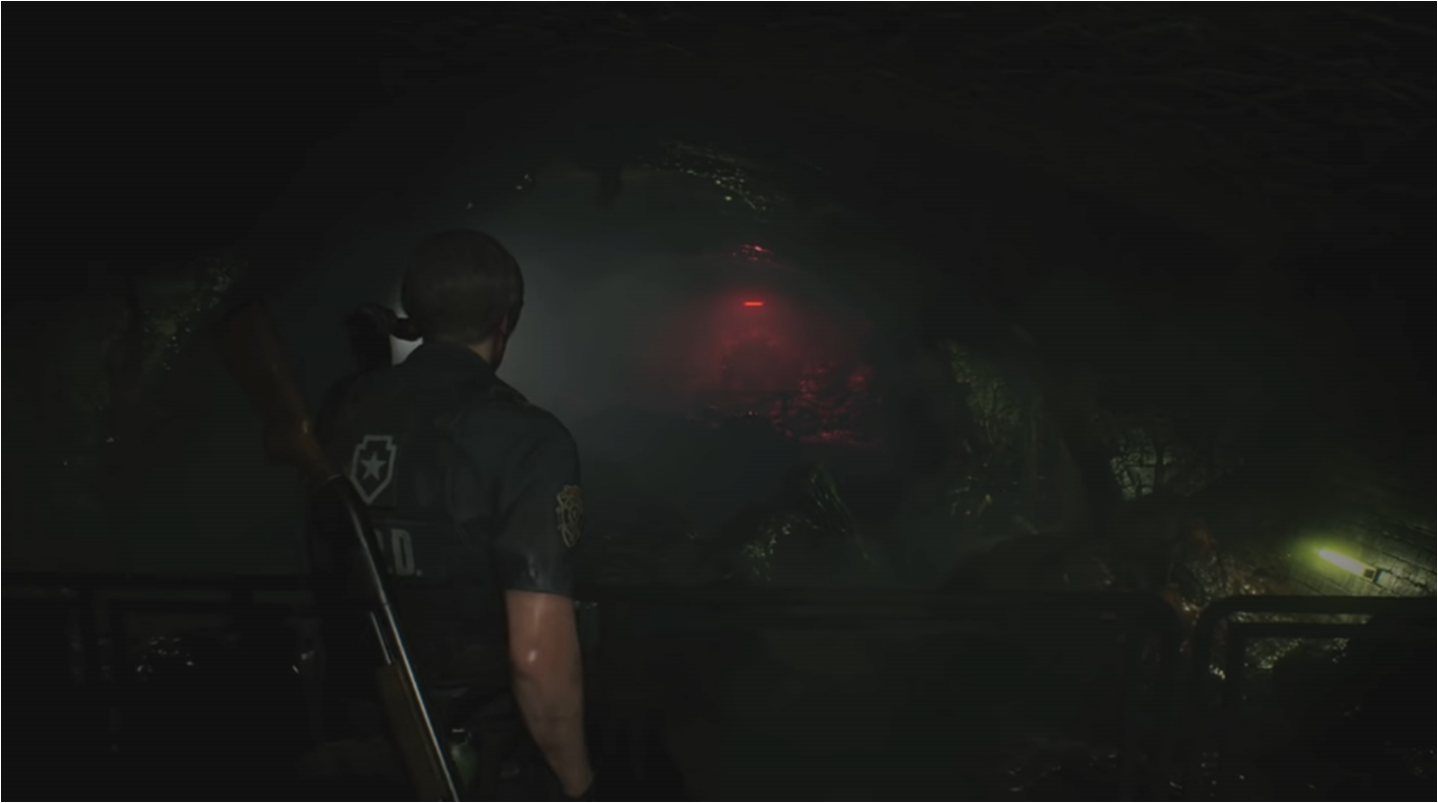
The game also really resurrects (no pun intended) that classic survival horror feel of the older games. Throughout my first playthroughs of the Leon A/Claire B scenarios (which have now been re-titled "1st and 2nd runs"), I felt as though I was constantly scrambling for ammo and health as I progressed, and that was just an awesome feeling. Survival horror was such a great niche genre because a large part of the uneasiness you feel as a player comes from struggling to survive on limited supplies, and this game really hits the mark there. And I haven't even tried hardcore mode yet, which I'm sure kicks that aspect up a few notches. The game is also much darker than previous ones- like, literally, it can be really difficult at times just to see where you're going. I had to actually readjust the brightness several times while I was playing because I kept missing things in the darkness. However, it definitely adds to the creepiness while you're prowling around the police station with just a flashlight illuminating your way, especially when an enemy leaps straight out of the darkness at you. There were definitely more than one expletives that escaped my mouth when I ran into a Licker coming right at me from the darkness.

I also found that the game had some really great moments where it manages to squeeze as much tension as possible out of certain situations. For example, there's a section in the basement where you must enter the station's morgue to find a key. Now, of course any zombie movie fan knows that hospitals, graveyards, and morgues are pretty much the worst possible places to be during a zombie apocalypse. Additionally, the original game had a similar moment where you find yourself in a morgue and you're surrounded by corpses that spring up on you in an instant, so veteran players already had an idea of what was coming next. So, as soon as you see "morgue" on the basement map, you know you're in for trouble. However, when you enter the room, there's no zombies anywhere- that is, until you realize that you need to check the lockers one by one, slowly pulling them all out until you find what you're looking for (which, of course, is in the next to last one in the room). This moment definitely had me on the edge of my seat as I pulled out each gurney just waiting for a zombie to jump out in my face. A similar moment occurs when you must push four bookcases into place to create a bridge in order to reach the door to the third floor. At this point in the game, Mr. X is still furiously stalking you through the R.P.D., and you have mere moments to get the bookcases into to place before he bursts in. However, your character drags the bookcases along verrrrrrrrryyyyyy slowly, so slowly that you can practically feel Mr. X breathing down your neck as you push the damn things into place- a truly terrifying moment.

Having to slowly pull out every single one of these gurneys worked very well in upping the suspense for me.
I was initially very happy with the experience, but the feelings kind of dulled a bit as the game went on. I do think the game is great overall, but there were plenty of flaws I noted along the way. The R.P.D. station is recreated wonderfully in the game, but the sewers and lab were lacking, I felt. I did like certain areas in each, especially the long passage in the sewers where you fight off a bunch of G-mutant monsters en route to picking up the King & Queen plugs, but for the most part I felt they crossed the figurative line in straying a little too much from the original game. There are a few visual nods to the original in both areas, but the sewer really felt like a giant maze and the lab reminded me much more of the crappy Resident Evil movies than the labs from any of the originals. I just felt that both the sewers and the labs didn't do enough of what made the original remake, as well as the first half of this game, so great- faithfully recreate areas from the original while mixing in new areas and challenges to overcome in a balanced manner.

This part in the sewers in which you must run through a gauntlet filled with G-mutant monsters was great and actually was one of my favorite parts of the game, but the rest of the sewers section left a lot to be desired, I felt.

And this leads me to another point, which was probably the biggest disappointment I had from this remake- the differences between the A and B scenarios were sorely missed. One of my favorite aspects of the original game was playing through the A scenario only to find that there was a 2nd scenario with the other character that felt just enough like the same game, yet was completely different in many ways. What's more, certain things you did in the A scenario actually affected the B scenario! For example, when picking up an item as Leon in the A game, that same item will no longer be available to Claire in the B game. I was completely amazed by the idea as a kid, and I was really expecting that aspect to be back with a vengeance in the remake. The possibilities seemed endless; with the advances in technology, imagine how many things one could do in the A scenario that might have a bearing on the B scenario this time around. Playing through Leon's 1st run initially, I even wondered how many things I was doing that might impact Claire's 2nd run. One part in particular stood out in my mind- in the safety deposit room in the R.P.D., where you have to find the missing keys to the keyboard panel in order to unlock the evidence lockers. I really thought this was a prime area to manipulate the environment such that it would affect both scenarios. Like, and I'm just spitballing here, what if one character found one key for the keyboard but the other found the second one? And that's just one example- there were plenty of moments all throughout the game where I felt the same concept could have been implemented fantastically.

This section in the safety deposit room would've been a prime spot to have some interactivity between the two scenarios.

However, I was quite disappointed to find that there's virtually nothing that carries over between scenarios. In fact, there's not even much of a difference between Leon 1st/Claire 2nd and Claire 1st/Leon 2nd at all. The only real differences as far as I can tell are in the beginning and end of the game. In the original, Leon A/Claire B and Claire A/ Leon B were nearly the same, but had enough differences that they did end up feeling like different sets in the end. For example, in Claire A/Leon B, Sherry is implanted with a G-virus embryo and the player must deal with creating a vaccine for her, while in the Leon A/Claire B scenario this doesn't happen at all. However, there were really no equivalent moments in the remake. Leon 1st is pretty much exactly the same as Leon 2nd, and the same goes for Claire 1st/2nd. Again, I really thought this was the kind of thing that a remake would take and make substantially more complex, yet unfortunately the developers ended up discarding the idea altogether.

One other thing that bothered me a little bit was the music...or, really, the lack thereof. I know it's not necessarily fair to compare this game to Remake 1 (and I'll have more to say about that in a bit), but that game did such a great job in recreating everything from the original in amazing detail, music included. Remake 2 definitely did not follow suit in that regard. There were a few familiar musical cues that came up here and there; for example, the very memorable theme of the main hall softly plays in the background when you first enter the station. However, most of the other music from the fantastic original soundtrack is not present at all, replaced with mostly generic and often subdued music. Don't get me wrong, what music is there is completely fine, and really for a lot of the game there's just no music at all, which adds a lot to the ambiance. I guess I just would've liked to have seen more of the great tunes from the original redone- again, something Remake 1 pulled off expertly.

Some other minor things kind of annoyed me as well. All throughout the game, the characters will, when aiming at an enemy, randomly blurt out things like "what the?" or "you asshole!" a lot. Which is, in my opinion, kind of stupid. Like, ok, realism or whatever, but I can't say I really care too much about realism in a game in which I'm carrying 4 guns at a time and fighting the living dead while an 8-foot linebacker wearing a trench coat and fedora stalks me through a police station. And it just sounds...dumb, to me. Also, the game just straight up cut out a lot of enemies like the spiders in the sewers, black Lickers in the lab, and the giant moth mini-boss battle. Which, fine, the moth I could understand getting rid of (even though I always thought the room you fight it in was so cool because it looked like something straight out of Aliens), but the black Lickers were awesome because of how much deadlier they were, and the giant spiders were always a staple of the early RE games, so I think it's hard to justify omitting them.

There were also a few minor continuity errors that kind of bugged me, being the detail-oriented geek that I am. For one thing, there's a moment in the 1st run scenario where, upon exiting the R.P.D. building onto the 2nd floor fire escape, your character will see the other character behind a locked gate and have a brief conversation with them. This occurs after you make your way through the city streets and do about 30-45 minutes worth of running around in the police station. However, upon starting the 2nd scenario with the other character and beginning the game right in the outer courtyard area of the R.P.D., you come to that very area and the same cutscene plays about 2 minutes in. When I first saw it, I literally said out loud "wait...what?" Even in the original, scenes with both Leon and Claire between the A and B scenarios occurred at roughly the same point in the playthrough, at least making it seem like it made sense.

So Leon took like an hour to get here and Claire took about...30 seconds.

Also, there's another moment that bothered me- so in Leon's game, he's stalked all throughout by Mr. X and it isn't until the very end that you find a way to kill him once and for all. Claire is only followed by Mr. X. for about half of her campaign, because upon entering the sewers area, Mr. X is actually chopped in half and killed by William Birkin right in front of you. So...is it not the same Mr. X between scenarios? It doesn't make a whole lot of sense, though I can't get too nerd-mad at this one because I think there is an explanation. It's not made explicitly clear in this game, but in the original, Mr. X is dropped into the R.P.D. by a helicopter which is also carrying five other tanks that we can only assume contain other tyrants. Also, at the very end of Resident Evil 3, a number of dead tyrants are seen scattered in a room in the factory. So, I guess it makes sense that there would be more than one, but the idea is not really explored at all.

Anyway, before I break your computer with extreme nerdiness, I have one final point that's a more of a philosophical question than anything- so, with all the changes made, is this game really a remake at all? Well, it's a little complicated. Compared directly to Remake 1...not really.

The biggest difference between Remake 1 and Remake 2 is that Remake 1 was actually a remake in a much purer sense of the word; very few details from the original game were subtracted, but many more were added and enhanced. Remake 2 is less of a remake in this regard and more of a re-imagining. Details were added and enhanced for sure, but others were subtracted, shuffled around, and mixed together to create an end product that felt familiar, yet significantly different enough that it's hard to call the game a straight up remake.

I think this is more a result of changes in the tech of video games over time than anything. Consider, for a moment, the timeline of these games being released and the gaps between each; the original Resident Evil was released in 1996, followed by Resident Evil 2 in 1998. Then, after a string of sequels and spinoffs, Remake 1 was released in 2002. That's only a 6-year span between the original and Remake 1; compare that to the 21 years that separate RE2 and Remake 2- or, hell, even the 17 years between Remake 1 and Remake 2. What I'm getting at here is that there was a far smaller gap between the original and Remake 1, meaning that technology hadn't really advanced all that much to allow for huge fundamental changes to be made from the original. It had advanced just enough so that Remake 1 most certainly changed the rules in a lot of ways (for the better, I might add), yet didn't stray too far from the tried and true formula of the original. Despite all the flaws it ironed out, the control scheme, pre-rendered backgrounds, and 3rd person fixed-camera POV of the original are all still there in Remake 1.

By 2019, however, video games have changed quite a lot from 1998. We're in the era of massive, open world games with huge amounts of interactivity and complexity in the environments they create. There's games with huge story branches, games with non-linear worlds in which you complete objectives in any manner in which you choose, and let's not even get into online multiplayer capabilities. So, remaking RE2 in the same style as Remake 1 did with RE1 just wouldn't quite work the way it did in 2002, I believe. I mean, it's hard to say whether or not Remake 1 would be more of a re-imagining as well if it were done today and not in 2002. But this is what we now have, and unlike Remake 1, Remake 2 is a true 3D, over-the-shoulder POV shooter much closer to a game like RE4 in look and style, even though it still manages to retain the general tone and feel of RE2.

Whatever the case and despite everything I've just talked about, I did really enjoy Remake 2 overall. There are plenty of liberties taken but overall it doesn't turn the game into something unrecognizable, which was my biggest worry from the start. I think it's got enough to keep fans of the original happy, and it didn't go completely overboard with trying to make something old new again. I also think it's definitely a lesser companion to the original than Remake 1 is to RE1 for sure, but as I said earlier, the original RE2 was a really tough act to follow, and this game did a damn good job trying. And, you know what, there's still plenty of things I haven't even gotten to in this game yet- Hardcore mode, the various "Ghost Survivors" mini-games, and the 4th Survivor game as well, so maybe this game will warm up to me even more.

Above all, one thing is for certain- survival horror is not dead yet. Maybe it just needed a resurrection, very much like a zombie infected with the T-Virus. Thanks for reading.

Monday, June 18, 2018

Double Dose of Quick Thoughts- Doom and The Evil Within 2 (PS4)

Hello dear readers and welcome back to the game room. It's been quite a while since I've posted, having had the adult world catch up and hit me pretty hard. However, as you probably know about me, video games constitute roughly 40% of my waking thoughts, and as long as that's going on I'll still need an outlet to express my unwarranted opinions, so here we all are. Anyways, today I have a bit of a two-fer for ya, that being two games for the PS4 I've played through and thought quite a lot about: Doom and The Evil Within 2.


I'll start off with Doom, having completed that one just last week. It's technically just Doom, and though it seems to be colloquially known as Doom 4, by my count it could be Doom 6 or 7. Anyway, Doom is one of my favorite franchises of all time. I've never played a Doom game that I haven't enjoyed the hell out of, so I was expecting just as much from this new one. The end result, I felt, was a little bit meh, but there was enough there that I still got plenty of enjoyment out of it. Let's talk about the positives first- I really liked the weapon/armor suit upgrade system, in which you'll need to do plenty of hunting through levels to find secrets and earn upgrade points. You can also complete certain challenges in each level to earn points for weapon upgrades; things like finding secrets, killing enemies in a certain manner, and using certain weapons in a level can all earn your points in different levels. This was a really fun aspect of playing, probably the thing that I enjoyed the most.

I also liked how you gain health and armor pieces from killing enemies. After lowering an enemy's health sufficiently, you can perform what the game calls a "glory kill" on it- that is, you'll instantly kill it in some savage, brutal, and crazily over-the-top way, very much in the good old Doom spirit of things. Performing glory kills causes an enemy to drop a plethora of health and armor, especially if you running low on either. You can also gain ammo by killing enemies with the chainsaw, which offers and insta-kill of any enemy, though you must have enough gasoline for it to do so.

I have to be honest, I wasn't that big of a fan of the enemy designs. Overall, I liked Doom 3's designs a lot better. That's not to say this games' designs were terrible, just that I felt like some were overdoing it. Imps and Revenants just look kind of ridiculous. Though, some choices were better; Cacodemons, Pinkies, and Mancubuses, for example, were closer to their original designs. Also, the inclusion of the Spider Mastermind as the final boss was pretty badass. And Doomguy is just the Master Chief now? Okay.

They say imitation is the sincerest form of flattery, but this is ridiculous.

The level design was interesting, though it starts to get old at a certain point. There's a lot of moments where you'll be momentarily trapped in an arena-like area that more so resembles a multiplayer map than a natural extension of the campaign level, and in these areas you'll need to square off with a horde of demons before you can progress. That's all fine and good and makes for some fun combat, but it happens a few too many times in each level for my liking. I'd rather progress through a level and spend more time fighting enemies over longer stretches of the level than to be constantly dropped into pits to have a gladiator battle to the death with demons for 5 minutes at a time. Again, this is something I thought Doom 3 did a lot better, as it feels like there's more of a natural progression through the level (and perhaps the only reason I'm saying that so much is because I'm currently playing Doom 3: BFG Edition and it's easy to make the comparison with it fresh on my mind, but who's counting).

A few times during each level you'll have to destroy these glowy orb things, which then drops in a bunch of demons whom you'll have to do battle with until they're all dead. Hilariously violent, sure, but a little tedious.

That all being said, the overall experience was a positive one, and if Doom 3 was a more serious take on the franchise, then Doom 4 definitely goes back to the absurdly violent and nearly comical nature of the original games. You know, the "shoot it until it dies" kind of attitude. But you know what, that's perfectly fine with me.

Next up, we have The Evil Within 2. The original game sparked my interest way back in the distant past of 2014 when I heard it was directed by Shinji Mikami, the very same director of the original Resident Evil. The first game was pretty fun, like a strange mix of Silent Hill and Resident Evil. It's got plenty of horror to go around while still offering enough action to be varied and enough weird shit going on to keep me entertained.

Anyway, the second game picks up where the first left off, with our protagonist detective Sebastian Castellanos still haunted by the events of the first game, as well as the disappearance of his wife and young daughter. He's pulled back into action when people from Mobius, the mysterious corporation performing all manners of unethical experiments, tell him where to find his daughter: inside S.T.E.M., the virtual reality machine that's basically The Matrix combined with Inception. You know, giant fake world constructed by a computer in the real world. Throw in the "tortured former cop with nothing to lose" angle and this game really does start to feel like a giant amalgamation of generic plots thrown into a blender. Like, you could basically stitch together this entire game from scenes from other movies and games.

 In a world...where evil is the rule of the land...a hard-boiled cop with nothing to lose gets plugged in to the system to take down the people who took away his family...oh, sorry, you've heard this before? In every single movie trailer ever, you say?

Well the plot might be as hackneyed as they come, but what about the actual gameplay? That's basically what makes the game playable. While it definitely leans more action-oriented than the weird, dream-like horror of the first game, the basic schema remains intact. You run around following different objectives, collecting lots of little pieces to craft into useful items and ammo, and do battle with a host of ugly creatures which have taken over the world of S.T.E.M. and turned it into a hellhole.

There's a little more of an open-world feel this time around. You'll have to run around in a large overworld area, fighting off enemies and hopping between objectives on a map. It's a little easy to get lost, but the map system is very helpful in finding your way. You can set waypoints on areas you'd like to get to, which really helps in guiding you along. However, everything is pretty non-linear; there's tons of little side missions and other points of interest to explore on the way to your next main objective. You'll also pass in and out of the "Marrow," which is a sort of in-between area within S.T.E.M. that controls how everything is formed in the overworld. You'll use the marrow to travel between overworld areas, and sometimes you must enter it during side missions. The side missions usually reward you with new weapon or a cache of ammo or parts, so there's plenty of incentive to seek them out.

The map is actually really cool and useful. Big points to the game for that.

I also enjoyed the weapon upgrading system a lot. You'll find various bits and pieces of weapon parts strewn throughout the game, which you can use to upgrade your weapons as you go. The pieces don't come easily, especially the so-called "high-grade" weapon parts which unlock further upgrades for each gun. You can also upgrade health and stamina and other abilities in a similar manner. It really does feel like an earned accomplishment to max out a weapon or a stat, and that's part of what makes the game as fun as it is, for me at least.

Despite the overall gameplay being fun, the nonsensical plot and generic characters kind of detract from the overall experience. Sebastian's voice actor unconvincingly grumbles his way through every line (who, by the way, is a new actor from the first game. I understand it's not always easy to get all of the same people to do all of the same parts over and over, but it's always just a little disappointing to me whenever that happens), and the rest of the characters don't exactly lend themselves to the experience. The first game was a lot darker in terms of the plot and it led to some really crazy and disturbing scenarios. It's basically a journey through the mind of a psychopath, and the tone of the game really reflects that. It seems like the sequel was really missing that element and turns more towards cliché action tropes than twisted horror. By the end, it just becomes "yeah yeah, you save the kid, take down the corporation, rediscover yourself, blah blah blah." But, again, at least the general gameplay makes up for it.

Anyway, so that's that for these two games. Would I recommend? Definitely, if you like shooting demons and not paying attention to the story too much. So hopefully it won't be another 5 months until I give another update. I have a few half-cooked reviews and whatnot in limbo on my computer, so I'd like to get back to finishing them sometime soon. In the meantime, relax, enjoy the summer weather assuming you live in a summer weather area at the moment, and also be happy that THE RESIDENT EVIL 2 REMAKE HAS FINALLY BEEN OFFICIALLY ANNOUNCED AND WE'RE GETTING IT IN 6 MORE MONTHS! YEEEEAAAHHHHHHHHHHHHHHHHHHHH

Thursday, January 18, 2018

Collection Additions Volume 15: 600!

Hello dear readers and welcome back to the game room. Once again I'm back to give an update on my ever-growing collection, which I've been working on for nearly 6 years now and have not showed any signs of slowing down just yet. In fact, I recently reached a milestone: 600 individual video games in my collection, spread out across over 20 different consoles and handhelds. That being said, let's look at the games that got me to that point.


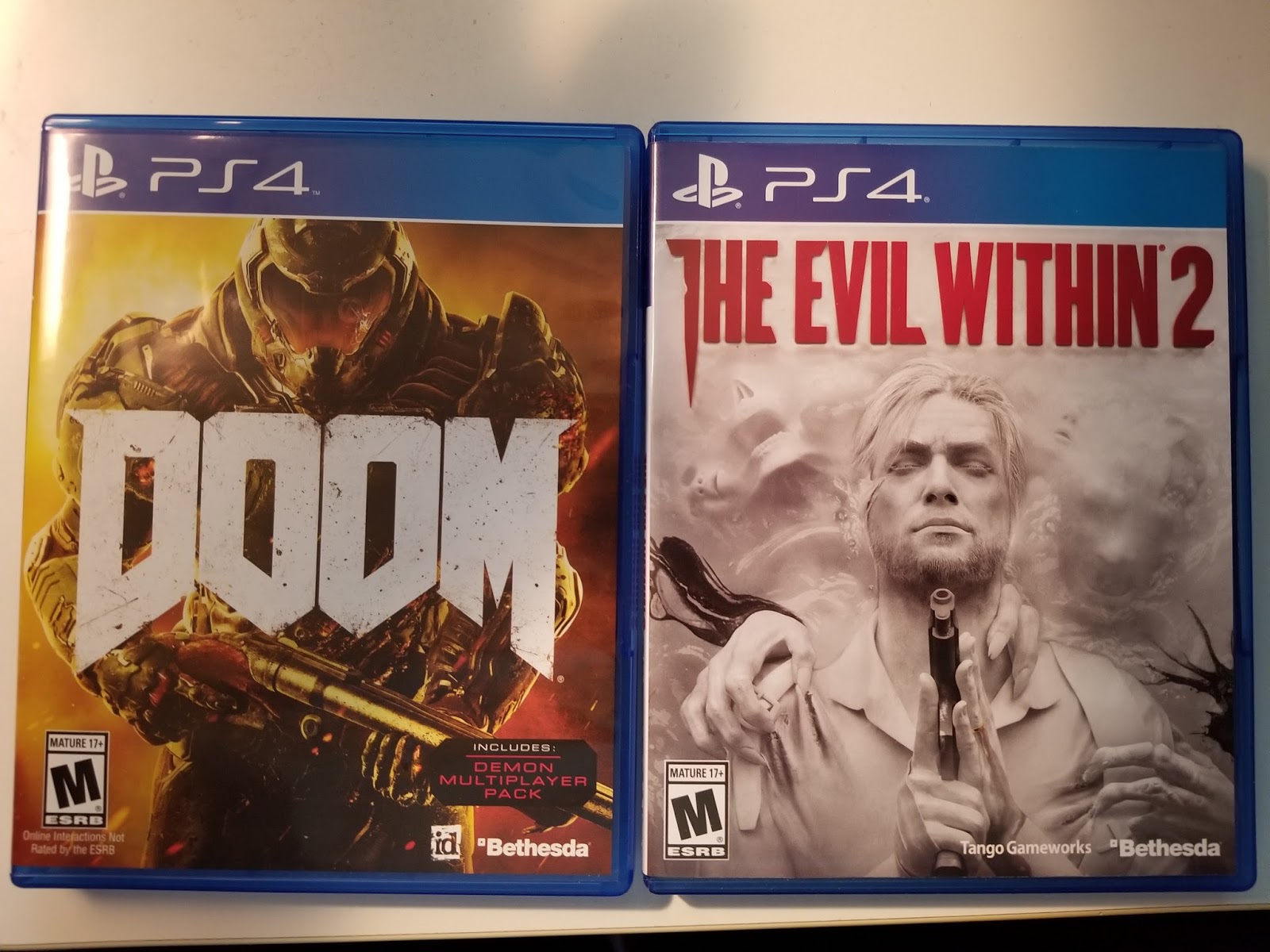
Though I usually focus on retro games on this blog, here's two brand new ones: The Evil Within 2 and Doom, both for the Playstation 4. The Evil Within was a game I enjoyed a lot when it came out in 2014, so I was looking forward to a sequel for a while now. Having played through it and just finished it yesterday, I have a lot of thoughts on it that just may fill a review at some point in the near future. However, for now, suffice it to say that it was pretty cool. Both the story and characters were all kinds of cliché and lackluster compared to the first, but the gameplay really made up for it. Again, I'll save the commentary for a longer review. As for Doom, I haven't played it yet but will definitely start it soon. I was a bit skeptical about it when I first saw trailers, since I'm very wary of "reboots" and thought it looked a little dumb. However, I've heard nothing but positive things about it since it's been released, so I'm willing to give it a try and judge for myself.


Back to retro, we have two Sonic The Hedgehog games for the Sega Saturn: Sonic Jam and Sonic R. Having already owned Sonic 3D Blast on the Saturn for a long time now, these two games complete the "trilogy" of Sonic games released for the Saturn in the mid-90s. Sonic Jam is probably the best of the three, but only because it's a compilation of games from back when Sonic games were actually still good (-Author's note: Sonic Mania is probably good, I haven't played it yet. Soon.). It contains the classic four of the Genesis era: Sonic 1, 2, 3, and Sonic & Knuckles. It even simulates the "lock on" ability of Sonic & Knuckles with 2 and 3, which is pretty cool.

Sonic R, however, is not a good game. I have a certain nostalgic sentimentality toward it since I played it a lot when I was kid, but having played it for about an hour as an adult...yeah, no, it's really bad. I think it wouldn't nearly be as bad if it weren't for the god-awful controls. Oh. My. They're terrible. Your character will just fly all over the place, repeatedly slam into walls, fall into water and other hazards, and constantly careen out of control as you struggle to just finish a race, let alone win it. This came out the same year as Mario Kart 64 (in fact, 10 months after it), so there's absolutely no excuse for being as bad as it is. But you want to know the worst thing about Sonic R? It's the only original Sonic The Hedgehog game that came out on the Saturn! As I just mentioned, Sonic Jam is just a compilation game and Sonic 3D Blast is a lame port of an even lamer Sega Genesis game. For Sega's next-generation console at the time, that was pathetic. It's really no wonder the Saturn did so poorly in the U.S. After the debacle that was the Sega 32X, one would think that Sega of America would do a better job with its next console, and while the Saturn does have some quality games of its own, the lack of a definitive game for its primary mascot was pretty sad. Looking back, it's pretty easy to see why Sega eventually pulled out of the home console market for good.


HOWEVER...just a few years prior, Sega did have a golden age of sorts with the Genesis. Here's two games to help prove that point: Fatal Labyrinth and Teenage Mutant Ninja Turtles: Hyperstone Heist. First off, Fatal Labyrinth is a really fun and original dungeon explorer/RPG that is still really fun to play. I first tried it on a compilation of Genesis games on the Xbox 360 called "Sonic's Ultimate Genesis Collection", and always wanted to play it some more. Again, I think I might have a longer review of it coming soon, but it's a really great original game for the Genesis, I think. Hyperstone Heist is an interesting specimen- it's the Genesis version of Teenage Mutant Ninja Turtles IV: Turtles in Time (which I also own), which was released one year prior, which in itself is the home console version of an arcade game of the same title. Still with me? I've never played it, but from what I understand it's a watered down version of the SNES game, though it's still a fantastic beat 'em up. I'd love to compare the two side by side one day and judge the merits of both simultaneously.


Last but not least, we end on an accessory, if not only for the ridiculous story I have about buying it. So, in short, I am a moron. I had been on the lookout for a Nintendo Gamecube Broadband Adapter, a very rare accessory that regularly sells for $80 or more on eBay. I'm mainly interested in this little piece of hardware for its ability to connect two Gamecube consoles to one another, which one could theoretically use to play a massive 8-man game of Mario Kart: Double Dash or Kirby's Air Ride (assuming you'll also be able to acquire not only a second adapter but two Gamecubes, two copies of the game, eight controllers, two TVs, and seven other people willing to play it with you). Anyway, when this popped up on my eBay feed one day for $40, I thought I had a steal on my hands and jumped on it as fast as I could. However...I didn't look very closely at the label. Yeah, that's not the Broadband Adapter, it's the Modem Adapter, which looks nearly identical to the Broadband Adapter, if not for a shinier label and text which distinguishes it from its counterpart.

What was it used for? Apparently, for connecting your Gamecube to a dial-up modem (remember those?) to play a very few select games online. In fact, the only game I know of that this could be used for is the RPG Phantasy Star Online. Anyway, I had no idea there was even such a thing and didn't read the description very carefully- I just saw a picture of it, assumed it was the Broadband Adapter and purchased it immediately, thinking I'd just gotten a pretty good deal. Well that, boys and girls, is a perfect example of why you should always read the descriptions carefully, lest you end up with a small piece of plastic that's worth no more than interesting an historical footnote in the graveyard of obsolete online-connectivity technology. Thanks for reading.

Thursday, December 28, 2017

Thoughts On Resident Evil 7: Biohazard (PS4)

**Contains massive spoilers for Resident Evil 7. The whole game.**

Hello dear readers and welcome back to the game room, where there is an evil all around us, and yes, it's a permanent resident. Yeah, I thought that was real clever too. Except not really.

Anyway, today I'll be discussing Resident Evil 7, which I've just finished my fourth playthrough of and am ready to discuss further. As you are probably aware of by now, Resident Evil is one of my favorite video game franchises of all time. However, since Resident Evil 4 some 12 years ago, my feelings regarding the series have been mixed. Generally, I think things have been in a bit of a downhill slide since 4. Though I did enjoy 4 and even 5 (albeit in a different kind of way), 6 was the first game in the main series that I really thought was a dud. I've been eagerly waiting for the franchise to return to its horror roots, and I think that 7 certainly represents a huge step in that direction.


"Survival horror" may not have been invented by Resident Evil, but it was the first game to really take the concept to the mainstream. After all, the original Resident Evil was largely inspired by a Japanese Famicom game called "Sweet Home," which was considered the first true survival horror game (in fact, Resident Evil was originally conceptualized as a remake of Sweet Home). The horror genre was the basis for the franchise, with its tale of an old abandoned house filled with zombies, giant spiders, and other monsters. Which is why it was a shame, I think, to see the game get dumbed down with its action-centric gameplay and inane story arcs that rival The Fast & The Furious movies for patent absurdity.

The return to the series' roots in horror is definitely refreshing, not only in gameplay but in story as well. The game follows a man named Ethan, who has recently received a mysterious message from his former girlfriend Mia, who has been missing for the past 3 years. She beckons him to find her in the bayou country of Louisana, a.k.a. the middle of nowhere. Ethan eagerly sets out to find her, and his journey brings him deep into the center of a nightmare when he finds himself trapped on a crumbling estate run by a psychopathic family called the Bakers. The family is headed by the homicidal Jack Baker, who runs things alongside his deranged wife Margeurite and sadistic son Lucas. There's also a little girl named Eveline running around who seems to have something to do with everything, but her role isn't quite clear initially. The story takes a break from the Resident Evil regulars and presents something new, but you do uncover connections to the franchises' past along the way- more on that later.

 The Bakers, your antagonists through a majority of the game. 

Anyway, the game begins with you, as Ethan, desperately trying to escape the house and save Mia while staying alive and avoiding the Bakers and other monstrous creatures that have sprung up in the house. You'll have to find weapons and ammo to defend yourself, solve puzzles, and unravel a mystery along the way- very reminiscent of the good old days of survival horror. In fact, that's what I liked the most about this game in comparison to recent Resident Evil games; it really felt like a desperate struggle to survive, much like the original games did. This is clearly in opposition to the newer games, which were mainly presented as noisy action movies with little substance to fill them out.

The first person perspective is a bit of a change up as well. Sure, there have been other first person Resident Evil games (i.e. Survivor, Dead Aim, The Umbrella Chronicles, etc.), but this is the first one from the primary series. This was a great decision as far as I'm concerned, as I believe the 3rd-person perspective that started with RE4 has gotten kind of stale by now. Again, this might just be my subjective dislike of RE6 that's showing, but I really feel like that style of gameplay for the Resident Evil games had played itself out, at least for the time being.

Anyway, the first person perspective also serves to add a new feature to the Resident Evil repertoire: Virtual Reality, in the form of support for the Playstation VR. Unfortunately, I don't have a VR headset at the moment, so I couldn't experience this mode of play. But, oh man, I could imagine that playing this game with the VR would be a thrilling/terrifying way to play the game. Maybe one day I will, but either way I think this is an excellent addition and future games should all have this option as well.

As far as the feel of the game, it reminded me of a lot of other games at times. It felt like there was a bit of old-school Silent Hill influence at times, mostly when waking through dark corridors with only a tiny bit of light illuminating what's in front of you. Other times it reminded me of games that emphasize stealth, especially in areas where Jack is hunting you down and you have to do whatever you can to stay out of his line of sight. But mostly, to reiterate, it felt a lot like the original Resident Evil games in that I was constantly on the lookout for any items, weapons, and health that could help me survive a little longer. Aside from other horror games, it also clearly had a ton of inspiration from horror movies as well. The whole "homicidal backwoods family" thing is definitely a nod to movies like The Texas Chainsaw Massacre and The Hills Have Eyes. At other times, there also seemed to be plenty of references to movies like The Exorcist, The Ring, The Grudge, Evil Dead, and Saw. As a horror movie junkie, this is all fine by me.

Anyway, now to the actual game. The entire first act of the game is dedicated to finding your way through the Baker's massive property, tracking down Mia, and staying alive while dealing with monsters made of what looks like a mixture of tar and caviar (the game calls these creatures "Molded"). The black stuff is all over the place, and though it does feed into the plot, it mainly serves to indicate the presence of the Molded. For example, at one point in the game you must travel into the basement of the estate, where you'll find the black gunk all over the place. It's a truly tense moment because you just know it will be crawling with the creatures, and you never know what lurks beyond the next corner.

I really do think they look more like caviar than mold.

Along the way, you'll also have to deal with the seemingly unstoppable Jack Baker as he stalks you through the house. On normal mode, it's fairly easy to dodge him and stay out of sight; however, on hard mode, he's pretty relentless and escaping his wrath is no easy task. You can hide from him if you manage to get out of his line of sight, which is where the stealth aspect comes in. However, it's not really necessary and there aren't too many areas in which you need to dodge him. It would've been interesting if this idea was explored a little bit more, but it doesn't really detract from the game either. Jack can be slowed down with bullets, but with a limited supply of munitions, it's best to just run and hide as much as you can and then sneak off when he isn't looking.

Speaking of munitions, you'll have to search high and low for them. Ammo is definitely scarcer than in recent RE games, and you'll need to do plenty of searching of the environment in order to find it. You'll also find a fairly sizeable supply of weaponry to fend off monsters, from various handguns to a grenade launcher with two types of grenade rounds. Some weapons will require a bit of ingenuity to acquire, though. For example, you'll find a powerful .44 magnum that's locked in a birdcage and can only be opened by inserting 9 so-called "antique coins" into a slot, and the tiny coins are often hidden out of sight and scattered all around the estate. If you're low on ammo, you also have the option to produce more by doing a bit of crafting. An item called "Chem Fluid" can frequently be found on the grounds, which you'll need to combine with other items like gunpowder or herbs to make ammo and health, respectively. There's also a less common "Strong Chem Fluid," which can make more powerful ammo or health. And lastly there's the "Separating Agent," which can be used to extract chem fluid from certain items in order to be used to make something else.

The .44 magnum requires a bit of work to obtain.

Inventory space is limited, but can be increased as the game goes on. Sometimes you'll need to juggle items around in order to be able to fit everything in your inventory, but this rarely gets in the way of the gameplay. The Resident Evil tradition of storage crates returns, and you'll find one in just about every major hub area of the game, which helps out with managing inventory space. One kind of annoying thing about the inventory though is that you can only use four weapons at a time, and if you have a fifth weapon, you can't even equip it just to reload it with ammo and manage some space. It's kind of dumb, considering every other game in the series let you carry as much firepower as you wanted. However, by the time this really becomes an issue, the game is almost over anyway.

About halfway through the game, they throw a curveball at you by having you take control of Mia when Ethan is temporarily incapacitated. From here, you'll need to navigate a derelict tanker ship and get to the bottom of what Mia's role is in all this madness. Mia plays exactly the same as Ethan, but you'll need to start from scratch with your inventory. This makes for some tense moments as you're stalked by enemies you've become familiar with but now lack enough supplies to deal with, even if it does feel slightly manufactured. Mia does get her some new weapons of her own, like a machine gun and some remote bombs to play with, so this section also manages to fit in some new things. Anyway, once you finish Mia's section and take control of Ethan again you'll be in the final stretch, and this is where I have my biggest complaint about the game.

After regaining control of Ethan, you escape the tanker and head into an abandoned underground salt mine, which is ominously labeled the "Lab" on a map that Ethan finds. My thought going into it was that this is where things were going to really get good, as the laboratory sections of previous RE games were always my favorite parts. And things definitely did get good, for a little bit: Ethan uncovers the last bit of the mystery, which explains where the Molded came from, the Baker's involvement, and Eveline's presence in the area. However...it all happens very fast. The lab section is very short and it's pretty much just a straight shot into the final fight of the game. There's no puzzles to solve, not much area to explore, and it doesn't even have a boss fight...well, it kind of does. At the end of the section, you'll square off against two "Fat Molded" enemies side by side, which are pretty much the toughest non-boss enemies you'll see in the game.

I got pretty excited upon seeing this map, but my excitement was short-lived.

After that, you'll re-emerge back at the Baker's house from the very beginning of the game, where you then square off against Eveline, who mutates into a gigantic black-mold blob with a face and tentacles. It's cool, sure, but it's also...very anticlimactic. The fight plays out on more of a script than an actual fight, and you don't even really need much ammo or health for this part. Ethan will grab a big, powerful gun that he finds on the ground, you fire off the last bit of ammo at the monstrous Eveline, and that's all.

I would've liked to have seen a lot of different things in the final act. First, as I mentioned, I would've liked if the Lab/Mines section was more extensive with more to do in it. I guess the idea was supposed to be that it explicitly isn't supposed to be a big fancy lab, but rather something thrown together by a backwoods mad scientist, like a meth lab or something. Still, I would've liked more out of the final section of the game. Also, the final boss fight left a lot to be desired. If it was less scripted and more reliant on actual player input, I think I would've had a much bigger sense of accomplishment upon beating the game, especially on hard mode.

Oh, yes, the game as a hard mode- called "Madhouse" mode, unlocked once the game is beaten once on easy or normal mode. This mode is far less forgiving than normal mode, but I think it's really the definitive way to play the game. For starters, enemies are a lot tougher- they deal out a lot more damage and can take much more abuse. Items are also completely rearranged. For example, a key that is used to unlock certain doors in the Baker's house can just be found out in the open in normal or easy mode; however, on hard mode, the key is locked in one of the bird cages and the player must find antique coins to unlock it, forgoing other helpful items that are locked up in other cages just to be able to progress.

By far though, the most drastic change in hard mode is the handicapping of the autosave feature. On easy and normal modes, you have two means of saving the game: manually saving at save spots (called "tape recorders") which are scattered about in hub areas, or waiting for the game to autosave. The autosaves are frequent enough that you get one for just about every major item you receive and most events that happen in the game. As such, dying will not set you back very far and you can often pick up and try again right where you left off. However, this changes big time in hard mode. In hard mode, there is only about 4 or 5 moments in the entire game where you get an autosave. In addition, manual saves come with a price; in order to save at a tape recorder, you'll need to find cassettes to use at the recorders (which, once again, harken back to the old days of typewriters and ink ribbons, which was another nice touch). You get about 3 cassettes per save spot, but I ended up using them quite quickly just to ensure I wouldn't get set back too much if I died (which, by the way, I did a LOT on hard mode). It's a much greater challenge than the other modes, but by the end, I found that I enjoyed hard mode the most. I think it's the best way to experience the game and get the most challenge out of it.

The lack of auto-saving on Madhouse mode is the biggest challenge you'll face.

There's plenty of fun things to unlock as well, which keeps the experience from getting old. Firstly, there's two different endings based on one choice you have to make, so that alone gives you a reason to play through more than once. Secondly, you'll unlock a more powerful handgun and an item which increases your defensive abilities after beating it once, which both really help to get through hard mode. Beating the game on hard mode unlocks infinite ammo for all weapons, which in turn helps make the game easier to beat in under four hours, which THEN will give you an item called the "X-Ray Glasses," which allow you to see exactly where any item is and helps to find many hidden items you may have missed before. Once you reach this point, you've pretty much mastered the game and any further playthroughs are just to have fun with all the unlocked content and to gain trophies (or achievements, in the Xbox One version).

So, after the fourth playthrough, I think I can say I definitely did have a lot of fun with this game, even if the ending was somewhat of a letdown. Besides that, I didn't have a whole lot to complain about. One minor thing though, there isn't a whole lot of variation in the enemies. Besides the boss fights (two with Jack, one with Margeruite, and half of one with Eveline), there's pretty much only 4 enemies in the whole game- regular molded, molded with large hooked claws, four-legged molded, and fat molded. There's also a section where you'll have to fight off some large bugs, but these things are more of an inconvenience than a real enemy. Of course, this is probably just me with the nostalgia glasses permanently glued to my face, but I can't help but think back to the days of Resident Evil 2, which had so many varied types of enemies that you needed to adapt different strategies to deal with. Obviously, they're two very different games, but I think experiencing so much variety is one of the main things that made me love the original games to begin with.

And one last thing, back to my point about connections to previous games- there's plenty of them, but you have to look a little hard and have a great memory (or, in my case, extreme nerdiness) to spot them all. For example, most RE fans would probably get this reference to the first game:


But, how many would see this one, from one of the files you find in the game:


Yes, that author is the very same Alyssa Ashcroft from Resident Evil: Outbreak, who apparently is still doing investigative journalism 18 years later. Now that's reaching into obscurity.

There was also this one:


And this one:


You get the idea. I just like how they managed to do their own distinctive thing, yet keep the spirit of the previous games alive, even if it was only in subtle little ways. That, in my opinion, is what any good sequel should do. I also think it's telling that even the title of the game represents the franchise coming full circle (for those who are unaware, Resident Evil is called 'Biohazard' in Japan, so calling the game Resident Evil: Biohazard was meant to be the bridge between the Eastern and Western versions of the game. And yes, it was called Biohazard: Resident Evil in Japan). It's as if they specifically meant to tie the whole thing together neatly, and I think this game did a good job with that.

And even though the final fight was a bit of a letdown, I did like the ending and the cliffhanger it left for future games. So the game ends with a squadron of helicopters swooping in to pick up Ethan after he finishes Eveline off, and the helicopters are branded with the...*gasp* Umbrella Corporation logo!? And what's more, a masked soldier descends from the helicopter and approaches Ethan, then removes his helmet to reveal...our old friend Chris Redfield! They carry Ethan off in the helicopter, and in the good ending, Mia is alongside him. But there are still many unanswered questions. It's been revealed that the Bakers were being controlled by Eveline, but who created Eveline in the first place? Who's running Umbrella now, and what is their role in all this? What became of Lucas, and will he be back in future installments? And what ever happened to Ark Thompson, damn it??

(P.S., these questions may have all been answered in the various DLC packages for the game, but I haven't played any of them as of this writing, so they're still unanswered for me at least. Except for that last one, that was a joke. Sort of.)
  
Anyway, my final verdict for RE7? It's a great game. Much better than 6, also better than 5 in different ways. I admittedly haven't played a lot of other recent RE games like Revelations 1 & 2 or Operation: Raccoon City, so maybe comparing this game to older ones isn't necessarily fair. Nonetheless, I still think 7 is a welcome addition to the series and I hope newer games continue to build on the precedent it set. Despite the flaws, I think it's a huge step in the right direction for the franchise. I enjoyed the horror, the mystery, and the journey, which are the exact elements that I enjoyed from the old days as well. Now if only Capcom will officially announce a remake of Resident Evil 2, then we'll be talking. Thanks for reading.

Thursday, November 30, 2017

Collection Additions Volume 14: Catching up again

Hello dear readers and welcome back to the game room. Once again, I've taken quite a bit of time off from the 'ol blog. I'd like to say it's because I've been busy, but in the interest of full disclosure, I've just been pretty damn lazy. However, I haven't forgotten about it, and since forming opinions on video games constitutes roughly 40% of my daily thoughts, it's unlikely I'll stop posting any time soon. As long as I can get myself to keep writing, that is.

Anyway, seeing as I'm always buying new things, here's another edition of collection additions to tide you over until I get around to writing another review (which, by the way, I have several drafts of things sitting around on my computer waiting to be finished, so one of these days I will probably get around to finishing and posting them).


So first up, I've completed the Super Mario Bros. trilogy on the NES. I've had all the games for a while of course, but I wanted boxes for all of them because they're just such iconic games for the NES. I bought Mario 3 complete a long time ago, and it just looked lonely on my shelf without Mario 1 and 2 next to it. So, being the completionist that I am, I hunted down boxes for 1 and 2 and was able to get them both in decent condition and for good prices. The box for 2 is very good, but 1 is a little bit rougher around the edges. That's alright with me though, since I don't put too much stock in condition. It's got some creases here and there, but for a 30+ year old game, I'm happy to have a decent box for it at all.


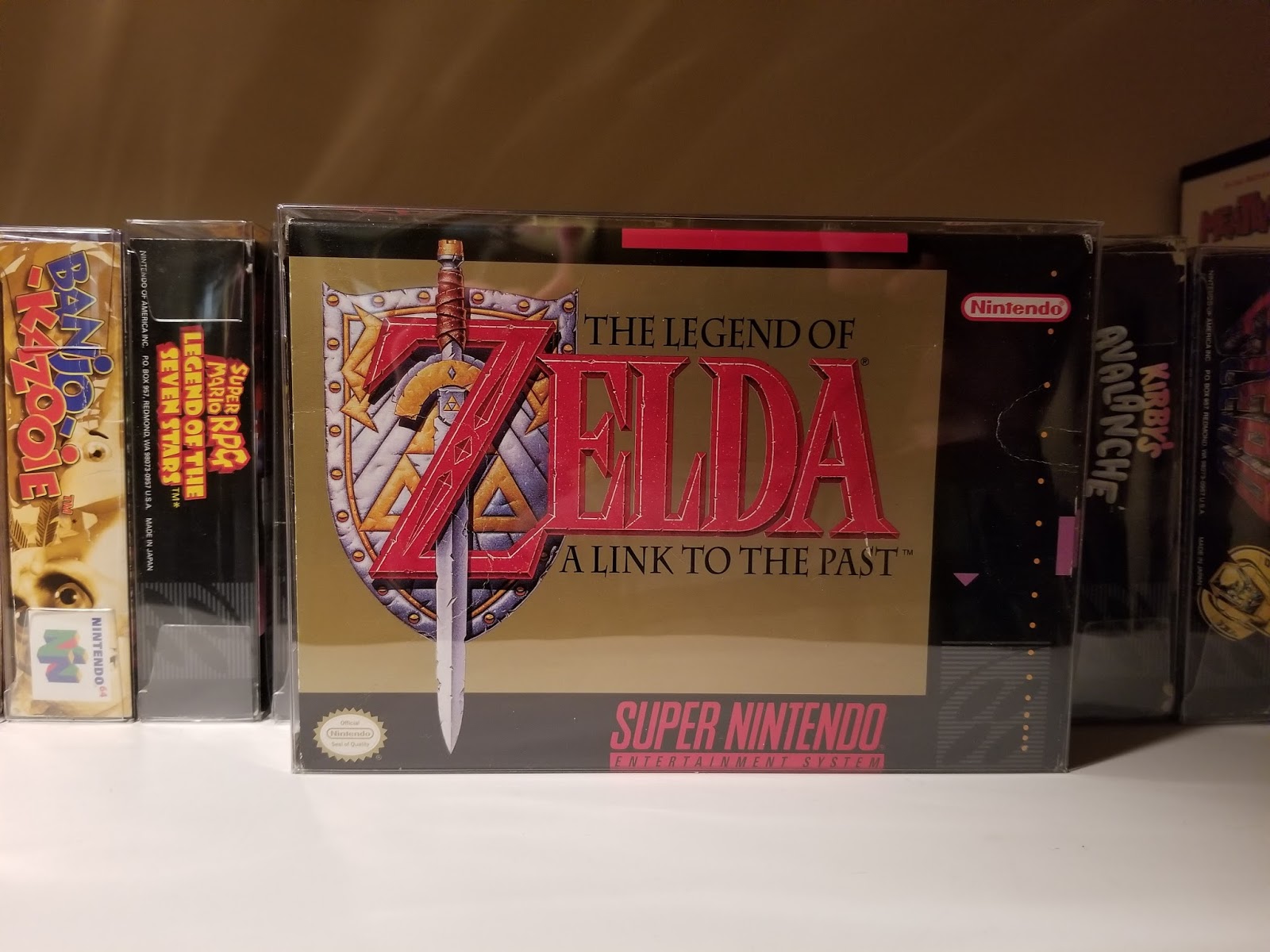
Speaking of boxes, I also picked one up for another iconic game, The Legend of Zelda: A Link to the Past. Once again, this was a game I had purchased a while ago that had just been sitting around on my shelf. Then, a few months back, I purchased a wholesale lot of manuals and boxes and such for SNES games on eBay, which came with the both the manual and the map from Link to the Past. With those two items in tow, I really wanted to get my hands on a box so I could complete the whole thing. I searched high and low for a while, sometimes finding decent ones, but never at a good enough price tag to justify purchasing it. Then, a few weeks ago I found a good one and jumped on it. Like the Super Mario Bros. box, it's got some creases here and there, but I'm happy enough with it.


Moving on to Sega Genesis, we have a game I've been meaning to pick up for a quite a while now: Ghostbusters. As you all should be aware of by now, Ghostbusters is one of my favorite things in existence (and if that statement doesn't convince you, read this review of Ghostbusters: The Video Game for Xbox 360 I did last year). I had never actually known about this game until seeing a review of it by the Angry Video Game Nerd a few years back, which is a real shame because I absolutely would have loved this game as a kid. I only had Ghostbusters II on NES, which is a fairly mediocre game but was still loved to death by me nonetheless, so I likely would've bought the Genesis one and played it nonstop, had I known of it back then. Anyway, Ghostbusters for Sega Genesis is actually on the more uncommon spectrum of Genesis games, so getting a nice complete copy is no easy task. I finally found a good one for a reasonable price recently, and now it's probably the second rarest Genesis game I own, behind Castlevania: Bloodlines.


Next up, we have MediEvil II for PS1. MediEvil was a game I played a long, long time ago on one of those random demo discs for the PS1 that you'd get from gaming magazines or video game stores. I liked it a lot, but never got around to buying the actual game until I was much older. I thought that it was possibly just nostalgia clouding my memory, but to my surprise, the game is actually really great. It sort of reminds me a little bit of Devil May Cry, before that was even a thing. I also had no idea that it had a sequel, so when I spotted it at my local retro gaming store, I had to pick it up. I haven't played it yet, but if it's anything at all like the first one, I'm sure it will make a solid addition to my PS1 library.


Next, a smattering of random games...NFL Football and Operation Wolf for the NES, and Super Punch Out!! for SNES. Very common NES games, two I'm not all that interested in, but when you can get a boxed NES game for under $8, it's pretty much always worth it. And now I can say I own an LJN game...perhaps the worst offender for bad games on the NES. As for Super Punch Out!!, I loved the original Punch Out!! on NES, so this one is a no brainer. I've never played it before but I've seen videos, and it looks just as fun as the original. I'll definitely check it out soon.


And lastly, we end on not an actual game, but an accessory. So, long before people built mods for their games in order to hack the game and do whatever they wanted with it, there was a little thing called Game Genie which seemingly allowed ultimate control over your video games. Want unlimited lives? Invulnerability? The ability to skip levels on command? Game Genie let you do it. It's interesting to think that we were actually using this thing to reprogram the game by rewriting it's coding right before our eyes. But we didn't know how the hell it worked, nor did we care- we just wanted to bend games to our will. I specifically remember using the Game Genie for Game Boy in order to hack myself a Mew in the original Pokémon. Anyway, this Game Genie for the NES is pretty beat up (as evidenced by the crack in the top covered up by an ancient blob of dried glue) and corroded-looking on the contacts, and though I haven't tested it, it likely doesn't work. However, what I find most interesting is the little code book that came with it. Back in the 80s and 90s the internet wasn't really a thing, so we had no way of looking up the codes. As such, this book was an absolute necessity in order to make the Game Genie work. I think some versions had pre-loaded codes on them, but it seems this one didn't.

Anyway, thumbing through the book is kind of interesting because it doesn't just list out the codes for a game, it actually has a little synopsis of each game and other little blurbs. I was also surprised at just how many games it has codes for: over 150, including some of the most popular titles for the NES.


It does get a little weird, however, when it starts talking about some strange and unintended effects that code alterations can have on your games. For example, look at this blurb in the Super Mario Bros. 3 section:


That's actually pretty funny, and not just because they spelled "Bowser" wrong.

Anyway, that's all for now. Thanks for reading and as always, game on.

Monday, October 30, 2017

Quick Thoughts: Crash Bandicoot: N. Sane Trilogy (PS4)


Hello dear readers and welcome back to the game room, where we always make time for obscure mammals that are primarily extant to Oceania. Today, I'll be heading downunda to discuss everyone’s' favorite Playstation Mascot, Crash Bandicoot.


Crash Bandicoot was easily one of the best games conceived for the Sony Playstation way back in 1996, and its duo of sequels for the PS1 are not too far behind it. The trilogy took 3D platforming to new heights and helped put the PS1 on the map as the premier console of the late 90s. Over twenty years later the Crash franchise has somewhat fizzled out, but it managed to make a big comeback earlier this year with the release of the PS4-exclusive N. Sane Trilogy, which combines the first three Crash games into one massive package. Having recently acquired a PS4 and being a huge fan of the original Crash games myself, this game was a must-have for me. Now that I've played through all three of the remastered games, I have a few lingering thoughts to get out.

First things first, all three of these games are just timeless. I was entertained just as much as the first time I played through any of them on the original Playstation. 

I was a bit intrigued when I heard how people were playing it and becoming unbelievably frustrated with how difficult it was. I never really thought the original games were all that hard, so I was interested to see if there really was a massive spike in difficulty. The result is...well, mixed. It's hard to explain, but I feel like it actually became easier in some aspects and more difficult than the originals in others. 

As an example of something made easier, in the original Crash, players had to break all the boxes in a level AND complete the level without dying in order to acquire gems. In the remake, this is only required of the levels with five colored gems and does not apply to the other 20 clear gem levels. However, I do feel that the controls for the original game did not translate all that well in the remake. 2 and 3 were fine, but for some reason I had a lot of difficulty on certain levels (namely, "The Road to Nowhere" and "The High Road") with the PS4 controller, which definitely did get frustrating after a while. However, this only happened on a few select levels and for the most part I did well enough with the controls.

In the way of new content, there's not a whole lot going on there. There's a few minor things- for example, you now how the option to play as Crashs' sister Coco in all three games on almost any level; however, she controls exactly the same as Crash and doesn't have any extra abilities or anything. Also, the time trials that were first introduced in Crash 3 were added to both 1 and 2, so players can now speed run any level in order to acquire relics (which don't really do anything for you besides fulfilling your sense of completionism).

The time trials work well enough for Crash 2, but in 1 I found that they are quite difficult to finish. I think it's because Crash 1 was not really built for speedrunning; its' levels were made in the early days of 3D platforming, which tasked players with progressing through levels slowly and deliberately. The levels are really hard to get through quickly AND without dying, especially the longer ones like "Native Fortress" and "Sunset Vista." Crash 2 was also a bit difficult in this regard, but a lot more forgiving and easier to cope with than Crash 1. Also, for some reason the developers added the "running" powerup to Crash 2 (which was originally granted in Crash 3 upon beating the game and allows Crash to run faster, making time trials way easier), but not to Crash 1.

 Due to the nature of early 3D platforming games, Crash 1 is not a very easy game to speed run.

The graphics and music are both updated pretty well. Even though both were (and still are!) wonderful examples of what the PS1 could do in the originals, the developers managed to keep that spirit intact for the remakes. 

In all, N. Sane Trilogy is both a nostalgic treat for fans of the originals, as well as an introduction to the franchise for a new generation of gamers. It might not necessarily justify the purchase of a PS4 on its' own, but is definitely worth the price tag if you already have one and are looking for some classic quality platforming action. Thanks for reading.

Sunday, October 1, 2017

Quick Thoughts- Devil's Crush (TurboGrafx-16)

Hello dear readers and welcome back to the game room, where I like my pinball games coated in a delicious mixture of skeletons, satantic imagery, and thrash-metal chiptunes. That sounds a bit specific, doesn't it?

Well, I am talking about a quite a specific and distinct game here, that being Devil's Crush for the NEC TurboGrafx-16.


From what I've gathered about life and the universe in my 29 years on the planet, pinball games and video games exist in two fundamentally different realms. They intersect at a number of points, but the bottom line is that pinball machines always involve some sort of physical manipulation as a measurement of skill, while video games can only simulate such manipulations at best. In current times that line is becoming a bit more blurred, what with things like VR, the Wii-motes, the Xbox Kinect, the Playstation Move and so on, which do involve some fundamentally physical movement in order to interact with a simulation. However, I'm talking about the early 90s here, where pinball and video games were just two different things, full stop. What does this have to do with Devil's Crush? Not much, I'm just kinda thinking out loud (or, in text).

But where I was going to segue there is that the two have been combined in the interesting specimen of pinball video games, which have existed as far back as the age of Atari in the 80's. That's been a concept that's always interested and perplexed me at the same time. How does one go about meshing the mechanical manipulation of a silver ball with a simulated experience? Why not just go play an actual pinball machine, if one desires an authentic experience? What's the point of getting a high score if you and your friends and siblings are the only ones who will ever see it?

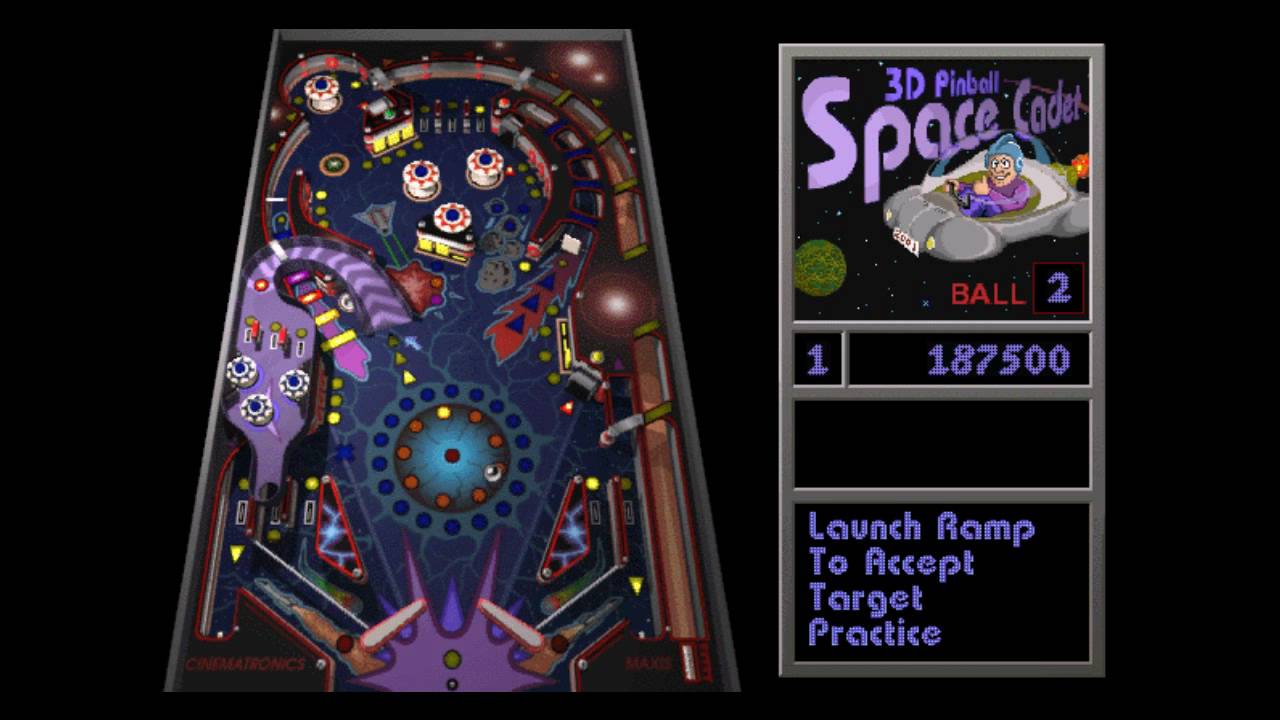
For that reason I've never really gotten into pinball-themed video games (minus that one that came with Windows XP that every millenial knows well), but I'm willing to give them a try if a good one comes along. Devil's Crush is one such good one.

I've already mentioned ad nuaseum in previous entries that the TurboGrafx-16 really fascinates me, and I've mentioned Devil's Crush's cousin Alien Crush in a previous entry as well. So when I received my tax return recently and went straight to my local retro gaming store with a bag of cash, I walked out with a boatload of TurboGrafx games I'd never played before and a newfound appreciation for some obscure and rare games.

The first on my list to try out was Devil's Crush, and I was not disappointed by it in the least. The first thing I noticed was the music. Holy crap. Ever wondered what Slayer would sound like if you fed one of their albums into an 8-bit processor? If you play Devil's Crush, you'll get an idea. It's awesome, probably the best I've come across on the TG-16 thus far.

The graphics are quite nice. The movement of the ball is quite smooth, and unlike its predecessor Alien Crush, the screen moves seamlessly between the upper and lower portions of the pinball arena instead of cutting back and forth between the two, which can be pretty jarring. The arena looks like something Danzig would come up with if he made a pinball machine- there's skulls everywhere, medieval knights, a disembodied female head which slowly transforms into a reptilian monster, and a pentgram with robed figures circling around it. In a word, it's fuckin' awesome.


There's a number of little mini-games interspersed throughout to mix things up a little bit, but they mostly just consist of launching your ball at skeletons, demons, or other monsters to rack up points. I've never actually been able to beat any of these mini-games, but they're a fun change of pace.


I think the most fun I get out of the game is just rocking out to the tunes and enjoying the graphics while trying to keep my ball in play. Which, I suppose, is the entire point of pinball, but I digress. There's not a whole lot to say about it otherwise, but it's definitely a game that will keep you entertained for quite a while and probably one of the most noteworthy titles for the TG-16 that I've encountered thus far. So if you like pinball, metal, the occult, and you've always wanted to see all of those things in pixelated video game format, Devil's Crush is for you. It's a must-have for TurboGrafx-16 fans, as far as I'm concerned. Thanks for reading.