Friday, August 18, 2017

Quick Thoughts- Halo 4 (Xbox 360)

Hello dear readers and welcome back to the game room, where we're always slightly behind the times but still ready to offer an in-depth analysis. Somewhat.

Anyway, today's behind-the-times review comes in the form of Halo 4, which I decided to pick back up recently because I wanted to shoot aliens and I can't afford an Xbox One, and also because I realized I never completed the game on Legendary mode, the hardest difficulty level. Released in 2012, Halo 4 was, from what I understand, lampooned by fans because it strayed too far into the "Call Of Duty" realm that has nearly consumed all modern first person shooters. I agree with that to an extent, but I don't think it necessarily "killed the series," as some have claimed.


Picking up three years after the events of Halo 3, the Master Chief and his A.I. companion Cortana have been drifting aimlessly in space when they are suddenly attacked and boarded by a Covenant armada. This, within the first 2 or 3 minutes of the entire game, is kind of where they lost me.

See, by the end of the events of Halo 3, the humans had reached a resolution with the Covenant, finally ending the long standing conflict between the two. However, three years after Halo 3 came out, a prequel to the original Halo was released called Halo: Reach. I have never actually played this game, but from what I understand, it takes place shortly before the events of the first game, where the humans are at the apex of their war with the Covenant. Naturally this game would have to portray the Covenant as enemies again, and they did so by totally redesigning all of the Covenant aliens and making them even more intimidating and fierce looking than they were in the original games.

That's all fine and good, but what does this have to do with Halo 4? Well, Halo 4 portrays the Covenant exactly the same way that Reach does. But wait, aren't we friends with the Covenant now? The game explains this away in that Chief and Cortana just run into a "rouge fleet." Oh come on. That's the best you can do? You couldn't just think of another explanation as to why the two factions would be at war again? It all just seemed like a really lame excuse to keep the style of Reach intact while continuing the main story. 

The Covenant was made menacing again thanks to the powers of exposition.

Anyway, that minor detail aside, Chief and Cortana have some other problems as well: Cortana is is beginning to experience "rampancy," which basically means she's falling apart. Thinly vieled metaphors for neurodegenerative disease aside, the other problem they must deal with is the Prometheans, the new threat that has joined forces with the Covenant. Who are the Prometheans? Uh...something something something Forerunners. You know, the beings that built all of the Halo installations. Sorry, I pretty much skipped all the cutscenes this time around due to lack of interest.

The Prometheans are being controlled by the Didact, the big bad of this game who was imprisoned in a floating ball for some reason...and now...uh..he wants to destroy the universe...or something...

Sorry, I'm just gonna stop trying to explain the story and discuss the gameplay.

Halo 4 throws a lot of new things at you in the realm of controls. There's now running, special item usage (i.e. jetpacks, shields, hologram-decoys, etc.) and a lot of new weapon mechanics. Actually, potentially none of these things are "new" because they may have already been implemented in Halo: Reach, but they were new to me, so that's what I'm going with here.

Again, I can see what they were complaining about here in making it more like a Call Of Duty game, but it still does feel like Halo to an extent. You've got all the classic enemies from the Covenant dropping by to throw a plasma grenade at your face, plus the new Prometheans, as I mentioned before. The Prometheans are all kinds of annoying. You thought the Elites were tough to kill? It seems like the developers intentionally made the Prometheans obnoxious just to give you that much more of a headache while you're trekking through a level on legendary mode.

They come in a few different flavors: there's these little dog-like things called Crawlers which will come running in and surround you in a circle. They aren't too dangerous on their own, but a group of them can easily overwhelm you and since they'll be running around at high speed, it can be a pretty frustrating affair to take them all out. Then there's the big guys, the so-called Promethean Knights, who I think look a lot like the aliens from the movie Independence Day. These guys will do everything in the book to annoy you. They can teleport away when being fired at, they'll use heavier weapons on you (some of which can instantly kill you), they'll run and hide when their shields are down and when you chase after them to finish them off, you'll likely be attacked by a group of Crawlers which will buy the Knights enough time to escape.

 It's all I thought about when I saw them.

But by far the most obnoxious enemies are the Watchers, which are these little drone things that buzz around in the air above the Knights and Crawlers. These things were specifically made just to piss you off. They don't really attack you directly, but they'll provide shields for other enemies, they'll catch grenades that you throw and hurl them back at you, and they'll even resurrect Knights which you've just killed if you aren't paying attention. And worst of all, these little pricks will quickly fly away the second you attack them. It doesn't take that many shots to take them out, but if you focus on one and start to shoot it, it will swiftly buzz away and you'll need to chase it down, leaving you open to attack from other enemies. This got me killed more times than I want to admit to and made me hate these things so much I'd be screaming at my TV just trying to destroy all of them.

However, like everything else in Halo, you can certainly make it through with a little perseverance. There's a boatload of hidden easter eggs to find and achievements to unlock if you wish to squeeze every drop of content out of the game, but I honestly couldn't really be bothered anymore- I just wanted to beat it on Legendary and call it a day.

And so I did, first playing through on Heroic mode before switching over to Legendary for one more go-through. There are certainly a few high points of the game. Among my favorites was getting the opportunity to actually pilot a Pelican, which are the classic drop ships that you had previously only hitched a ride on in previous games. Getting to fly it around and fire crazy powerful weapons at enemy ships was a ton of fun, even though you only get to do it for a fairly miniscule portion of the game. My other favorite moment was the chapter "Reclaimer" in which you rode around on the massive "Mammoth" which looks a lot like the Sand-Crawlers from Star Wars and provides you with a slew of heavy weaponry and vehicles to battle the Covenant. You also get this little gizmo called the "Target Designator" which allows you to lock onto certain targets and then annihilate them with a massive laser from space. Pretty awesome.

Ever wanted to fire a giant laser from the sky? This was your chance. No, I have no idea what you mean by "Gears of War did it first."

But by the end, I didn't quite feel the same sense of achievement upon beating the game on Legendary as I did with the previous entries in the series. I don't know, maybe I've just gotten more cynical as time has gone on (the original came out nearly SIXTEEN YEARS AGO after all), but it just kind of felt like "eh, whatever" compared to the epic finales of prior games. Oh well.

In all, it does feel somewhat different from the previous Halo games I've played. I suppose that's largely due to the departure of Bungie studies, which had developed all of the prior games in the primary series, but I can't tell you for sure. It just has a much different feel to it. Does that make it bad? Not really. Forgettable maybe, but certainly not bad. At the very least, worth a playthrough if you were a fan of the originals. And this isn't even getting into the multiplayer portion of the game, which I didn't play nearly as much as I did with Halo 2 and 3 but still provided quite a bit of fun.

To sum it up, no, Halo 4 is not as good as its predecessors. But did it kill the entire series? I wouldn't say so, because if I had enough time and effort and energy, I still would've purchased an Xbox One and Halo 5. And maybe I will anyway someday, long after both of them have faded from the public spotlight (I kind of feel like they already are). But until then, I'll just have to stick to killing grunts the old fashioned way on the old fashioned consoles. Thanks for reading.

Saturday, June 24, 2017

The Importance of the Sonic The Hedgehog Comics


Hello dear readers and welcome back to the game room. I’ve once again been thrust into the mystical land of studying, so I haven’t had a whole lot of time for video games lately, let alone writing about them. However, I recently heard some news that sparked a long-dormant interest of mine that I’ve had since the year 1995. It isn’t really a video game itself, yet is inextricably tied to video games that I loved as a kid, and it’s something I generally have a lot of thoughts about.

Even if you’re just casually into video games, I’m sure you are aware of the Sonic the Hedgehog franchise. It’s something I’ve already talked about at length on this blog, seeing as it was one of the first video games I ever played in the early 90s and one of my cherished childhood franchises, right alongside Ghostbusters and Teenage Mutant Ninja Turtles. 


The video games are only half of what made me love Sonic so much though- the other half was the comic books. As a kid, I had a monthly subscription to the Sonic the Hedgehog comic book series by Archie Comics which I was absolutely obsessed with. There was nothing in the world more exciting than seeing a new issue in my mailbox at the turn of the month. Every time I got one, I’d instantly snatch it up and run to my room to read it. The stories were like an extension of the video games; when you were done playing one of them, the comics would continue right where they left off. And in addition to being its own standalone series, it also produced tie-ins to each new Sonic game that came out- Sonic Spinball, Sonic CD, Sonic & Knuckles, Sonic Triple Trouble, Sonic 3D Blast and more all saw their own comic book adaptations.

The reason this all has been brought to my attention is because word has recently spread across the internet that after a 24-year run and nearly 300 issues of the main series, the comic is finally being cancelled. There hasn’t been any formal announcement as of yet, but it’s been placed on an indefinite “hiatus” and the general speculation is that this is the end for the blue blur in the comic book medium.

Although I haven’t actively been reading the comic for probably 16 or 17 years now, it’s still kind of sad to think about, considering that I grew up with the series by my side. The Sonic the Hedgehog franchise has basically been the butt of every joke in the video game community for a long time now, but the comics, to me, represent Sonic is his prime. Looking back on it, it just makes me realize that a majority of the affection I feel for the franchise was not so much because of the games, but rather because of the comics. Anyway, with that in mind, I thought I’d do a little reflection on my personal experience with the series.

I arrived a tad late to the party, as the very first issue I had was #24, bought for me by my mom in May of 1995. The instant I read it though, I was hooked. In the beginning, the series didn’t have much of a narrative and each of the issues were lighthearted, goofy little stories about the evil but bumbling Dr. Robotnik causing trouble and Sonic and his gang of pals squaring off against him in a variety of different scenarios. The story went that Robotnik was constantly seeking to rule the world by turning animals into robots, all while polluting the landscape and converting everything into some kind of mechanized factory. So, basically the same story as the early video games. Sonic and his friends (dubbed the “freedom fighters”) had been driven into hiding in a secret forest hideaway called “Knothole Village,” where they would meet and strategize on how to take on Robotnik next in their ongoing underground revolution against him. 

The comics introduced some new characters to compliment Sonic in his adventures. There was Princess Sally, often the brains of the operation and Sonic’s semi-love interest, Antione D’Coolette, a snooty rival-type character to Sonic who was friendly but often resented him, Boomer (later called Rotor), the technical expert who often cooked up new gadgets for the team, and lastly Bunny Rabbot, who was half robotic thanks to nearly becoming “roboticized” by Robotnik before being rescued by Sonic and the team. And of course there was also Tails, who made his first appearance in the game Sonic 2. Tails was often portrayed as a young child, looked down upon a bit by Sonic and the others. This added to his characterization, and as time goes on he begins to resent this fact, which leads to him having his own 3-issue mini-series in which he proves that he can go on his own adventures and be a hero too.

Which leads me to another point- aside from the main series, there were often  individual “specials” that were released in between issues, some of which were the aforementioned game tie-ins, while others were mini-series’ that focused on side characters like Tails, Sally, and later, Knuckles. At first, the specials were just side stories that had nothing to do with the main series. However, later down the line these specials became very closely linked to the main series. The specials had to be ordered separately, since they were not delivered in the mail with your regular yearly subscription, so getting your hands on one felt like a real treat (and mind you, this was in the pre-internet age where we had to get our parents to actually send out for things in the mail).

Anyway, as the series went on, it gradually started to get more and more serious. It developed more of a solid narrative, with a lot of backstory devoted to Sonic’s and Sally’s pasts, Robotnik’s origins, the beginning of the revolution, and more of a focus on Knuckles, who didn’t appear until issue #13 but gradually became a mainstay of the series. In fact, Knuckles became so popular that he eventually got his own spin-off series that lasted for 32 issues, as well as various specials of his own (a fact that I spoke about in my review of the game Knuckles’Chaotix a while back). Knuckles develops much more as his own character, as Sonic’s nemesis who is not quite on his side yet not quite an enemy either.

 As Knuckles became more popular, he gradually earned his own set of comics.

It all culminates into a thrilling four-part story leading up to issue #50, where Sonic is framed for Sally’s murder and Robotnik develops a massive weapon with the power to annihilate everything. Wow. That took a turn, didn’t it?

Also, I should mention that the artwork for the early era was absolutely awesome. The panels are very well drawn, representing Sonic perfectly in still image format. I also totally loved the cover art, especially for some of the specials like the Knuckles mini-series (issue #1 pictured above) and the Super Sonic vs. Hyper Knuckles special (I'll get to that in a bit).

Anyway, even though the series would continue all the way to issue #290, issue #50 was pretty much the climax for me. After that issue my interest gradually began to wane, as I was getting older at that point and my interests were shifting to less cartoony things (after all, this was roughly around the time that I first played Resident Evil, which became my next obsession). I still continued to receive it in the mail all the way up to around issue #80, but by then it had changed so much since the old days that I completely lost interest. My mom had also gotten sick of buying it for me and finally stopped renewing my subscription.

Looking back now, I still feel a great deal of affection for issues 24-50, as well as a few other early ones that I managed to get my hands on. The story arc leading up #50 was amazing, including both the main series and the various specials and mini-series’ that complimented it. Rather than talk about it on a whole, I’ll just discuss a few personal highlights that I remember best from these issues.


As I mentioned before, issue #24 holds a special place in my heart as the very first issue I ever read. The plot involves an alternate universe in which Robotnik is the good guy, pursued by an evil version of Sonic and his gang of counterparts. This gang somehow crosses over into the regular Sonics’ universe and begins framing Sonic and his friends for a number of misdeeds. Sonic catches wind of this, which sparks a battle between good and evil duplicates- a classic story.


The next issue, #25, is a tie-in to the game Sonic CD in which Robotnik develops a robotic version of Sonic called “Mecha-Sonic,” which challenges him to a race across the massive “Stardust Speedway” zone, just like in the climax of the game. Sonic also has to deal with the fact that Robotnik has kidnapped a cute little fan-girl of Sonic named Amy, which was also a part of the game.


There’s issue #33, which is one of the very last of the “sillier” issues before things got more serious later on. In this issue, Robotnik has infected all of the freedom fighters with a deadly virus, except for Sonic, who is then shrunk down to microscopic size in order to combat the virus from inside of each of his pals.


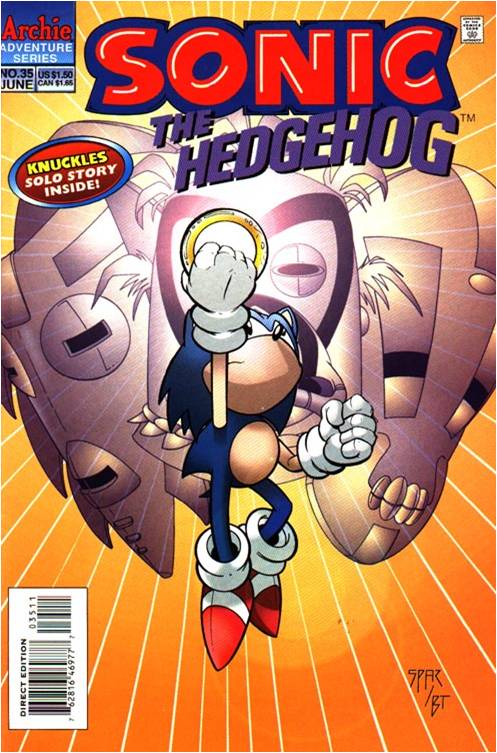
Then there’s issue #35, which is probably one of the craziest and most bizarrely creative issues of the entire series (at least out of the issues I remember, anyway). Upon collecting his billionth magic ring, Sonic is transported to a strange alternate universe, where he’s tested by the mythical “ancient walkers” who give him all kinds of mysterious and cryptic riddles. It’s so out there and weird, I remember loving it as a kid.


There’s also the “Mecha Madness” arc, which was a three-part story that included its own special. In issue #39, Sonic concocts a plan to let himself become roboticized by Robotnik, while using some kind of special microchip that would allow him to retain his own free will as a robot so he could then infilitrate Robotnik’s defenses. However, the rest of the gang denies his request by Sally’s royal decree, on the grounds that Sally herself attempted something similar in issue #29 to no avail. Sonic is pissed and leaves in a huff, only to ambushed and captured by Knack the Weasel, a character from the Game Gear game “Sonic Triple Trouble,” which had its own special as I mentioned before. 

Anyway, Knack delivers Sonic to Robotnik, who promptly turns him into a robot and sends him off to destroy Knothole village. One by one, Mechanized-Sonic kicks all of his friend’s asses, including Knuckles, who has joined in on the fight. All seems lost, which leads into the “Mecha Madness” special issue, which I remember begging my mom to order for me after issue #39 came out. In this issue, Knuckles is roboticized by Sally and the gang with the experimental microchip, which works well enough for him to fight back against Sonic in robotic form. The two kick the shit out of each other with Knuckles barely winning out. They are then transformed back to normal and everything is well and good…right? Nope. Once turned back to normal, Sonic is promptly arrested for treason, since Sally believes he defied her royal decree. Issue #40 starts with Sonic in prison, awaiting trial for a crime he didn't commit. He is eventually granted a chance to prove his innocence, and heads out to track down Knack and show that he was captured against his own will.

As I already mentioned, issue #50 ends on a thrilling note, with Sonic finally defeating Robotnik once and for all (seriously, he is actually DEAD after this and never comes back!). I thought the comic would actually end here (it was called the "Endgame" saga, after all), but it turns out that this was just the beginning; afterward Sonic finds many other foes to fight, but once again, I sort of stopped reading the comics after #50.

 Sonic actually fights Robotnik TO THE DEATH in issue #50. Think about that.

By far though, my favorite issue of the entire series was not even an issue from the main series, but a 48-page special released between issues 33 and 34 titled “Super Sonic vs. Hyper Knuckles.” In this issue, Sonic and Knuckles find a special zone where they each collect 50 rings and 7 chaos emeralds (just like in the games!) and transform into super-powered versions of themselves, then beat the total crap out of each other in an knock-down drag-out brawl. This was just amazing on so many levels. You didn’t even need to read the comics to know that the two were bitter rivals- at the climax of the video game Sonic & Knuckles, they square off with each other in a battle, only to put aside their differences when Knuckles realizes that they both have a common enemy in Dr. Robotnik. However, this moment is the only time the two ever actually fight in the games, and afterward they become friends.

In the comics, however, Sonic and Knuckles frequently clashed with each other, with neither ever admitting that the other was an ally. Actually, when Knuckles got his first mini-series set of side comics, the title described their relationship perfectly- “Sonic’s friendly nemesis.” So in “Super Sonic vs. Hyper Knuckles,” seeing the two in super-powered form pounding each other’s faces in was just incredible. I loved this issue so much that I still have my original one, which is almost completely falling apart, if not for the ancient pieces of scotch tape that are holding the spine together.

 My original copy of "Super Sonic vs. Hyper Knuckles," barely still in one piece.

Anyway, all this nostalgia filled me with a desire to read the first 50 issues again, even the ones I never had when I was kid. As such, I’ve started collecting issues, starting with the very first one. I’ve never been much of a comic book collector, and I definitely did not keep my originals in very good condition AT ALL; nearly all of them I owned have pretty much deteriorated into a pile of shredded paper. Thankfully, most issues are still readily available online for very cheap (with the comic’s imminent cancellation, this might change soon as more people like me suddenly want to relive their childhood!). It might take a while, but I think it will be worth it, as I can appreciate it on a different level as an adult.

This small stack is all I have left of my original comics that are still intact enough to 
read- the rest have been completely shredded beyond legibility. Hopefully I'll have more soon.


If you have an interest in the Sonic the Hedgehog series and you’ve never read any of them, I highly recommend checking them out. Whether you’re an old or a new Sonic fan, there’s enough there to satisfy your interests and then some.

So thanks for reading and remember, fun is infinite. Stay cool my fellow Mobians.

Sunday, May 14, 2017

Collection Additions Volume 12: NTSC-J FTW

Hello dear readers and welcome back to the game room. Well, after a long winter, here we are in late spring at last. The weather's getting nicer, the flowers are in bloom, and a deadly bio-organic weapons experiment has gone terribly wrong and spilled a horrific mutagenic toxin in a hidden laboratory underneath a crumbling mansion out in the woods. That last part is fictional of course, but in the game Resident Evil, released in 1996 for the Sony Playstation, these events did take place on May 11th, 1998.

As such, this time of year always makes me think of the Resident Evil series. If it wasn't already evident from the myriad of posts I've previously made about it, Resident Evil is one of my favorite video game franchises of all time. To talk about everything I enjoy about it at this point would be exceedingly redundant, so suffice it to say that it's one of my absolute favorites. And of course, once this time of year rolls around, I always get the itch to play it again. Itchy/Tasty, that is.

Anyway, this year I decided to try something a mite bit different. Heading over to the 'ol interwebs, I went ahead and purchased these two items:


A simple Sony Playstation 1 and a game called Biohazard. At first glance, the unassuming reader might ask, what does this have to do with Resident Evil?

Well dear reader, as it happens, Biohazard is Resident Evil, just the Japanese version of the game. When the game was brought over to the U.S., it was renamed due to a swath of trademark issues with the name Biohazard, and thus Resident Evil was born. However, that's not all that was changed. The game was also censored in a few places and rearranged a tiny bit. Being the hardcore RE fan that I am, I wanted to get a closer look at these aspects and find everything I could see that was different.

However, I first needed something to play it on. Japanese PS1 games are region-locked, meaning that they will only play on a Japanese PS1. Therefore, I went ahead and picked one up. Thankfully, only the games are an issue; U.S. controllers, cables, and memory cards will work perfectly fine (though memory cards do need to be reformatted to work, meaning all previous data on them needs to be wiped. Also, the power cable needs to have a "figure-8" ending, as opposed to the U.S. power cord that ends with one square side, which won't fit in the power slot of a Japanese console).

Aesthetically, the console is nearly identical to a U.S. region PS1. In fact, the only way you can really tell the difference is by looking at the sticker on the bottom of the console:


The NTSC-J code marks the console's region as Japanese, meaning that I had everything set to get the game going.

I decided to play through Jill's scenario, since it's the easier of the two. The very first thing I noticed was that both Jill and Chris' scenarios are actually marked easy and hard, respectively, as opposed to the U.S. version where the player is left to just play it and figure out which one is more difficult on their own. An interesting omission.

Of course, there's the infamous censored scenes in the beginning of the game. During the opening FMV cutscene, there's three moments that were censored. When Chris begins discussing the bizarre murders that have been occurring, a mutilated corpse is actually shown; in the U.S. version, it cuts to newspaper headlines describing the murders instead. Later on, when the S.T.A.R.S. team is investigating the forest, one of the members finds a severed hand and is subsequently attacked and brutally killed by dogs, which his teammates then fire at and kill. His gruesome death is shown in full detail, as well as the mutant dogs being shot at; in the U.S. version, the scene cuts away just before the severed hand is shown fully and his death is edited down to a few jump cuts of dog teeth and feral growls. Lastly, during the character introductions, Chris Redfield is shown lighting up a cigarette and taking a drag from it; this scene was censored in an odd way in the U.S. by pasting other footage of Chris over it, while the other character intros were left the same.

Another interesting tidbit, I always thought that the Japanese version was colorized, as opposed to the U.S. version which is in black and white. However, this is not the case, as both versions are in black and white. I thought this was odd because I have actually seen the full uncensored cutscene on YouTube, which is colorized. As such, I thought this was the Japanese version. As it turns out though, this intro is actually from the PC version of the game. The Japanese one is uncut but is still in black and white, which was kind of a downer, but was likely due to hardware limitations of the time.

Moving on, while playing through I noticed that the Japanese version is actually easier, oddly enough. Usually it's the other way around because us dumbass Americans can't seem to handle the difficulty, or at least that's what the corporate suits thought (see: Super Mario Bros. 2, NES). Anyway, everything is a lot easier. Enemies are weaker, auto aim is enabled, and the amount of ink ribbons found is higher, meaning game saves can be made more frequently. Also, in some areas where three enemies might attack you in the U.S. version, only two or one will be present.

There's also a few minor differences that only an eagle-eyed RE veteran would notice. For example, for each of the file texts, a picture of the file will appear behind the text, unlike the U.S. version which just shows the text on a blank screen. At least it gives me something to look at since I can't read Japanese. Also, the Plant 42 boss has some, um, interesting music to say the least. However, this music was replaced with the music of another boss in the JP version, that of the giant spider. Small details, but noticeable if you've played the game as many times as I have.

So that's Biohazard on the Japanese PS1. Was it necessary for me to buy it? Not really, since I already have the original, the Director's Cut, the Director's Cut Dual Shock Edition, and the Sega Saturn port of Resident Evil, meaning that this is literally the 5th different version of it I now possess. But it was cool to play it as it was originally intended for the folks in Japan, and it's also generally cool to me that I've played the game so many times in my life that I can beat it without even needing to read the text. I define "cool" quite differently from most people, as you can probably tell.

Anyway, I have one last thing to share as far as collection additions, and it's just as redundant as having a 5th different version of the same exact game I already own: a Game Boy Advance.


But not just any Game Boy Advance! No, this is the special "Target" edition, only sold at Target stores (obviously) with a big old corporate logo plastered right on the front of it. Whatever, I thought it was unique. And all I need is two more and then four copies of Mario Kart Super Circuit and I'll be able to get a sweet four-player Mario Kart advance race going! Or, at least I can tell people that I can if I wanted to. Thanks for reading.

Saturday, April 29, 2017

Collection Additions Volume 11: TurboGrafx Goodies And More

Hello dear readers and welcome back to the game room once more. With a bit more time and effort on my hands, I've stepped up my collecting game a bit in the last few weeks. With an eclectic pile of stuff there's a lot to discuss, so let's dive into it.


So firstly, there's the obvious TurboGrafx-16 items. Unlike many other consoles, extra TG-16 controllers in working condition are a bit hard to come by these days. You have to be fairly patient to find one for a good price, and when you do you need to jump on it. I had been on the hunt for one for quite a while now, since the TG-16 was the only console I owned with only a single controller for it. Honestly, it's hardly even worth having since most TG-16 games are only one-player, but for the relatively uncommon situations where I might have a friend over who would say "hey, let's break out some TurboGrafx games and play them together!", and then I whip out TV Sports Hockey and am like "yeah, let's do this!", now I'm covered.

But wait, there's another problem. The TurboGrafx-16 has only ONE controller port! Yeah, I did not even realize that until the second controller came in the mail. How ridiculous is that! Hell, even the Atari 2600 had a second controller port and that came out over a decade earlier.

So what is one to do in this situation? Why, spend even more money just to be able to play with a second player! And not just a second player, but up to four others with the TG-16 Turbotap. Yes, a multitap was required just to be able to play with a second player. Seems excessive, but hey, I only need three more controllers now to a get a sweet session of Battle Royale going. I did happen across one with the original box & instructions though, which is always cool to have.

Next we come to a fantastically rare TG-16 game, Bonk 3: Bonk's Big Adventure. Now the Bonk series might not be all that well known to the average gamer, but it's a really great one and fantastic addition to any library. Bonk actually spanned multiple consoles, from the NES to SNES, something I was not aware of at all until I did some digging. Anyway, Bonk's Adventure is one of the more common TG-16 games, while it's sequel, Bonk's Revenge, is on the more uncommon end but still readily available. However, Bonk 3 is very hard to find, having been released quite late in the life-cycle of the TG-16.

I spotted a Hu-card only copy on eBay for quite a bit of cash, but a decent enough price that I had my eye on it for a while. I kept a lookout for other game only copies, but the only other two listings I saw were a complete one for $800 and a sealed one for an even more ridiculous price. Finally, when no other copies came up, I decided to go for it. And I'm quite happy that I did, because Bonk 3 officially became one of the rarest games in my entire collection once I received it. I haven't played it extensively yet, but it is definitely worth showcasing in my collection given it's rarity. I'd probably rank it at #4 out of the rarest games I own, behind only complete copies of Mega Man X2 and X3, and of course my crown jewel, a complete copy of Spider-Man: Web of Fire for the 32X.

Anyway, moving on we have two Nintendo pieces: an emerald blue Gamecube controller and Snowboard Kids for the N64. The emerald blue Gamecube controller might not seem like anything fancy at first, but this color of controller was never released in the U.S.; yes, it's a Japanese exclusive color. I love the way it looks and couldn't resist grabbing one, even though I already have five other Gamecube controllers. Well, now all I need is 3 more, another Gamecube, two network adapters, and another copy of Mario Kart: Double Dash in order to have an eight-man tournament...

Uh, yeah, where was I? Oh yes, lastly we have Snowboard Kids for the N64. I admittedly knew pretty much nothing about this game, I mostly just purchased it as a special request from my girlfriend, who had it when she was a kid and had been dying to play it again. So being the chivalrous boyfriend that I am, we went straight to the local game store and snatched it up, then promptly went back to my house and played it. It's...uh...interesting to say the least...

It felt kind of like a poor man's version of Mario Kart 64, if you ask me. I tried to persuade her to try that instead, but she wasn't having any of it. Oh well, we all have that one game from our childhood that might not be very good to others, but we love it simply due to the nostalgia factor. I mean, I absolutely love Ghostbusters II for the NES, so I'm not immune either.

So that's all for this edition, thanks for reading and as always, game on.

Sunday, April 2, 2017

Collection Additions Volume 10: Tax Return Season Glory

Hello dear readers and welcome back to the game room, where video games are the only thing on my mind when I get those lovely checks in the mail from the federal government and the state of New York. I unfortunately have to make this entry another quickie since I have a lot of very important things unrelated to video games to do today (what a world we live in, right?), but I did get quite a nice haul from my latest venture, too good not to discuss. That said, let's have a look:


It may not look much, but this pile of plastic and metal cost nearly $500. Amazing, right? It was mainly due to the Turbo Grafx 16 games, which if you're unfamiliar with, are the baseball card-sized chips on the bottom (and one in a jewel case on the left). I've developed a bit of an addiction to buying TG-16 games, since they are often quite obscure and the console on a whole had a pretty small library (only 94 so-called "TurboChip" games). As with any other console, its library ranges from dime-a-dozen sports type games to very uncommon and rare games like Super Star Soldier (the one on the right). I honestly don't know what makes these games so rare, if they are just great games or had a low print run or what, since I haven't been able to really sit down and play each one of them in an extended session yet, but some of them do look quite interesting. The aforementioned Super Star Soldier, for the example, is a shoot-em-up space shooter type game, the very Japanese kind of "bullet-hell" games which launches about a thousand projectiles at you in a minute. But it looks and plays really well, and I will definitely be playing that one quite a bit when I have more time. And on first glance at the others, Devil's Crush is a pinball game very similar to Alien Crush (which I mentioned in my first "collection additions" segment that was also entirely about TG-16 games), Dragon's Curse is like a side-scroller mixed with an RPG, and Neutopia is a bit of a Legend of Zelda knockoff. Tricky Kick, I honestly have no idea. Anyway, like I said, I will have to examine all of them more closely in the future to make sure I get my money's worth.

Moving on, we have an undisputed video game classic for the Super Nintendo, one that any 90's kid will probably remember well: Teenage Mutant Ninja Turtles IV: Turtles in Time. This game was an absolute hit in the arcades and kids would be lined up around the block to take control of their favorite turtle and battle Shredder and the Foot Clan. Unlike many other arcade games though, it managed to gracefully make the jump to home consoles and retain its fantastically fun gameplay. It's a side-scrolling beat-em-up, which do tend to get monotonous after a while, but Turtles in Time still manages to keep it fun throughout and still have a lovely sheen on it over 20 years later. Just grab a second player and you have an instant afternoon's worth of fun.

Lastly, we end on two related games for the Nintendo 64: Chameleon Twist 1 and 2. These aren't rare games by any means at all, but they are definitely fun games worth owning. I distinctly remember renting the first game from Blockbuster back in the late 90s and spending a weekend trying to beat it, ultimately never being able to do so. So I have a long-standing grudge to settle there, and although I've never actually played the second one, if its anything like the first one I will be able to move right onto it after I finish the first.

So that's all for now, I apologize once again to the most likely two or three people who read this regularly that I've been slacking on entries lately, but after my big test next Saturday I'll be able to focus a lot more on gaming that I have been lately. So for now, thanks for reading and as always, game on.

Saturday, March 11, 2017

Surgical Strike for the Sega CD-32X: a mystery finally solved

Hello dear readers and welcome back to the game room, where we go looking for the truth about obscure games that nobody has cared about for over 20 years (and even back then they probably didn't care). I apologize once again for not posting anything in a while, I've been studying to take a big test soon and video games have kind of taken a back seat. However, I did just get my tax returns back recently, and as such I planned on going on a video game spending binge pretty soon, so once I come back with a massive haul, I'll do a nice big post about it. For now though, I want to revisit a certain unanswered footnote in gaming history that has bugged me for quite a long time: the mystery of Surgical Strike for the 32X.

If you read my post from a while back about completing the 32X library, you already know my feelings about this long lost game, but I'll give a quick recap if you don't feel like reading that: back in the 90s, when Sega was still desperately trying to keep their doomed add-on consoles chugging along, a number of CD games were released that utilized both the Sega CD and 32X simultaneously with the Sega Genesis to produce the "ultimate" gaming experience.

While that description is obviously questionable, what isn't questionable is that five CD-32X games were indeed released for the console, which were all just slightly upgraded versions of their original Sega CD counterparts. None of them are very interesting in their own right and they pretty much proved to be the last dying gasps of a console that had overstayed its welcome in the market. However, where our mystery begins is with an advertisement on the front of a Sega CD game called Surgical Strike, which touted a free copy of the advanced CD-32X version for gamers who sent in a mail-in coupon included with the game. Unsurprisingly, very little hype was generated for this, and the CD-32X version was never even put into production. Or...was it?

As you may know, I'm somewhat of a 32X aficionado, if you will. Yes, I know the thing is pretty much a mushroom-shaped hunk of garbage, but it just has this odd appeal to me. I can't really explain it. Anyway, that appeal is what inspired me to collect all 36 games that were ever released for it, as well as a few that weren't even released in America. However, my quest for completion has always had this one strange caveat to it: what about Surgical Strike for the CD-32X?

The reason I ask this question is because many websites, including GameFAQs and Wikipedia, list Surgical Strike as an official CD-32X release. However, it is one of four games that is listed as exclusive to other countries (the other three being Darxide and FIFA '96 in Europe and San Goku Shi IV in Japan). This piqued my interest while collecting, since I'd obviously have to obtain it in order to have the complete worldwide collection, right? However, in all my years of researching, I was never actually able to confirm that the game was ever released at all. I was able to procure copies of FIFA and San Goku Shi, and though I don't have a copy of Darxide, I have seen it floated around for sale on rare occasions. However, I have never once seen a copy of Surgical Strike for sale, and any pictures of it I have found on the internet all seem to be of the same beat up copy. This led me to believe, for a while, that the game was never actually released in Brazil and that the one copy that has cropped up in pictures from time to time was likely just a prototype or something. However, it seems I was wrong.

While surfing the random dark corners of the internet, I happened to stumble across this article from two years ago, which did a fantastic job outlining the very mystery I just described. It provided a wealth of historical background and testimonials from insiders of Sega's South America distributor Tec-Toy, who were said to have released the game in 1995. Indeed, as the article points out, the game was released in 1995 in very limited quantities. Considering the economic turmoil of Brazil in the 90s that was described by the article, it seems like a small miracle that it even managed to happen at all. That being said, it's no surprise that only 500 units were sold, according to the article. That would certainly explain why it has scarcely ever been seen or spoken of over the last 20 years.

An already obscure and quite frankly mediocre game released in minuscule quantities into South America, for a combination of three different consoles that I'm sure exceedingly few people even had in Brazil 20 years ago. It's no wonder very few copies have ever seen the light of day.

However, this does confirm a very strange and fascinating mystery that I've long kept in the back of my mind. It also leads me to believe that if one were to ever get their filthy little hands on such a rarity and add it to their library, they might have the greatest and most distinct 32X collection the world has ever seen. While I can't even imagine what the logistics involved in attempting to hunt down a copy would look like, one can always dream. And if there's multiple copies out there, who knows? It's good to always stay open minded. And you know what, a quest isn't a quest without some shining light at the end of the tunnel with mysterious and mythical properties attached to it. Thanks for reading.

Monday, January 23, 2017

Collection Additions Volume 9: Road Tripping in Search of Games

Hello dear readers and welcome back to the game room. I apologize for the lengthy absence, it seems that life has caught up with me lately and I haven't had nearly as much time and motivation to write interesting things about games as I'd like to. However, that hasn't stopped me on my quest for ultimate video game collecting glory, and recently that very quest took me beyond the suburbs of my home on Long Island and into the great blue yonder in search of games high and low.

This adventure recently took me to Asbury Park, New Jersey, which is not only home to a very cool pinball museum/arcade, but also a fantastic little video game store called Kill Screen Games. They had a huge variety of retro games, consoles and accessories, and the second you put me in an establishment like that with a handful of money, I'm undoubtedly going to walk out with a pile of games. So what did I get? Let's have a look.


So here we have Zoop! for the Sega Genesis, Street Fighter II for the Super Famicom, China Warrior for the Turbo Grafx 16, and Turok: Dinosaur Hunter for the Nintendo 64.

Let's start off with the obvious here- Street Fighter II, which I believe needs no introduction. It's one of the greatest and most memorable fighting games ever made. Everything about it is great and it still stands up as the gold standard of fighters to this day. I already own literally 5 different versions of this game, including three on the Super Nintendo and two on the Sega Genesis. Why get it for the Super Famicom? Well, there's just something about playing games from other countries that fascinates me, especially if they are already some of my favorite games ever. I like trying to spot differences between what they got and what we got here in the U.S. As for SFII, the only difference I can see is in some of the enemy names (i.e. M. Bison, Vega, and Balrog were all shuffled around) and the text is almost entirely in Japanese. Still, it's fun to see it in a bit of a different light. Also, not for nothing, but I think the Super Famicom console and cartridges just look way cooler than their American counterparts.


Moving on, we have a strange little puzzle game called Zoop! for the Sega Genesis. I admittedly had no idea what this one was about, but I have seen it many times before. For three dollars I think it was worth investigating. What I got..well...is certainly quite interesting. It's very unique, I'll give it that. It's a bit difficult to explain so if I do a poor job, just refer to this video instead. As a little triangle piece, you move around a grid shooting away corresponding-colored pieces that move in from all sides. Once you clear away a certain amount, you move on to another stage where the difficulty increases. Yeah, that was pretty bad. Sorry, just watch the video. In all, it's not bad. I definitely enjoy the jazzy soundtrack it has.


Next we have China Warrior for the Turbo Grafx 16. As I've mentioned in the past, I'm a bit of a sucker for TG-16 games; if I see a bunch of them, I'm pretty much guaranteed to walk away with at least one, especially if it actually comes with the case. China Warrior is definitely on the more common end of the spectrum as far as TG-16 games go, as I've seen it many times before. As far as it's quality as a game...well, it seems to me like it can't make up its mind about whether it wanted to be a side-scrolling beat 'em up or a straight up fighting game. What you get is some kind of weird hybrid. Also, as you can probably tell from the picture, the first thing you notice is that the characters are huge. As in, they take up half the damn screen. Well, at least its consistent?


And lastly, there's Turok: Dinosaur Hunter for the Nintendo 64. This game is freakin' awesome. It might be one of the best first person shooters on the N64, for that matter. I remember playing this game as a kid and having a blast blowing away dinosaurs and such with modern guns. It's sequels got even better, adding in multiplayer that rivaled even the likes of Goldeneye 007. But this one started it all and is still a lot of fun to this day. I remember it also had a ton of hidden bonus features like a cheat code that turned every map into a disco with flashing lights and dancing dinosaurs. Now that's trippy. Another bonus about this one is that it might be the best condition box I have for any N64 games. I'm personally not really a stickler when it comes to the condition of my games, but this one looks like it just came off the shelf of a Toys 'R Us for the first time yesterday. It's also got all those little extra pamphlets and stuff that came with all N64 games. Pretty cool.


So that's it for this week, thanks for reading. Hopefully I will have more material to write about soon, but I can't promise anything for the time being. Just keep checking back for updates and as always, game on.